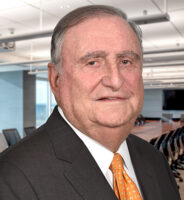
Westbury Village Trustee Peter Cavallaro strongly believes that the Lighthouse Development Group's massive redevelopment of the Nassau Coliseum site in Uniondale will burden several neighboring communities and, as a result, is advocating that tax revenue generated from the $2 billion project be dispersed among them.
Proposed by NY Islanders owner Charles Wang and partner Scott Rechler, the project, which is still pending Nassau County and Town of Hempstead approval, includes the creation of sports and entertainment facilities and residential, commercial and office components along with the renovation of the Coliseum itself on some 150-acres along Hempstead Turnpike. In all, the project could generate upwards of $40 million in annual tax revenue, which, under current state law, would benefit the state, county, town and Uniondale School District.
Cavallaro, however, believes that if neighboring communities are expected to suffer burdens in terms of quality of life, changes in suburban character, traffic congestion and flow, noise and air pollution, etc., then they, too, should reap the benefits. "No matter the actual figures, the tax windfall to the Uniondale School District will certainly be disproportionate to the impact the proposal [will] have on that district in comparison to the impacts that will be felt by numerous other municipalities, school districts and other governmental units in proximity to the site," Cavallaro reports.
He believes that a project this massive will not only affect the immediate area but also those communities north, south, east and west of the site, including East Meadow, Hempstead, Westbury, Garden City, Carle Place, Mineola, Merrick, Bellmore, Old Westbury, Levittown and others. "These communities, while receiving significant negative impacts, will not stand to share in the windfall of new tax revenues that will result from the development," Cavallaro stated, telling The Westbury Times, "This proposal is unprecedented. It is unique. We cannot treat it the same as a proposal to build a strip mall."
Cavallaro has been advocating for "taxpayer equity to all affected residents of Nassau" since the proposal first came to light in 2005 and, in June, released a seven-page report entitled "Achieving Taxpayer Equity in Connection With the Lighthouse at Long Island Project." The report includes a suggestion that Nassau and the Town of Hempstead, in reviewing the Lighthouse proposal, refer to a taxpayer equity template set by New Jersey lawmakers during the 1970s when ironing out the details for the Meadowlands Sports Complex. Currently, tax revenue from the complex is shared by many of the surrounding schools and communities, not just one district. To date, no such precedent exists in New York State.
"The Meadowlands example is now almost 40 years successful ... While that template may not fit Nassau County's needs exactly, it is a good starting place and it proves that it can be done," said Cavallaro, adding, "All it will take to achieve taxpayer equity here is a consensus that it is the right thing to do, cooperation among the interested and affected parties, coordination of the legislative process needed to implement the necessary authorizing laws."
He continued, "Hempstead Town board members, county legislators and the Uniondale School District will undoubtedly want to keep the benefits exclusively for their own constituents, but the elected officials of other surrounding and affected communities, along with our state representatives, must work together to assure that taxpayer equity is achieved. This regionally transformative project must have a regional approach and must make sense for the entire region, not just the Town of Hempstead or the Uniondale School District."
Chester McGibbon, vice president of the Westbury PTA Council, supports the village trustee's idea and believes that it requires "political will and a desire to go all the way for the constituents." He cited that, in addition to the New Jersey Meadowlands Commission's template, a similar plan was implemented during the early 1970s in the twin cities of Minneapolis-St Paul. According to McGibbon, under the Minnesota Fiscal Disparities Act, the 48 school districts and 60 other taxing authorities benefit from a tax-base sharing system.
"I'm really surprised that there is not more public debate on this aspect of the proposal ... I have made efforts to engage my counterparts in the aforementioned school districts for us to form a united front in encouraging the politicians to seriously address the issue but sadly, there has been no response so far. Hopefully, as the economic realities begin to sink in, especially with proposed cuts to state aid for education becoming a reality, people will begin to speak out and take a stand," said McGibbon.
Carle Place Civic Association President Peter McDonnell said, "I agree that this project will impact our community so any method that would share the tax revenue from this site should be pursued."
Westbury Superintendent of Schools Dr. Constance Clark-Snead added, "We certainly favor any plan that would provide funds to help ease the property tax burden on our homeowners and I would urge our elected representatives to consider legislation that would offer an equitable distribution of tax payments to surrounding communities impacted by the Lighthouse project."
It is important to stress that Cavallaro is not against the Lighthouse project but rather a proponent for a fair balance when it comes to the burdens it will have on the surrounding communities. "The purpose and intent of taxpayer equity is to make sure that such a significant project is carried out fairly to all affected areas and communities, including by sharing the burdens and the benefits that will result. Those that would be more burdened should get more of the benefit, proportionately with all other affected communities," Cavallaro said, adding, "Hopefully ... leadership will emerge from among the ranks of our elected officials to recognize the need for taxpayer equity.
"It is up to the state, county, town, village, school and other local officials in areas abutting or nearby the site in other jurisdictions, to aggressively act as advocates for their respective areas. Our state senators, assembly people and county legislators, in particular, can and should be the moving forces behind the move for taxpayer equity, Cavallaro said.