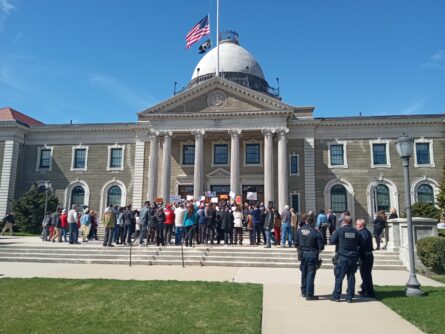
Once again the Town of North Hempstead (TNH) is embroiled in a battle over the control of its garbage. Last week, representatives of local villages and residents filled town hall for the continuation of a public hearing on the proposed revision of its flow control ordinance.
According to the Environmental Protection Agency's website, flow controls are "legal provisions that allow state and local governments to designate the places where municipal solid waste (MSW) is taken for processing, treatment or disposal." Flow controls enabled designated facilities to hold monopolies on local MSW and/or recoverable materials until 1994 when they were ruled unconstitutional by the United States Supreme Court. However, in 2007, the decision was reversed and the town is considering whether to reinstate its flow control ordinance and require all municipalities with North Hempstead dispose of their waste at the town's Port Washington-based transfer station.
"The town has researched the history of flow control, and we believe that the basis of flow control is local control at a level that allows economies of scale and greater efficiency. We believe that flow control would reduce costs and...provide environmental benefits," said Kaiman.
The supervisor added that, over the last couple of years, the town has held a series of meetings with carters, school districts and the village officials association and established a committee consisting of village representatives, including mayors, and that opinions are mixed.
Kaiman said that one of the major purposes of the new legislation is to "make sure that everybody is treated equally." He also went on to assure his constituents that the revenues received by the Solid Waste Management Authority (SWMA) funds will never be used to finance town operations. "All of our operations and agreements will be transparent and will be made public," he said.
An overwhelming majority of those who gave testimony during last week's meeting were mayors of the incorporated villages - including Westbury, Mineola and New Hyde Park - who, for the most part, are opposed to the flow control legislation currently proposed.
One of the major objections to the proposal in its current form would be its mandatory nature. "It is illegal for the town to interfere with the villages - they have no jurisdiction," said Mayor J. Leonard Samansky of the Village of Saddle Rock (Great Neck). "This proposal strikes at the heart of home rule. We don't need a 'hammer' to come to the table. Let us continue with the negotiation."
Other speakers echoed these sentiments, many labeling the proposal as a "monopoly."
"Why not form a consortium rather than just a committee?" asked Mayor Jack Martins of Mineola, who went on to propose that the revenues collected be shared with the consortium.
With the reversal of the Supreme Court decision does not come a mandate that flow control be reinstated. As a result, many local officials and leaders are looking to the town to answer the question "what's the rush?"
"There is nothing in state law that requires you to reimpose flow control as the SWMA exists in North Hempstead," said North Hempstead Republican Committee Chairman and Westbury resident Frank Moroney.
A number of mayors and village officials, including Westbury Mayor Ernest Strada (the committee chair), urged that the town give villages an opportunity to "opt out" of the arrangement. According to Kaiman, having the option to "opt out" would impose a burden on those who do participate as they would bear the entire cost of the infrastructure. "We want a plan that is equitable for everyone," he said.
Fifteen years ago this same topic surfaced and in the end, after many meetings and many legal battles, the Incorporated Villages of Westbury and New Hyde Park opted out and chose not to send their garbage to the town's transfer station in Port Washington citing the exorbitant prices for tip fees that the town charges. Currently, both Westbury and New Hyde Park have contracts with Babylon-based Omni Recycling; for 2008, Westbury is paying $79 per ton to dispose of its trash. With Westbury Village's contract with Omni slated to expire in 2009, combined with inflation and an increased need to dispose of waste, Strada and the board of trustees late last year began looking into the possibility of operating a local transfer station. Public hearings took place and residents were not sold on the proposal, which ended up being tabled when the town began discussing the possibility of returning to flow control.
"If the town were to be successful in [reinstituting flow control], we would be compelled by law to send all municipal solid waste to the town's transfer station in Port Washington," Strada stated in a previous edition of The Westbury Times. "This possibility raises many legal as well as logical [questions] and other considerations that we need to fully understand and take into consideration [before] determining the village's future plans for waste disposal."
During last week's meeting, Strada publicly stated that it "would be very easy to draft the law with an 'opt out' provision." He said, "I don't know that the villages [who utilize the town's transfer station now] would opt out; they seem to be pretty comfortable. I don't know that I would opt out. It would depend on what the situation would be."
The mayor continued, "It is not that I want to go my own way and the heck with everyone else. That's not what the Village of Westbury, or any other village, is looking for. We would like very much to control our own destiny, if we can. Currently, 28 or 29 of the villages in the town tip with you; New Hyde Park and Westbury do not. We, as a board will decide what is best for the Village of Westbury."
In addition, there is concern that those villages located at the southernmost portion of town will incur additional transportation costs to travel to Port Washington. According to attorney Lawrence Boes, who serves as special solid waste attorney for Westbury Village, the new flow control rules would force village vehicles to travel at least 16 miles in "wasted transportation and transfer station costs to a facility in Port Washington" he describes as a "Rube Goldberg apparatus."
"This was cobbled together in 1991 following the state-mandated Long Island Landfill Law, which closed the North Hempstead landfills east of West Shore Road and the abandonment of plans for a resource recovery facility within the town," Boes, whose wife Joan serves on the Westbury Village Board of Trustees, currently as deputy mayor, said. "The nature and location of this transfer station is totally unsatisfactory for a number of reasons principally because it is inefficiently located on the only site available to the town in the early '90s. It is an open-air facility located in or near wetlands at the foot of Hempstead Harbor, close to a condo development and between the Village of Flower Hill and Roslyn south of Bar Beach-North Hempstead Park."
The supervisor stated that he is looking to give the villages as much input as possible into the decision-making, but that current law precludes a village official from being a voting member of the SWMA, but added that he is looking into the possibility of changing the law. He denied that the primary purpose of the law is to bring more revenue into the town's coffers, and reiterated that the town has no intention of using the revenues for general operating expenses and that, indeed, it would be illegal to do so. "Our hope is o come up with a resolution that makes sense for every resident in our community ... We want people to pay as little as possible for the removal of the garbage," said Kaiman.
Although only one licensed carting company testified (from a special district), Anton Community Newspapers has a copy of a memorandum dated June 25, 2008 from the National Solid Waste Management Authority (NSWMA) addressed to all the elected village officials in the Town of North Hempstead expressing opposition to the plan and making essentially the same points as the village officials made during the hearing. The memo said, in part, "At risk is your ability to control both the cost and direction of your villages waste and recycling program and system."
Although a vote had been expected at last week's meeting, the board decided it will continue the hearing at its next meeting, which is scheduled for Tuesday, July 29 at 7:30 p.m. "I don't know if there will be a vote then, but we will continue to dialogue," said Kaiman. The meeting will take place at North Hempstead Town Hall, 200 Plandome Road, Manhasset.
If a new law is passed, it will take effect in April 2010. Please note: The law only relates to tipping fees and dumping, not to garbage collection; villages would still enter into individual contracts for pickup.