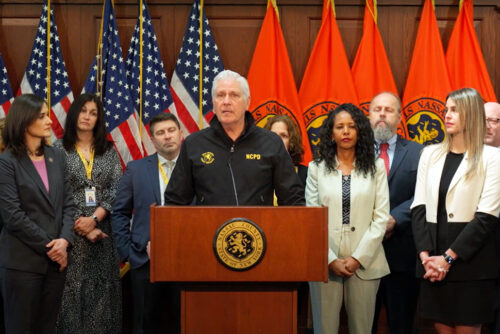
Nassau County District Attorney Kathleen Rice and Suffolk County District Attorney Thomas Spota announced last week their support for Attorney General Andrew Cuomo's new Electronic Security and Targeting of Online Predators Act (e-STOP) legislation and its protections against sexual predators online.
Introduced last week with bipartisan support in the Senate and Assembly, e-STOP is the nation's most comprehensive legislation to deal with the threat of sexual predators on the Internet. It also creates the country's first mandatory ban on sexual predators from social networking websites.
"Existing laws protecting children from sexual predators have not kept pace with rapid advances in technology. Government's primary responsibility is to protect its citizens, and e-STOP will be effective at helping prevent sexual predators from using the Internet to victimize our children," said Cuomo.
New York State Senator Dean Skelos, prime sponsor of the e-STOP legislation in the Senate and original author of New York's Megan's Law, said, "Since the enactment of Megan's Law we have worked to adapt it to changing technologies. This new legislation will help prevent dangerous sex offenders from hiding behind a veil of anonymity and preying upon our children online. Attorney General Cuomo's e-STOP legislation creates the nation's first ban on sexual predators being able to use social networking sites and offers significant new protections for children who use the Internet. I'm proud to sponsor this legislation and thank Attorney General Cuomo for his leadership in this important area."
Nassau County District Attorney Kathleen Rice said, "It is crucial that New York's laws keep up with advances in technology so children have the best protections available, and I firmly endorse this new measure to help do that. Attorney General Cuomo's e-STOP act should be enacted as soon as possible and should be adopted by Congress as a national model."
According to Suffolk County District Attorney Thomas Spota, "Providing convicted sex offenders' e-mail addresses, screen names and other Internet identifiers to social-networking and other online services makes sense, as does expanding the authority of courts and parole to restrict the Internet privileges of the worst sex offenders. The companies that operate these online communities need this information to make the monitoring of their sites far more effective than it is today."
He continued, "I appreciate Attorney General Cuomo taking the leadership in getting this legislation, which I fully endorse, approved as a new tool for local law enforcement."
Passage of e-STOP would prohibit sexual predators from accessing social networking sites and restrict their Internet usage in a variety of other
ways. It would require sex offenders to register all of their instant message screen names and any other online identifiers, and would give access to that information to companies with social networking websites. Those companies would then be able to prescreen and block access by convicted sex offenders.
The e-STOP legislation has also been endorsed by the District Attorneys Association of the State of New York.
"On behalf of the District Attorneys Association, we are thankful to Attorney General Cuomo for his initiative in protecting children from predators on the Internet," said Jim Murphy, president of the District Attorneys Association of the State of New York and the Saratoga County District Attorney. "This important legislation should be voted and signed into law immediately. We cannot let one more day go by that allows sex offenders access to children on the web. General Cuomo has taken the lead in cyber-safety. This law will allow prosecutors to convict predators for their heinous crimes against children and make all New Yorkers safer."
Sex offenders have been shown to have recidivism rates far higher than those who commit other types of crimes.
According to the state Division for Criminal Justice Services (DCJS),
there are 457 registered sex offenders in Nassau County and 825 in Suffolk County. Also according to DCJS, New York State has more than 25,000 registered sex offenders of which 9,594 are level 2 registered sex offenders (moderate risk to commit another sex crime); and 6,528 are level 3 registered sex offenders (high risk to commit another sex crime and a threat to public safety exists).
The Electronic Security and Targeting of Online Predators (e-STOP) Act:
• Requires, as a condition of probation or parole, mandatory restrictions on a sex offender's access to the Internet where the offender's victim was a minor, the Internet was used to commit the offense or the offender was designated a level 3 (highest level) offender. Such offenders would be banned from accessing social networking web sites, accessing pornographic materials, communicating with anyone for the purpose of promoting sexual relations with a minor and communicating, in most circumstances, with anyone under the age of 18;
• Requires that sex offenders register all of their Internet accounts and Internet identifiers (email addresses and designations used for chat, instant messaging, social networking or other similar Internet communication) with the State Division of Criminal Justice Services; and
• Authorizes the Division of Criminal Justice Services to release state sex offender Internet identifiers (email addresses and designations used for chat, instant messaging, social networking or other similar Internet communication) to social networking sites and certain other online services, that may be used to prescreen or remove sex offenders from using the site's services, and notify law enforcement authorities and other government officials of potential violations of law and threats to public safety.
Cuomo has led recent groundbreaking efforts to protect users of the Internet from sexual predators. Last spring, he worked with other state attorneys general and MySpace, a popular social networking site, to share with law enforcement authorities the identities of registered sex offenders who they had found and removed from the site.
In October, Cuomo and the popular online community Facebook announced a new model to enforce safeguards aimed at protecting its network members, especially children and adolescents, from sexual predators, obscene content and harassment. The agreement was reached after serious deficiencies were found in the site's safety controls and investigators posing as young teenagers were sent online sexual advances from adults within days of setting up their accounts.
Both MySpace and Facebook, with tens of millions of users each, have taken significant steps to protect their users and supported efforts to create new laws protecting all Internet users from sexual predators. Cuomo applauds their initiative in taking industry leadership roles with respect to protecting the online community. Both companies agreed the new registry information e-STOP creates would help them be better able to block sex offenders from their sites.
The attorney general has also advised parents to take preventive steps to keep their children safe and issued the following tips on how to occupy space on social networking websites safely:
• Be cautious about sharing your personal information online that can be used to locate you offline. This includes your screen name, personal photos, hobbies, social security numbers, address, phone number, bank or credit card number, and for children, the schools they attend. Remember, websites for underage users are not permitted to request personal information without a parent's permission.
• Do not share information online that you would not share offline -
There are no "takebacks." Once information is posted online, it cannot be removed. If deleted or modified, older versions continue to exist online. Share information that is appropriate for the public. Remember, colleges and potential employers may rely on a social networking website to check you out.
• Use privacy settings to restrict access. Social networking websites provide a variety of privacy settings that can restrict access to personal information. These settings block unknown individuals from breaking into your account and misusing your profile and information.
• Install safeguarding programs with monitoring or filtering capabilities. Your online service provider may offer these services. Setting up a monitoring product is like having a camera in the corner of your local bank - it can help collect evidence for law enforcement and trace a predator, if necessary.
• Watch out for unsolicited messages and emails. Do not respond to emails or download attachments you are not expecting. Some viruses can
"spoof" the name and email address of friends and fool users into an unwanted online relationship.
• Beware of inappropriate or threatening online behavior. Risky online behavior can lead to cyber crimes. It may start with an online stranger following you into chat rooms, breaking into your account, abusing your personal information, sending you sexual solicitations or signing you up for porn sites and IM. Pay attention to these predators. Websites do not have the capability to verify ages or information of their users.
• If in doubt, report it! If you believe that a predator is communicating with you or your child, you must report it. In every case where a child is molested or killed by an Internet sexual predator, law enforcement find messages sent to the predator by parents threatening to report them. Do not hesitate to report it.
In announcing his support of the bill, New York State Assemblyman Charles Lavine (13th A.D.) said, "New York is the first state in the country to craft legislation with such strong online prohibitions and mandates requiring registered sex offenders to keep law enforcement informed of their online activity. The Internet can be a wonderful tool for learning and communication, but the appropriate safeguards must be in place to keep it safe for children and others. This legislation takes an important step in shielding them from dangerous predators."