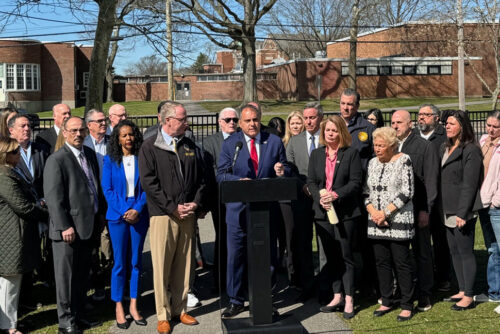
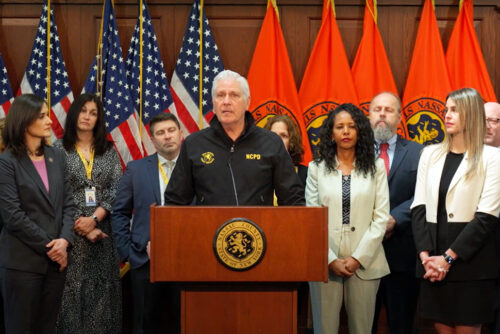
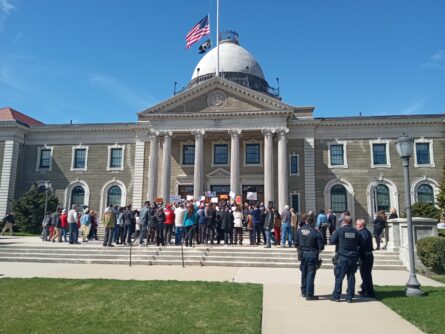
At a meeting Feb. 7, Westbury Mayor Ernest Strada announced that the village is no longer considering Omni Recycling's proposal for a transfer station on School Street. This should come as good news to the dozens of residents who, over the past six month, have voiced adamant opposition to the idea.
"... We have decided that it is not currently in the best interests of the village or our residents to continue consideration of the proposed solid waste transfer station in the village," stated the mayor. "Therefore, the village is no longer considering the transfer station proposal by Omni Recycling at this time."
Strada stressed that two developments in recent weeks have led the village's decision to table the issue. The first was Hempstead Town's January agreement with Covanta that resulted in a second 25-year solid waste disposal contract; the town's initial contract with Covanta is slated to end in August 2009 and the new one will pick up from there and run through 2034. According to Westbury officials, this contract renewal could "affect the significant questions concerning market availability and available capacity" as well as impact pricing in the solid waste disposal market.
The second contributing factor also occurred last month and has to do specifically with North Hempstead Town Supervisor Jon Kaiman's announcement of intent to reinstitute flow control on all town municipalities, including Westbury Village.
According to the Environmental Protection Agency's website, flow controls are "legal provisions that allow state and local governments to designate the places where municipal solid waste (MSW) is taken for processing, treatment or disposal." Flow controls enabled designated facilities to hold monopolies on local MSW and/or recoverable materials until 1994 when they were ruled unconstitutional by the United States Supreme Court.
"If the town were to be successful in [reinstituting flow control], we would be compelled by law to send all municipal solid waste to the town's transfer station in Port Washington. This possibility raises many legal as well as logical [questions] and other considerations that we need to fully understand and take into consideration [before] determining the village's future plans for waste disposal," said Strada.
Trustee Peter Cavallaro believes the board's decision to table the issue, at this time, is the right one. "The board, at all times throughout this process, maintained that there was no preconceived plan to build a transfer station and was merely exploring all options available to us," said Cavallaro. "The decision to cease consideration of the transfer station makes sense in light of the many potentially negative factors that came to light in our investigation, as well as the new developments that have occurred since we started looking into this, namely the Town of Hempstead's renewal with Covanta and the Town of North Hempstead's possible move back to flow control."
In light of these developments, Westbury Village officials state that they will review ways to improve their current recycling program. "The best way for us to mitigate the cost of waste disposal is to reduce our waste stream and an effective and aggressive recycling program is one of the most important ways to accomplish this reduction," stated Strada.
Cavallaro added that by stepping up the village's recycling program, Westbury would be able to reduce its overall waste stream, which would translate into "lower disposal costs for residents."
A second option the village will be considering is the implementation of a Solid Waste Cost Equity Program. "Such a program will more fairly allocate disposal costs between our residential and commercial properties and we expect that this will result in cost relief for many of our residential property owners," said Strada.
In addition to enabling the village to allocate disposal costs between residential and commercial properties in a more fair manner, Cavallaro said such a program could "lower the overall cost to residential properties by requiring the commercial properties to pay a fairer share of waste disposal costs," he said. "This is something that we have been looking at for a while now and we should look to implement it in the near future."
Currently, Westbury Village disposes of its solid waste through a contract with Babylon-based Omni Recycling. The fact that this contract is slated to expire in 2009, combined with the village's decision to table the transfer station proposal, the possible return to flow control in North Hempstead Town and Hempstead Town's renewed contract with Covanta, still leaves Westbury faced with the question of how to dispose of its garbage in the not to distant future.
Among the solutions being explored are: continuing to dispose of waste stream at third-party facilities outside of the village, under negotiated contracts, on renewal terms that are the most beneficially available at the time of renewal; exploring possible intermunicipal agreements with municipalities (including North Hempstead Town and other villages and municipalities) that currently operate their own, existing transfer stations or incineration facilities; and considering the privatization of waste collection and disposal operations by contracting with third-party operators as is currently done by many municipalities.
"We will continue to explore these and other alternatives," said Strada. "We are confident that we will be able to manage our waste disposal needs, whatever circumstances may arise in the future, in the most economically and efficient manner possible."
Information in the second paragraph of the Page 1 article "Residents to Village: Dispose of Transfer Station Proposal," which appeared in the Feb. 7, 2008 edition of The Westbury Times, was incorrect. The following is a clarification on how the village board voted in respect to the transfer station proposals:
In 2004, the village board began its formal consideration of conducting a feasibility study to consider alternatives in garbage disposal. In October of that year, a resolution to perform the study was voted on and Mayor Ernest Strada and Trustees Joan Boes, Paul Echausse and Peter Cavallaro voted in favor of the resolution; the late Trustee Charles Russell was not present. As a result of the four affirmative votes, the village moved forward with the study, which looked at using Westbury's existing Department of Public Works (DPW) yard as a transfer station. The study was to commence after an appropriate agreement to protect the Village was formed pursuant to general municipal law.
In February 2006, however, the board was asked to vote on a resolution that authorized the mayor to move forward with the feasibility study presented by Anthony Core of Omni Recycling and Cameron Engineering. This refined agreement required the mayor's signature and included an escape clause, allowing the village to terminate consideration at any time. Strada, along with trustees Boes and Cavallaro voted for the resolution while Echausse voted against it; Russell was not present.
It should be noted that in March 2005, Echausse sought election as village mayor, running against Strada and a third candidate, Joe Masiello. During his campaign, Echausse produced campaign literature opposing the building of the transfer station and did not indicate that he had voted in favor of authorizing the initial feasibility study.