Construction of the Neptune Regional Transmission System (RTS), LLC 660-megawatt, 65-mile electric underwater/underground direct-current line from New Jersey to New Cassel is virtually complete with installation of electrical and mechanical equipment at the new Duffy Avenue converter station currently being finalized. The multimillion dollar system, which will supply power to thousands of homes throughout Nassau and western Suffolk, will be up and running in time for summer.
|
|
Thyristor valves like these inside the Duffy Avenue Converter Station are used to convert Direct Current (DC) power to Alternating Current (AC).
|
According to Bert Cunningham, spokesperson for the Long Island Power Authority (LIPA), testing of the cable, which is not yet connected to the grid, began last week and the electric provider is anticipating the line to be in service by the first week of July. "Power that comes through that cable will be available to help meet summer demands," said Cunningham of the 20-year contract the power authority has with Neptune.
Chris Hocker, vice president of planning for Neptune, told this newspaper that the next step is to complete the "commissioning and testing at the converter stations" as well as to restore the landscaping and pedestrian/bike path along the Wantagh Parkway spur.
Neptune, as agreed on and included in its contractor's original scope of work, will fund the restoration of both the path and vegetation, said Hocker. "The new vegetation will be similar to what was disturbed or removed as approved by the Office of Parks and the Department of Transportation," he said, adding that the path is expected to reopen by Memorial Day, if not earlier. Completed restoration of the pedestrian/bike path, Hocker said, depends on the overall progress of the Wantagh Parkway restoration as well as weather conditions during the replanting period.
In July 2005, Neptune closed financing on the project and in early 2006, after all appropriate approvals were received from the corresponding state agencies, trenches were dug along the Wantagh Parkway to bury conduits. The cable was laid over the course of last winter and spring and construction of a converter station at 508 Duffy Avenue in New Cassel that began last summer is also complete.
While residents along the Wantagh Parkway will be unaware of and unaffected by the Neptune cable itself, many have expressed concerns regarding the tree removal and water ponding cause by the project installation.
Hempstead Town Councilman Gary Hudes, whose district includes a section of Levittown, East Meadow and Bellmore homes that abut the parkway, has, over the past year, written letters to the New York State Department of Parks and Recreation, the state's Department of Transportation, LIPA and others expressing his concern and has, he stated, received both written and verbal assurances that the damaged and destroyed trees will be replaced and the water ponding will be remedied
In a letter to LIPA, reprinted in this newspaper a few weeks back, Levittown resident Gordon Reilling expressed concern for the thousands of trees bulldozed for the Neptune project. Reilling, who has been running on the path for the past 20 years, stated that LIPA has "returned the property to a treeless open area, creating a blight from the previous existing environment ... Everywhere they have worked and removed trees, not one tree has been replaced ... this work ... with primary emphasis on the removal of these trees, has been an egregious and destructive act to the former landscape ..."
Hocker, however, assured Anton Community Newspapers that the "visual impacts of the construction work are expected to be gone by early summer." He added that "All work performed in connection with the project was done with the prior approval of appropriate agencies to make sure it will conform to proper standards of public safety and minimize long-term impacts to the environment."
The transmission line extends from Sayreville, NJ at the Raritan River and travels some 51 miles beneath the New York Harbor and the Atlantic Ocean approximately 4 feet below the seabed before making landfall some 1,000 feet off the shore of Jones Beach. It then runs under the Wantagh State Parkway some 14 miles before heading north and interconnecting with the newly constructed Duffy Avenue converter station in the form of direct current (DC) where it is converted into alternating current (AC) for distribution to Long Island customers before going through a separate transmission line back down the Wantagh Parkway to the Newbridge Road substation. The converted AC power is sent out east and west to the other major substation on LIPA's system.
Over the course of the past two years, LIPA conducted significant upgrades at its Levittown, East Garden City (Stewart Avenue) and Meville (Ruland Road) substations. Once connected to the grid, the $600 million Neptune system will, for the first time, link Long Island to the Pennsylvania, New Jersey and Maryland (PJM) system. With one megawatt enough to support 1,000 average-size homes, the Neptune system will enable LIPA the ability to provide power from New Jersey and the mid-Atlantic and southeastern states to some 660,000 homes annually.
"This is a huge project," said Cunningham. "Not only is it unique in terms of length, it is historically significant for Long Island because, for the first time, it links us to the grid to the south of us."
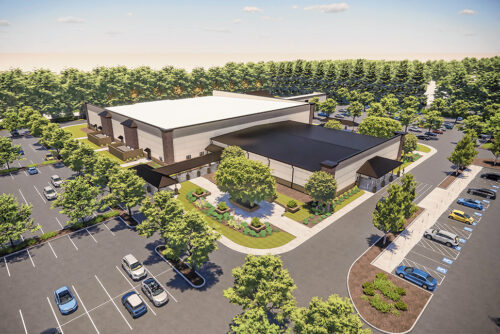
In return for being granted the go-ahead to construct the converter station on North Hempstead Town property, Neptune is expected to provide North Hempstead with funding in the amount of some $10 million to build a state-of-the-art community center in New Cassel. Neptune is also expected to pay the town $10 million over the course of 12 years, beginning in 2007, which includes additional funding for the Westbury School District over the course of Neptune's 20-year contract with LIPA.