Officials from the Town of North Hempstead recently traveled to Washington D.C. to lobby for federal support for improvement projects, including a $1.5 million proposal for economic development in New Cassel.
|
|
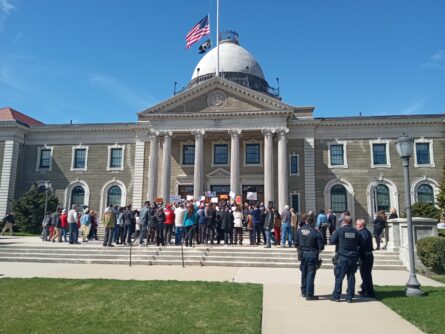
Town of North Hempstead officials recently traveled to Washington D.C. to lobby for federal support for improvement projects, including a $1.5 million proposal for economic development in New Cassel. The team of town delegates, shown here during a March 15 press conference at town hall, included (left to right) Planning Commissioner Michael Levine, Supervisor May Newburger, Councilman James O'Connor, and the town's Director of Operations Arthur Gianelli.
|
During the lobbying trip, representatives from the town met with Senators Charles Schumer and Hillary Clinton, Congress members Gary Ackerman, Peter King, Carolyn McCarthy and General Hans A. Van Winkle, director of the Civil Works Program of the U.S. Army Corps of Engineers. The team of town delegates included Supervisor May Newburger, Councilman James O'Connor, Planning Commissioner Michael Levine, and the town's Director of Operations Arthur Gianelli.
The town representatives requested support for two major improvement projects - a New Cassel revitalization initiative, and a waterways restoration initiative for Long Island Sound bays and communities. The officials provided an overview of the initiatives during a March 15 press conference at Town Hall in Manhasset.
The New Cassel revitalization initiative includes a request for $1.5 million in Housing and Urban Development (HUD) funding to implement a comprehensive community participation and vision plan in the area, as well as the acquisition of certain parcels along the Union Avenue Urban Renewal corridors for their environmental remediation and commercial redevelopment. Goals of the economic development project are: 1) The environmental remediation of contaminated properties (New Cassel includes an industrial park that encompasses 17 inactive hazardous waste sites overseen by the New York State Department of Environmental Conservation); 2) The rehabilitation of vacant, deteriorated and underutilized properties into environmentally compatible, sustainable commercial and industrial businesses; 3) Enhancement of job training efforts and the creation of jobs for New Cassel residents; and 4) Increasing the area's livability by enhancing recreational and affordable housing opportunities, public improvements and overall aesthetics of the area.
In explaining why New Cassel should be a priority for federal funding, officials described the blight which New Cassel has experienced due to years of neglect, and the real need for improvement there, according to Newburger. "We tried to point out the fact that it's been neglected for years and years," she said. She noted that New Cassel, which is a poor community in the southeastern corner of the town, is an often forgotten part of North Hempstead, which is well-known for its affluent north shore areas. Newburger added that although the town's Community Development Agency (CDA) has implemented such improvements in the area as affordable housing, New Cassel needs a comprehensive vision, with regard to community planning.
Levine noted that New Cassel has a sizeable population of 25,000 residents who need better community-based resources. "It's a sizable population that has not been reached," he said.
During the press conference, both Newburger, a Democrat from Great Neck, and O'Connor, a Republican from Westbury, indicated that the trip was a bipartisan town effort, and the supervisor commended the councilman on his valuable participation. Newburger noted that O'Connor was particularly instrumental in presenting the town's needs to Republican Congressman King. O'Connor responded, "These are great projects, easy to agree on. I much prefer to work together with the supervisor."
Funding for the waterways initiative, which is for the northern part of the town, would help the municipality continue with ecosystem initiatives that have been under way with the support of federal, regional, state and local partners. In particular, the town seeks a $1.5 million appropriation in Environmental Protection Agency Infrastructure Needs funding for stormwater management throughout the Hempstead Harbor and Manhasset Bay watersheds. The town is also requesting a federal environmental study for Hempstead Harbor and Manhasset Bay, as well as Congressional authorization and appropriations giving the Corps of Engineers study authority to address water resource issues in the harbor and bay.
Newburger commented that the trip was successful, noting that in response to the town's lobbying efforts, Congressman Ackerman, Congressman King, and Congresswoman McCarthy had signed a letter to General Van Winkle in support of the waterways initiative. This is important, as the Army Corps of Engineers needs congressional approval for its projects.
Town officials are expected to continue to lobby on behalf of the New Cassel Revitalization and Waterways initiatives, and hope that appropriations for them will be voted on in the 2001-2002 federal fiscal year.
(The following is the request for Economic Development Initiative Resources for New Cassel prepared by the Town of North Hempstead planning department for the Washington D.C. lobbying trip:)
The Town of North Hempstead ("Town"), working closely with its Community Development Agency ("CDA") and a variety of community groups, has undertaken an ambitious economic and environmental revitalization of the Hamlet of New Cassel - a United States Department of Housing and Urban Development ("HUD") - designated urban blight area with predominantly minority residents in the southeast corner of the Town. These efforts have been recognized by the United States Environmental Protection Agency, which designated the Town as a Brownfields Demonstration Pilot Community in 2000.
To further these efforts, the Town is requesting a HUD Economic Development Initiative appropriation in the amount of one million, five hundred thousand ($1,500,000) dollars. This money will be used for the development of a comprehensive community participation and vision plan in the New Cassel area, as well as acquisition of certain parcels along the Union Avenue Urban Renewal Corridor for their environmental remediation and commercial redevelopment consistent with the Urban Renewal Plan for the Union Avenue Corridor Urban Renewal Area ("Union Avenue URP").
The CDA, with extensive input from New Cassel community groups, has completed Urban Renewal Plans for the Union Avenue and Prospect Avenue corridors. These Urban Renewal Plans are general blueprints for New Cassel's redevelopment and revitalization. Their full implementation will result in:
1. The environmental remediation of contaminated properties;
2. The rehabilitation of vacant, deteriorated and underutilized properties into environmentally compatible, sustainable commercial and industrial businesses;
3. Enhancement of job training efforts and the creation of jobs for New Cassel residents; and
4. Increasing the area's livability by enhancing recreational and affordable housing opportunities, public improvements and overall aesthetics of the area.
New Cassel is a poor community, with 9 percent of its population living below poverty level. New Cassel's corridors contain a mixture of dangerous, contaminated, abandoned and underutilized commercial and industrial facilities that have used, stored, generated and released a variety of toxic chemicals and hazardous wastes into the soil and groundwater. Elevated levels of tetrachloroethylene forced the closure of one public water supply well. Seventeen sites in the NCIA are on the New York State Registry of Inactive Hazardous Waste Sites. Numerous other sites are brownfields.
Running from the west toward the northernly portion of the surrounding residences is the Union Avenue Urban Renewal Corridor. Directly north of the residential area is the Prospect Avenue Urban Renewal Corridor.
These two blighted corridors have a mixture of residential, commercial and industrial uses with a great deal of underutilized, vacant and abandoned properties. There is an inordinate amount of drug use and drug-related arrests along these corridors, as well as other arrests from violent crimes.
New Cassel's environmental conditions and criminal activity motivated leaders from New Cassel's business, community and resident organizations to develop and implement a comprehensive community revitalization strategy in addition to the two Urban Renewal Plans. As part of this strategy, two important community-based initiatives developed. In 1995, a number of concerned citizens and community activists formed the New Cassel Environmental Justice Project ("NCEJP"). The NCEJP works with the New York State Department of Environmental Conservation ("NYSDEC") to monitor environmental, commercial and industrial permitting compliance, oversee NCIA remediation efforts, and educate New Cassel residents on environmental and public health issues. In 1998, the New Cassel/Westbury Neighborhood Advisory Council ("NAC") secured New Cassel's designation as a U.S. Department of Justice ("DOJ") "Weed and Seed" community. Community activists now partner with the DOJ, Nassau County Police Department and representatives from the Town to develop programs that address or provide drug treatment, neighborhood restoration and economic development, housing and neighborhood beautification, neighborhood watch, youth activities and auxiliary police 911 coordination. Most recently, the Unified New Cassel Community Revitalization Corporation ("UNCCRC") was formed. Comprised of local clergy and community leaders, the UNCCRC mission is to facilitate community revitalization, sustainable economic development, and a shared vision in the New Cassel community.
Other community groups and corporations supporting and involved in the New Cassel revitalization efforts include the New Cassel Improvement Committee; The New Cassel Business Association; the Westbury Community Improvement Corporation; the Carman Community Association; Sustainable Long Island; the Long Island Progressive Coalition; the Institute for Sustainable Development; KeySpan Energy; and the Long Island Power Authority.
Thank you for your assistance in the Town's New Cassel revitalization efforts. Should you have any questions or comments, please contact Robert Benrubi, Town and CDA counsel, at (516) 676-1121, or Ken Brown or Matt Ward, the Town's Washington representatives, at (202) 879-4000.