Working under the terms of a contract that expired Aug. 31, and protesting a median salary that union officials say is far below the median in Nassau County, negotiation leaders were already calling conditions in the East Meadow School District "a crisis."
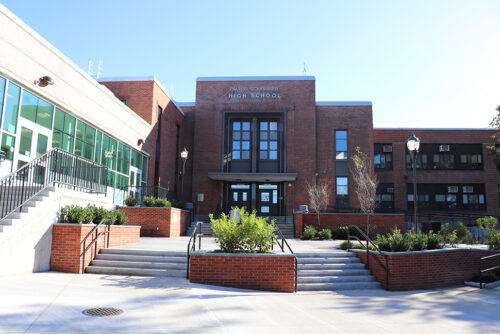
The Dec. 16 arrest of two teachers who were picketing in front of East Meadow High School added more fuel to the fire.
"I feel it is a travesty," said East Meadow Teacher Association President Roellyn Armstrong. "We are only doing what we are allowed to do within our legal rights."
Nassau police said that the teachers, Gerald Vance, 58, and Clare Chotiner, 32, were blocking one of the school's entrances as they picketed. They were handcuffed and taken to the 3rd Precinct in Williston Park, where they were charged with disorderly conduct.
Picketing two or three times a week, wearing black clothing, and participating in 'dress down' days are some of the ways teachers are protesting what they believe to be unfair working conditions in the district.
Making matters worse is a contentious relationship between the teachers and the new superintendent of schools, Dr. Robert Dillon. "He has been in office for four months, and not once has he been in this building to introduce himself to the faculty," said Dave Casamento, union building president and a high school teacher for 10 years. "At the last board meeting, each member of the union put in a vote of no confidence in the superintendent and we presented that to the board. The board has done nothing."
Dillon, who declined comment to The Westbury Times, sent a letter to East Meadow residents Dec. 3 to "clarify the positions of the school district and to promote a general understanding of the district's goals for the collective bargaining process." Casamento claims the content of the letter is deceptive. "Dr. Dillon's correspondence with the community, and even with the staff itself, has always had truths that are mixed in with half-truths," he said.
The primary dispute is over the low salary ranking of the district compared to other Nassau County districts. In his letter, Dillon cites the median wage for teachers as $61,823, with the opportunity to move on the salary schedule to $82,661. John Ambrose, a teacher at the high school for 11 years, and a representative of the union's crisis committee, claims the information is misleading.
"Yes, we have the opportunity to make $82,000 a year, but only if we have 36 years experience and a Ph.D.," Ambrose said. "If you start teaching at age 22, like I did, and wait 36 years, you'll be 58 years old before you see that kind of money. I plan on retiring at age 58, and there is really no point getting a Ph.D. to teach high school."
Currently, East Meadow's median salary ranks 46th out of the 51 districts surveyed in Nassau County, with the number one ranking being the district with the highest median salary.
In the district's defense, Dillon cited a tax rate that continues to rank East Meadow among the top 10 school districts in the county, and a benefit program that is among the best in the region. He stated, "Full time teachers in East Meadow Schools have 85 percent of the cost of health insurance for themselves and their families paid by the district. This benefit, with the district paying 85 percent, continues into retirement for life. This is unusual in Nassau County...The district permits teachers to accrue and accumulate unused sick leave and pays the employee for up to 170 days of accrued leave upon retirement."
Unfortunately, countered Casamento, many teachers won't have the opportunity to take advantage of this and other retirement benefits because, if conditions do not improve in the district, teachers will go elsewhere. "I know a lot of people that are thinking about leaving, and in most districts, that is unheard of," Casamento said. "I personally have put together my resume."
Dillon called the purported loss of East Meadow teachers to other districts a "misconception." He stated, "The fact is that the district enjoys a low turnover rate with the average East Meadow teacher having 13 years with the school district. The overwhelming majority of teachers ultimately retire from the school district."
Other outstanding issues include the 'ninth period' and graduate credits.
A number of years ago, the standard eight periods in the district's secondary schools were shortened to create a ninth period. The ninth period was to be used "to more effectively implement a student extra help program," according to Dillon. Casamento says that this extra help program is anything but effective. "They want to mandate that we sit in a room and wait for students who need extra help. Right now, almost every teacher in this building gives more extra help than required by contract. Also, there is no guarantee that your students are going to be free the same period you are sitting in that room."
The teacher contract provides that teachers taking graduate courses get salary increases for achieving certain amounts of graduate credits. The district is currently seeking a provision "...common to most school districts, which requires prior written approval by the district for all graduate courses that are to be used for salary advancement and are not part of an approved degree program from an accredited educational institution." Ambrose believes that the district will use the provision to limit teachers' ability to move up the pay scale. "I'm nervous that if they get the right to decide which classes I take, what's to stop them from arbitrarily blocking any class just to save money?"
Casamento said his name has been mentioned in negotiations as a person who is "moving up the pay scale too fast."
"They want to be able to control that," he said.
The next step in negotiations is called fact-finding. A state mandated mediator will listen to both sides and present a factual report, which is non-binding. Negotiations are currently stalled, as the Public Employee Relations Board has yet to appoint a fact-finder. In theory, the dispute could take years to resolve, as it has in districts such as Massapequa and Miller Place.
Although it is illegal to strike, and the union generally discourages such tactics, Ambrose believes that some teachers would be willing to do it. "There was a teacher strike here in 1974, and the veterans who experienced that think it worked," he said. "Personally, I have never heard voices calling for a strike as loud as I have now."