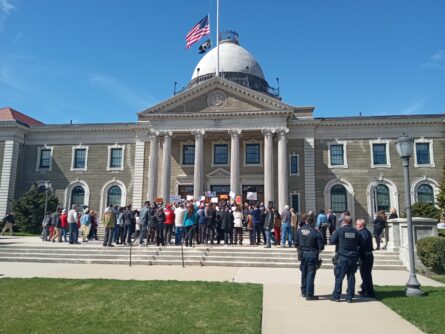
The New York State Commission on Property Tax Relief, formed by Governor Eliot Spitzer and chaired by Nassau County Executive Tom Suozzi, held a hearing in Hauppauge last Wednesday. Those who addressed the commission, which was created to seek ways to alleviate the property tax burden on state residents, expressed their feelings that property taxes, specifically how they relate to the funding of Long Island school districts, are overburdening residents of Long Island and some sort of tax relief is essential to the future of Nassau and Suffolk Counties.
|
|
Nassau County Executive Tom Suozzi (2nd left) is the chairman on a commission that seeks to get a handle on high property taxes.
|
Suozzi called property taxes an "unsustainable problem" in New York State. "This problem exists in every community. Local taxes in New York State are the highest in the nation, 79 percent above the national average," he said.
Many residents have felt the impact of the high property taxes that are used to fund school districts on Long Island and some feel Nassau and Suffolk have reached their breaking points and are urging lawmakers to make changes that will enable residents to stay in their homes and young people to afford to live on Long Island.
"There is much emotional attachment on the part of the education establishment to maintain the status quo. However, this is not a sustainable course," said one Nassau taxpayer, Anita McDougall of Oyster Bay.
Spitzer's appointed commission will explore ways to possibly put a cap on school taxes, something some feel is a good idea. Andrea Vecchio, a member of East Islip TaxPAC, said she has seen property taxes increase in her district by 47 percent in five years. She urged the commission to consider a 4 percent cap or a cap tied to the rate of inflation, whichever is lower, on school taxes. "The system is broken. The never ending quest for more money to pay higher salaries and benefits has been a corrupting influence in too many districts," she said. "Homeowner property taxes cannot keep rising without any limit. School districts cannot keep spending to levels that are forcing families off the Island and out of the state."
With salaries and benefits of school district employees making up approximately 80 percent of school district budgets, some are urging the commission to take a look at school district administrator and teacher salaries and benefits. Superintendent of schools for the Sachem Central School District, Dr. Charles Murphy, who, according to data from the State Education Department, had a salary of $205,000 in 2006-2007 testified that teachers in that school district see, on average, a 6 percent raise each year.
With salaries and benefits rising at a rate greater that some salaries in the private sector, some may wonder if Long Island will be a sustainable place to live.
Harvey Levinson, chairman of Nassau County Board of Assessors, points out that an average home in Farmingdale with a home value of $400,000 paid $5,088 in school taxes for 2007-2008 while one in Levittown with a home value of $424,000 paid $6,392 and one in Westbury with a home value of $530,000 paid $7,092.
"The assessed value of a home is not an indicator of a family's ability to pay school taxes. We have to explore alternatives to providing school district funding to help families on Long Island who find themselves house rich and income poor and struggle to pay their property taxes," said Levinson.
The county assessor is proposing to eliminate the residential portion of the school property tax and replace it with an income tax to be paid by owners of one, two and three-family homes, condominiums and co-ops as well as renters. Under Levinson's proposal, all commercial and utility properties including apartment buildings with four or more units and non-residents would continue to pay property taxes.
There are other proposals to stop the tide of escalating school spending. New York State Senator Dean Skelos had mentioned a plan in which newly hired teachers would immediately become state employees with the State of New York assuming contractual obligations.
This plan also is favored by economist Marty Cantor of Dowling College, who suggested having the state negotiate union contracts for four to six regions in the state. Cantor believes taking labor negotiations out of the hands of school boards would make school budgets easier for school boards to manage.
E.J. McMahon, senior fellow for tax and budgetary studies at Manhattan Institute, advocated a cap similar to one used in Massachusetts, which caps the tax levy at 2.5 percent of the market value and growth in the tax levy at 2.5 percent from the previous year. But, said McMahon, "While a comprehensive tax cap needs to be recognized as a major step forward for taxpayers, it's only a first step."
With increases in salaries and benefits dictated by contracts between unions and school boards, a concern of a tax cap could be that school board's would be capping the amounts of the budget that go for student extra-curricular activities and equipment.
"By capping school spending with no regard to inflationary costs such healthcare, heating oil, diesel fuel and construction costs and retirement benefits, the pinch is often felt in educational programs and we would have to truncate these programs as well as extra-curricular activities, cut staff and services and perhaps review our entire special education population to see where savings could be made," said Marty Kaye, a member of the West Hempstead School Board.
School boards, when formulating a budget, must deal with increasing costs such for those items such as employee healthcare benefits, pension contributions and state and federal mandates. "If we do not control costs that are mandated upon us, it makes it extremely difficult, at budget time, to do property job," Kaye said. "Any solution to spiraling property taxes must to address some of the root causes."
Some suggest that, in order to put the brakes on escalating school taxes, lawmakers must take a look at the laws that govern collective bargaining between unions and school boards. "I think that the most important area to address in terms of school expenses is personnel expenses," said McMahon. "You basically have these individual school districts negotiating with units of a powerful statewide cartel that is focused like a laser on its own self-interests...Districts need help with that."
"The commission needs to take a close look at all the collective bargaining agreements between schools and their labor groups. Many districts have items in their contracts that are virtually impossible to negotiate out. It would make it very difficult for these districts to stay under the cap," said Dr. Murphy.
One organization, Long Islanders for Educational Reform, believes that the Triboro Amendment to the Taylor Law has to be repealed when it comes to school districts. The amendment allows a contract between a bargaining unit such as a teacher's union and a school district to remain in effect until a new contract is signed. "The intention was to reduce school strikes. But now districts are put in very challenging positions during negotiations. By doing nothing, some unions are better off just staying put," said Dr. Murphy.
"We need to be able repeal that particular portion of the Taylor Law because it will give us the ability to not pay contractual benefits in non-negotiated years of a contract. It gives the union an advantage in terms of bargaining," said Kaye.
The commission is expected to make its interim report no later than May 15 and its final report no later than Dec. 1.