By Victoria A. Caruso
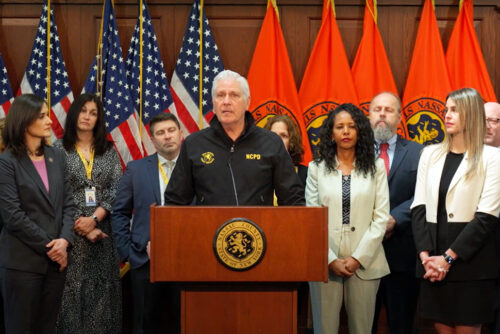
During a press conference on Oct. 4, Harvey Levinson, chairman of the Nassau County Board of Assessors, announced a proposal to eliminate the school property tax altogether and replace it with a modest income tax. In addition, the assessor would also like to see a set commercial property school tax rate created throughout the county.
"Nassau County homeowners, while benefiting from one of the most prolific real estate markets in the country, frequently find themselves having to adjust to some of the largest school property tax increases each year," said Levinson. "Even though Nassau County is one of the most desirable places in the nation to live, it has come about at a great cost to many longtime homeowners who find themselves 'house rich and cash poor.'"
The 2004-2005 school property tax bills were recently mailed out (most homeowners will have received them as of press time) and, according to Levinson, homeowners in two-thirds of all school districts will see increases from 10 to 17 percent in their school property tax obligations while one-third of homeowners will see increases between 4.88 and 10 percent.
"There are enormous differences between one school district and another," said Levinson, referring to the Jericho School District's tax rate, which will increase by 15.21 percent for the 2004-2005 school year, and the Roslyn School District's tax rate, which will only rise 4.88 percent.
Currently, the Great Neck School District has the lowest Class 1 (residential) tax rate (at $98.34 per $100 of assessed value) while districts such as Hempstead (at $264.44 per $100 of assessed value) and Levittown (at $243.84 per $100 of assessed value) have the highest in the county.
"By way of comparison, a typical home in Nassau County pays triple the amount of school property tax compared to an identical valued home in Douglaston, Queens," said Levinson. "Although property tax rates in New York City are generally stable, school property tax rates in Nassau County often increase by 8 to 12 percent each year. What is often overlooked is that even at an annual 8 percent increase, homeowners would see their school property tax obligation double by the end of a decade."
For example, the owner of a Jerusalem Avenue home in the Levittown School District, assessed at $300,000, will pay $5,841 in school taxes for the 2004-2005 school year while the owner of a $300,000 home just across the street in the Island Trees School District will pay $4,146. According to Levinson, that is a 40 percent difference for homes with identical value.
In addition, the average Carle Place homeowner pays $5,000 in school taxes while the average Westbury homeowner pays $7,600. And in Franklin Square, a home assessed at $350,000 will usually have a school tax bill of $5,500 without the STAR program while the owner of a comparable home in Hempstead will be faced with a bill for about $9,200. In the Roslyn School District, the tax bill on a $ one million home is over $16,000 while in Manhasset, a home with the same value, will be taxed at about $10,700. All calculations are based on figures before the STAR reduction.
"It is an injustice situation that cannot be eliminated as long as we have 50-plus school districts with their own rate," said Levinson. "Since what the public wants is separate school boards and separate school districts, we must find a way to reduce the unfairness between one homeowner and another. These enormous differences can no longer continue."
As a result, Levinson is proposing to eliminate, completely, the school property tax and replace it with a modest income tax that would be paid for by both owners and renters.
"Unaffordable homes, high property taxes, the lack of affordable rentals and starter housing have caused many of our children to move away from Long Island in record numbers," said the assessor. "Even if young people can somehow scrape together funds for a down payment on a home in Nassau County, many do not have the financial resources to come up with the thousands of dollars needed to fund their mortgage escrow account. By eliminating school property taxes, the sizeable deposit will no longer be necessary and the monthly mortgage tax payments will be dramatically reduced."
According to Levinson, by eliminating the school property tax, Nassau County would also be able to eliminate the STAR program. "There would be no need for STAR because there are no taxes," he said, adding that the money the government appropriates to STAR could then be added to state aid to offset districts that may need additional support as a result of collecting lower income taxes.
In addition, Levinson is also looking to establish a set commercial property school tax rate throughout the county for all school districts. Through this set rate, the assessor said tax monies collected can be redistributed to all school districts under a revenue sharing formula.
"As draconian as school property taxes are for homes, school taxes paid for by businesses are even harsher and vary significantly from school district to school district," said Levinson.
For example, a gas station valued at $500,000, based on commercial school tax rates for 2004-2005, would pay $28,790 in the East Meadow School District; $40,665 in Valley Stream District 24; and $17,350 in Garden City.
"I propose that a single commercial property school tax rate be created for all school districts and that the tax monies collected be redistributed to all school districts under a revenue sharing formula," said the assessor, who also questions the current way in which taxes from the Roosevelt Field Mall are distributed.
"Other than sheer happenstance, is there any reason that only the Uniondale and, to a small degree, Garden City, school districts share in the school taxes presently paid by Roosevelt Field? If nothing is done to address this inequity, the soaring school taxes paid by the owners of commercial properties will, in time, make it unlikely for many businesses to generate a profit and impede future economic development."
As it stands now, Levinson's ideas are being drawn up in a proposal that will be sent to Albany and reviewed by Governor George Pataki. "I am calling upon the governor to appoint a non-partisan, blue-ribbon commission to study my proposal and to report its findings within a year of its creation," said the assessor. "It is my hope that other county and local elected officials will join with me in this endeavor."
He added, "The facts are undeniable. The school property tax system is broken and must be replaced in order to promote fairness and equity for all Nassau County taxpayers based on their ability to pay."
|
Class 1
|
Class 4
|
|
Carle Place: $142.749
|
$451.220
|
|
East Meadow:
|
$186.956
|
$575.802
|
|
East Williston:
|
$163.052
|
$336.701
|
|
Elmont:
|
$180.116
|
$495.317
|
|
Farmingdale:
|
$214.388
|
$404.482
|
|
Floral Park-Bellerose
|
$145.094
|
$391.182
|
|
Franklin Square:
|
$158.557
|
$399.787
|
|
Garden City:
|
$111.510
|
$347.005
|
|
Great Neck:
|
$98.343
|
$344.563
|
|
Herricks: $148.523
|
$246.741
|
|
Hicksville:
|
$129.384
|
$329.758
|
|
Island Trees:
|
$177.790
|
$623.467
|
|
Jericho:
|
$145.971
|
$423.854
|
|
Levittown:
|
$243.084
|
$576.474
|
|
Locust Valley CSD #13: $111.654
|
$121.461
|
|
Manhasset:
|
$107.897
|
$293.373
|
|
Massapequa:
|
|
$159.599
|
$500.801
|
|
Mineola:
|
$139.669
|
$464.049
|
|
New Hyde Park-GC Park:
|
$136.344
|
$414.014
|
|
North Shore:
|
$115.46 $238.332
|
|
East Norwich-Oyster Bay:
|
$105.125
|
$216.607
|
|
Plainedge:
|
$205.899
|
$391.715
|
|
Plainedge-Old Bethpage:
|
$191.850
|
$388.229
|
|
Port Washington: $127.701
|
$398.937
|
|
Roslyn:
|
$166.929
|
$3483.365
|
|
Seaford:
|
$182.558
|
$320.545
|
|
Syosset CSD #2:
|
$175.173
|
290.637
|
|
Wantagh:
|
$183.679
|
$361.632
|
|
West Hempstead:
|
$175.568
|
$438.751
|
|
Westbury:
|
$218.830
|
$485.762
|