By Susie Trenkle
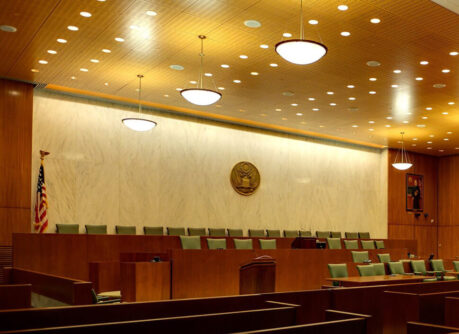
In what is considered the final legal step of the 12-year lawsuit against the Town of Hempstead claiming the at-large voting system was racially discriminatory, United States District Court Judge John Gleeson, ordered a special election to take place on November 7, 2000, to implement councilmanic districts mandated by the district court, a decision upheld by the Supreme Court last month.
The Goosby Case, as it is commonly known, was brought forth by attorney Frederick Brewington in 1988, alleging that the Town of Hempstead, which is the largest township in the nation, was in violation of the Voting Rights Act of 1965 with its at-large voting system. The case was a class action lawsuit, with the lead plaintiffs being two African Americans and two Latinos. Dorothy Goosby, who had lost an election for a town board seat prior to the lawsuit, became the most well-known of the plaintiffs. She then made history this past November when she, under the at-large voting system, became the first African American woman elected to town board and was among the first three Democrats elected to the Town of Hempstead in nearly a century.
Judge Gleeson first ruled against the town on Oct. 20, 1997, mandating that the township be divided into six ward districts, one district to be made up primarily of minorities. Each district is to have its own councilmember representing that particular area. Since Gleeson's ruling, the municipality has exhausted all appeal processes, ending on Jan. 24 when the United States Supreme Court refused to hear the town's appeal.
Following the Supreme Court's decision, the attorneys for the Town of Hempstead, despite previous arguments against going to a councilmanic system, proposed an April 11 election to implement the ward system. In a letter to Judge Gleeson, the town attorneys suggested that the current councilmembers discontinue holding office on May 1, 2000 and the new councilmembers, elected from the districts, be seated on that date. The proposal also suggested that terms of office for councilmembers seated on May 1, from wards one, three and five would run until Dec. 31, 2001, while councilmembers elected from wards two, four and six would serve until Dec. 31, 2003 to maintain the staggered terms provided for under the Hempstead Town Code. All councilmembers elected following the expiration of the initial ward system terms would serve for four years.
This proposal from the town attorneys angered the three Democrats, Goosby, Rita Kestenbaum and N. Scott Banks, who were elected to the town board in November. The Democrats said that they were not consulted about this letter to the judge and publicly voiced their opinion that the elections should be held off until the general election in November. Goosby noted that this would allow the voters time to be educated about what the councilmanic systems were and who the candidates will be. Brewington sent his own letter to the judge reflecting these ideas.
Following a meeting on Feb. 14 with all the attorneys involved in the case and commissioners of the board of elections, the judge, on Feb. 18, made his ruling for a November election.
"I have considered all of the factors brought to my attention by the parties, including the practical problems associated with having voting booths available for a special election this spring; the need to implement, and perhaps fine-tune, the new election districts established by the Oct. 20, 1997 order; the need to educate the town residents about the new system; the need for a meaningful period of time to accommodate primaries and campaigning; and the need to act with deliberate speed to remove, as the town has put it, a 'cloud [that] exists over the town government,'" said Judge Gleeson in his ruling. "I have given special consideration to the town's assertion that the town board 'has many important decisions to make' and that 'the court thought that the plaintiff[s] ought to have a representative on that board.' This is a peculiar argument for the town to make. Given its 12-year fight against a new electoral system, any concern on its part for the plight of the plaintiff class would ring somewhat hollow."
As for the court's concern, the judge went on to note that he has been told by those representing the class of people in the Town of Hempstead that will be adversely affected by continuing the system as it currently is, that the disadvantages of maintaining the system until a November election would be outweighed by the benefits of combining the special election with the general election in the fall.
The judge then concluded that, "it would be inappropriate to order the new electoral system to be implemented before this fall. While the entire eight and one-half month period between now and the general election may not be necessary in order to properly to prepare for the new town board elections, it seems to me both unwise and inefficient to schedule the election in late September or October."
Following the judge's ruling, Hempstead Town Supervisor Richard Guardino released a statement announcing that although the town administration had hoped for prompt elections, they would comply with the court's directive. "The time for crossing swords in connection with this case is over." The supervisor continued, "My promise today is to do everything within my power to maintain the town's strength as our form of government is converted from an at-large system to one in which councilmembers are selected from wards."
Now both the Republican and Democratic parties have more time to select which candidates they will run in the council elections in November. Prior to the judge's decision both parties had begun looking at the viable candidates from each district. Democratic Party Leader Thomas DiNapoli has stated that the party will be running the three incumbents but have not made any decisions as far as the other three wards are concerned. "People have been talking, in varying degrees depending on the district and the area, about running, but I don't suspect the time frame will be any different than we'll have for other candidates so the formal designations probably won't be until May," said DiNapoli.
Anthony Santino, executive assistant to Republican Party Chairman Joseph Mondello, noted that the party would have been ready with six candidates for an April election and added, "We're already well on our way to picking our candidates. We've been looking at résumés and interviewing people and doing some polls to make sure we get the very best people in each seat so we're well on our way to having candidates ... within the next couple of weeks it'll be pretty clear as to who the candidates are going to be."
Although the Republican Party had been in full support of an April election, Santino said of the judge's decision for a November election, "We're looking forward to it and we're excited about it." Santino, who himself is currently seated on the Town of Hempstead Board, said that the town is looking forward to highlighting the positive record in the Town of Hempstead. He added that the $50 million budget surplus and the fact that the town has the best bond rating of any town or county on Long Island shows that, "In the Town of Hempstead, the Republicans run local government the way Republicans are supposed to- lean, tight-fisted, very conservative, very careful with people's tax dollars." He went on to say that Chairman Mondello and the Republican Party were "thrilled" with the judge's decision and that the party is anxious to bring the record of fiscal success in the Town of Hempstead before the voters.
"I think what it means for the people of Hempstead is that more people can be involved in the process of selecting the new town board because you're going to have a much higher voter turnout, especially in a presidential year, in November, than you would have in April so I think that is good and I think generally Democrats do well when more people are participating in the process," said DiNapoli of the judge's ruling. "I think it's a great victory for Dot Goosby and for Fred Brewington and for the plaintiffs and I think ultimately it will be seen as a great victory for the people and the neighborhoods in the Town of Hempstead that will now be more fully represented in town government."
Supervisor Guardino has pledged to do everything that he could to assure that town government, "remains strong and on the right track during these changing times in Hempstead."