By Victoria A. Caruso
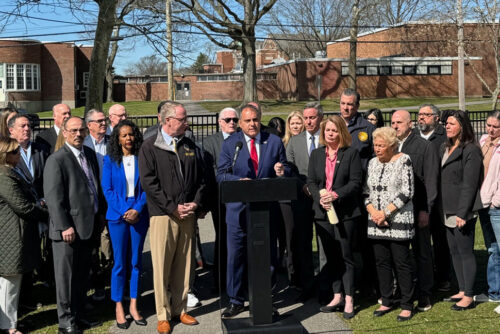
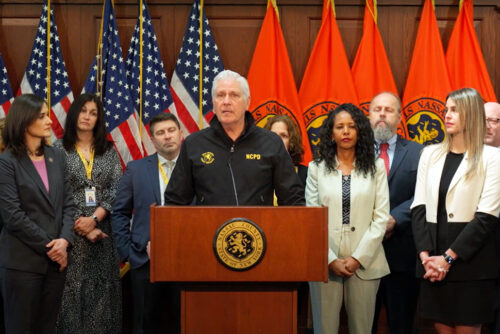
Harvey Levinson, chairman of the Nassau County Board of Assessors, held a press conference last Wednesday to announce that five additional properties will be reassessed as well as to present his newest proposals in his ongoing effort to combat Nassau County's illegal housing issue. Levinson's initiatives are the result of weeks of intense investigation into the increasing numbers of illegal boarding and rooming houses operating out of single-family homes within the county.
The five additional properties, three in Long Beach and two in the Westbury/New Cassel area, will be reassessed in November and transferred from Class One property (residential) to Class Four property (commercial) for taxation purposes. The assessor's announcement comes just one month after the reclassification of four dwellings he said were found to be illegal. They included multi-family dwellings at 2389 Post Street in East Meadow, 335 Princeton Street in Westbury, 16 Doris Avenue in Franklin Square and 54 Roquette Avenue in Elmont.
Levinson plans on reclassifying the properties in November. However, the change in taxes will not be immediate as the property owners have a right to appeal. Even if the property owners elect not to appeal or are unsuccessful, there will be a delay to get those taxes. The owners can then file a complaint with the assessment review commission. Grounds for an appeal could be that the assessment is not correct or that the illegal conditions that caused the reassessment no longer exist.
The creation of illegal, multiple dwellings, said the assessor, has in a sense, contributed to Nassau County's black market housing issue. "The lifeblood of this black market is rents," he said. "I am not targeting the grandmother who is renting a small room; I am targeting absentee landlords and others who have turned their homes into a cash cow of income. The reason people are doing this is pure greed."
At the press conference, Levinson presented the media with four initiatives he hopes will be put forth to combat illegal housing throughout the county. Levinson's proposals include changing the sworn affidavits landlords must sign when taking a tenant to court for either eviction or back rent purposes; preventing landlords from collecting back rent from tenants unless they produce proof the residence is a rental property; asking the New York State Department of State to discipline real estate brokers who advertise illegal apartments; and the chance of either losing their fire insurance or paying extremely high rates.
According to Levinson, the procedures utilized in the landlord/tenant section of Nassau County District Court may unintentionally facilitate the proliferation of unlawful apartments throughout the county. Currently, when a landlord files a petition in court to obtain an order to collect back rent and/or evict a tenant, the petition itself does not require the landlord to attest to whether or not the apartment he or she is renting conforms to local building codes and zoning laws.
"They are coming before the court with what appears to be 'clean hands,' but their hands are not clean," said Levinson. "They are not required by the court to reveal that they are renting illegal apartments. They are running an illegal business."
Levinson stated that if the court required sworn proof of the apartment's legal status, landlords would be forced to either admit to the apartment's legal status or face the possibility of being charged with perjury for filing a false document. He believes that the fear of criminal prosecution would not only reduce the number of actions brought to court, but also deter many landlords from engaging in the renting of illegal apartments.
The assessor is optimistic that most landlords will consider illegal rentals a risky business for two reasons: they will be taxed as commercial property and they will not be able to collect back rent. "Who is going to take on this challenge of running illegal housing if they are going to be paying more commercial taxes and additionally, not have the courts cooperation to collect rents?"
Since he does not have any authority to change the form, Levinson said he is hopeful that "one of our local legislators will read this and say 'Levinson's not crazy, let's just change the form.'"
In addition, Levinson stated that judges should be required to notify local towns and villages when an illegal property comes before the court. "In many cases, the judge finds out by accident that the apartment is illegal [because] the tenant raises the issue. Some judges will nevertheless order back rent, but that illegal rental should be referred to the town attorney for immediate, forthwith prosecution as a violation of the building code," said Levinson. "I am calling upon the district court judges to, when they hear evidence of illegality, to not just turn to the next case. There should be a transcript made of the proceedings and forwarded forthwith to the town attorney to prosecute the person for violation of the building code."
He added that in the Town of Hempstead, violation of building codes is a misdemeanor carrying up to a six-month jail sentence.
"As most residents know, the growing industry of illegal housing is the number one issue in the county," said Levinson. "It is not limited to low income areas; it is throughout the entire county. In the past, both the courts and the towns have looked at it on an individual basis and it's not; it's a global issue. It is an entirely unregulated industry that has been ineffectively enforced by government." He added, "I am not blaming the towns because this is an overwhelming problem, but unfortunately, the genie is out of the bottle and it's very difficult to get it back since there are so many illegal properties in Nassau County."
Currently, only the Town of North Hempstead has enacted laws aimed at preventing landlords from being able to pursue rent disputes arising from illegal apartments in court unless a "Rental Occupancy Permit" is produced. "[This law] only applies to property in North Hempstead and most of the illegal rentals in Nassau County are not in North Hempstead," Levinson said. "North Hempstead has a serious problem in the Westbury/New Cassel area, but other than that, North Hempstead is mostly incorporated villages and luxury homes with very few of these illegal rentals."
As a result, Levinson is calling upon the Towns of Hempstead and Oyster Bay, where he said the most serious illegal housing issues exist, to pass similar laws to prevent the ordering of back rent for illegal units. "Unfortunately, unless all local municipalities adopt, on a countywide basis, a unified version of the North Hempstead statutory initiatives, the widely divergent treatment of illegal rental agreements in landlord tenant court continue," stated Levinson. "This legislation will give the courts a clear legal basis to deny the payment of back rent based on the case submitted."
Levinson added that the Nassau County Police Department has been cooperating by giving the assessor's office a list of approximately 150 properties within the county that are either being used as rooming houses or have four or more units in them. They are present in Baldwin, Bellmore, North Bellmore, Roosevelt Uniondale, Plainview, Williston Park, Mineola, Carle Place, Island Park, Oceanside, Elmont, Valley Stream, West Hempstead, North Valley Stream, East Hills, Great Neck, Sea Cliff, Roslyn Heights, Levittown, Hicksville, Bethpage and South Farmingdale.
"The reports from the police are based on the cop on the beat knowing what's going on in the community," said the assessor.
Levinson is also looking to enforce stricter laws against real estate brokers and agents who advertise illegal rentals in the media. "In the past, no one has really looked at the brokers' side of this problem, but if you prevent or make it more difficult to market these apartments there will be fewer of them," said Levinson, adding that brokers would be less likely to take these listings if they knew there was a consequence.
"These brokers should be disciplined by the New York State Department of State," said the assessor. "They are licensed and should lose their license or be censured if they advertise illegal rentals."
Currently, it is illegal for an agent or broker to advertise illegal housing in the Town of North Hempstead. The Towns of Hempstead and Oyster Bay do not have such ordinances. Levinson is looking to the other towns, as well as the Cities of Long Beach and Glen Cove, to follow North Hempstead's lead and have similar ordinance of their own. "These agents and brokers need to know that if they are found guilty, they will not only be fined, but could have their licenses suspended or taken away."
Levinson said he notified the Chief Judges Office of Nassau County of this proposal and it will go to the New York State Office of Court Administration for consideration.
Levinson said he recently received an informal letter from an insurance company after they read in the media that some of their properties may be insured as single family homes and they are not. Landlords who do not inform their insurance carries of the properties' actual use and, in doing so, are at risk for additional costs or loss of coverage for lawsuits that might emerge as a result of accident claims, loss of property or fire.
"I am going to fully cooperate with the insurance industry as I find evidence of illegal units," said Levinson. "Once a property is confirmed to be in violation of local building and zoning codes and is reclassified accordingly, a list will be provided to the property's insurance carrier upon written request." He added that he will also work to notify fire insurance carriers.
While these initiatives will in no way solve Nassau County's illegal housing issue, Levinson believes they are steps in the right direction. "I've threatened the [owners of] illegal housing with higher taxes. I am asking the court to be tough on the landlords. I am asking the Department of State to be tough on the brokers," he said. "The only way to crack this is to see someone in handcuffs and see someone paying large fines. The brokers will get the message and the landlords will get the message."
Above all, Levinson said he aware of the extremely limited supply of apartments and the tremendously high demands for affordable housing in Nassau County. "We must encourage affordable housing and we must do it quickly," he said. "The towns have to realize that these people need a safe, clean and affordable place to live. The economy of Nassau County requires that."