By Brad Barth
Presenting the third-annual, millennium-edition Top 10 Syosset-Jericho Tribune stories of 1999, as selected by the editor. Although numbering entries from one to 10 in order of significance is usually the most fun way to make these lists, the editor understands that, depending upon where one lives, certain of these stories will ultimately seem more important than others. Therefore, they will be grouped in themes.
A small fire that started in a trash container outside of 333 North Broadway, Jericho, blossomed into a full-fledged, highly-destructive blaze in the early hours of May 19. The intense, smoky fire was the largest in decades, according to Jericho fire officials, and completely ravaged the four-story building.
A combination of unfortunate elements was responsible for the fire growing out of control. The winds whipped around the building in such a way that it fanned the flames toward the ceiling of the building's first-story parking garage. The fire spread quickly across the ceiling, which was insulated with Styrofoam, a highly-flammable material.
Although the fire originated from the north, the building's southernmost side suffered the most severe damage. The steel infrastructure on the south side of the building was dangerously compromised. The remainder of the building remained structurally sound, but incurred smoke and fire damage.
Fortunately, no one was occupying the building at the time of the fire. However, about 30 small businesses in the complex were forced to relocate. Some employees were able to retrieve their belongings after several days, but many lost everything. Among the building's tenants were law and accounting firms, a travel agency, a dentist's office and a Fox Channel 5 Long Island Bureau office.
The building's insurer predicted that it would take nine months to repair the building. In the meantime, it remains an empty, gutted-out shell.
The fire was brought under control in about three hours. Firemen attacked the blaze from outside the building only, as it was deemed too unsafe to enter the burning complex.
First Assistant Chief David Ginzburg said, "I've spoken with guys who have been here 20, 25 years, and this was the biggest by sheer size of the structure and the amount of involvement."
Money to Burn
Citing slipshod financial record keeping, dubious contracts and questionable expenditures, the New York State Comptroller's Office conducted a scathing audit of the Syosset Fire District. The infractions listed in the audit outraged, among others, Oyster Bay Cove Mayor Michael Peragine and Syosset Fire Commissioner Ronald Geraci.
At a January 11 board of fire commissioners meeting, Peragine, backed by a small but contentious group of residents, demanded that the five-member fire board admit accountability and take measures to prevent future pecuniary irresponsibility.
An irate Geraci agreed that the board needed to revise its system, but his four fellow commissioners, including chairman Henry Marzola and district secretary Peter Morley, denied any wrongdoing, calling themselves scapegoats.
The 42 problems listed in the auditor's report fell into two categories - poor internal procedures and exorbitant expenditures.
Internal procedure infractions committed over the last few years included the awarding of contracts before the board officially voted on them and failure to process claim vouchers and invoices. Chairman Marzola was also criticized for signing blank checks without knowing to whom the payment was going.
The audit cited several questionable expenditures, including $57,000 on the repair and maintenance of two racing vehicles and a $74,000 Annual Installation Dinner in 1997.
The auditor's report also questioned the salary of former fire district attorney John Lewis, who resigned three years ago.
At a subsequent meeting on January 25, Geraci placed most of the blame on Morley, who as district secretary was responsible for the district's finances.
Geraci said that Morley's secretarial job, coupled with his volunteer commissioner position, presented a conflict of interest. He demanded, as did other angry residents, that Morley give up his paying job.
After the commissioners met in a private session, Geraci retracted his request for Morley to resign at a third meeting, held February 8. Geraci, however, still insisted that the board of fire commissioners clean up its act.
Almost one year later, Geraci has reported to the Tribune that the board has not adopted most of the corrective measures that the public was demanding.
Although the fire district is supposed to comply with the comptroller's recommendations, there is very little the state can legally do to correct the problem. The State Attorney General's office does not have the resources nor evidence to investigate whether the fire board has in any way acted criminally.
This past fall, all of the commissioners except Geraci voted in favor of buying property located adjacent to the fire department's Woodbury station house on Woodbury Road. Geraci claims that the multimillion-dollar purchase was made capriciously, with no expressed purpose in mind.
Earlier this December, Syosset held its annual fire district election. Chairman Marzola ran unopposed and was reelected.
Calling the Syosset Central School District a model educational system that schools across the county should replicate, first lady Hillary Clinton visited Village Elementary School on April 20.
Village was an appropriate stop for Clinton as she toured Long Island, testing the waters for a possible New York Senatorial race. The namesake of the school fit perfectly, considering her well-publicized book about education in America, It Takes a Village.
It was Superintendent Carole Hankin, an acquaintance of Clinton, who coaxed the first lady to visit. Hankin called the first lady's visit a "lifetime experience."
Clinton was escorted into a third-grade classroom to observe a science experiment. Later, at a mass assembly held before awestruck students, parents and faculty members, the first lady reported on what she witnessed in the classroom.
"What I saw was the kind of interactive learning that works for young people today," said Clinton. "You have made sure class sizes are small enough that you can have the interaction I saw."
Addressing the country's status in education, Clinton said that more schools must follow Syosset's lead. She advocated smaller class sizes and easy access to computer technology. She also said that America's schools will require two million more teachers within the next 10 years. Finally, she said that secondary education in America is currently inferior to that of other countries and must improve.
Appreciating Syosset's gracious welcome, Clinton surprised everyone by reciprocating the invitation. She asked the third grade to visit her at the White House during its upcoming trip to Washington D.C. The very next week, the students arrived in the Capital, where they once again encountered the first lady.
Clinton is the first first lady to visit the school district since Eleanor Roosevelt did in 1958.
On September 16, the Syosset School District played host to yet another government official, U.S. Secretary of Education Richard Riley, who was presented with Syosset's Educator of the Century Award.
The Fan-dom Menace
The Syosset School District took extraordinarily stern measures last June to ensure that no paparazzi or brazen Star Wars fans crashed the high-school graduation ceremony of movie superstar Natalie Portman.
The district tried to conceal its prized student's identity from the public, but the mega-hype surrounding Star Wars, Episode I, The Phantom Menace, engendered a huge media stir. Portman's secret was discovered shortly before the movie's spring premiere, making the school the target of invasive tabloids and entertainment reporters. (The Tribune also pursued an interview, but went about it the honest way. Portman's agency was contacted in the proper manner, but our request for an interview was rebuffed twice.)
Portman played two roles in the long-anticipated Star Wars prequel, portraying the stoic, ornately decorated Queen Amidala, and the compassionate and nurturing servant Padme, who later is revealed as the true queen of Naboo. The movie played at the United Artists' uniplex theater in Syosset, where surely many of Portman's friends watched her on the big screen.
Portman had already starred in several other films, including Beautiful Girls and The Professional, but none thrust her into the national spotlight as this film did. An aggressive marketing and merchandising campaign featured her attractive and ubiquitous visage on action figures, posters and even soda cans.
Exclusive images of Portman were so highly in demand by collectors that people began selling Syosset High School 1998-99 yearbooks, with Portman's senior picture in it, over the Internet for hundreds of dollars apiece.
The entire S-J-W area, strangely enough, has become a virtual Hollywood East for young, female starlets. Jericho High School graduate Jamie-Lynn Sigler hit the big time last January when she made her acting debut in the critically-acclaimed HBO series, The Sopranos, an insightful, sometimes comical look at a dysfunctional family tied to the Mafia. Sigler plays the mob boss's daughter, Meadow Soprano. Many critics called The Sopranos the best new show of the year. Its second season will debut this month.
Also, Jericho resident Dara Paige Bloomfield played the Little Girl in Broadway's Ragtime, and Woodbury resident Lindsay Lohan, who recently starred in the Disney film, The Parent Trap, was honored by Oyster Bay Town Supervisor John Venditto.
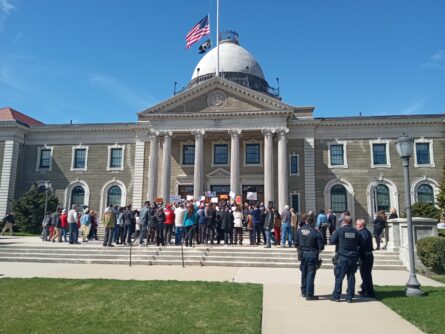
Residents were chanting this slogan in unison on November 20 as they assembled to protest the proposed construction of a million-square-foot mall on the Cerro Wire site in Syosset.
The Birchwood Civic Association organized the community rally, held along a stretch of Robbins Lane that is adjacent to the controversial property, which is owned by the Chicago-based Tribune Co.
Current BCA President David Passigli and former BCA president Todd Fabricant, who is leading the anti-mall campaign, warned those who gathered at the rally that a shopping complex of such magnitude would cause immense traffic congestion and diminish quality of life.
"The quality of life will be forever changed if this mall is built," bellowed Passigli to the crowd.
Rally-goers hoped to discourage the Oyster Bay Town Board from allowing the Taubman Co., the mall developer, to build additional roads on town-owned property. According to the BCA, if the town denies Taubman this request, parking lot ingress and egress will be unfeasible, and the mall plans will crumble; Taubman spokesperson Gary Lewi denies this assessment.
Last month, Supervisor John Venditto did ask Taubman to submit a contingency plan in the event that the town does deny the developer access to town land; however, the town has not dismissed the possibility.
In reaction to the rally, Taubman is claiming that the BCA's PR company and BCA lawyer Herb Balin are perpetuating falsehoods and turning community residents against the mall plan because they represent the Simon Property Group, which owns the Roosevelt Field Mall, a competitor.
"This is no longer a discussion over legitimate issues; this is now a fight over market share," said Lewi. However, many consider this statement highly spurious, considering that the lawyer and PR firm were hired long after the community first opposed the mall plans.
BCA officials stress that they are in favor of development on the former Superfund site, which in its current state is merely a decrepit eyesore. "We're not NIMBYs," insisted Fabricant. "We're happy to have corporate offices...hotels...housing."
The Underhill saga began in the '80s, when landowner Roger Tilles submitted an application to the Town of Oyster Bay, requesting to construct housing units on 81 acres of pristine property in Jericho. Come the dawning of a new decade, century and millennium - surprise, surprise - it remains unresolved.
However, there were several new twists and turns this year in the community's quest to preserve the property.
After Judge Melvin Barasch ruled last year that Tilles Industries must submit a new Environmental Impact Statement for its 270-unit development plan, civic groups waited to see what Tilles' next move would be. Tilles appealed the decision, but also began drawing up a new EIS to cover all his bases.
Meanwhile, Joe Lorintz, president of the Oakwood Princeton Park Civic Association, had plans of his own. Over the summer, Lorintz founded The Society to Preserve Underhill, and was named the organization's president. The newly-formed association staged an emotional rally on the bucolic property of William and Ellen Doremus, whose land is directly adjacent to the Underhill parcel.
Those attending the rally marveled at an unimpeded view of Underhill's rolling grass and picturesque ponds. The rally marked the first stage of what was dubbed the "final push" to save the property.
County Executive Thomas Gulotta expressed a desire to purchase the property and turn it into a preserve, but said that it would require funding from the state and the cooperation of Tilles. Tilles' attorney Louis Soloway said that his client is not inclined to take offers from any municipality.
The Town of Oyster Bay dealt a blow to Tilles on the day of the rally. Supervisor John Venditto announced that the town, which had agreed to Tilles's 270-unit plan after rejecting a higher-density proposal, was satisfied with Judge Barasch's decision and would not join Tilles in the appeal.
Tension between Tilles and residents reignited on November 16 when Tilles ordered workers to bulldoze a small portion of the Underhill property and deposit the soil into several of the parcel's ponds. The town issued a Cease and Desist Order, which halted the work.
Changeover in government abounded on Election Day, November 2, as a sweeping voter backlash against budget woes and skyrocketing taxes unlocked the GOP's stranglehold of the Nassau County Legislature and the Oyster Bay Town Board.
Voters appeared to vote Democratic across the line, largely in retaliation for a $200 million county deficit accrued under Republican leadership, particularly County Executive Thomas Gulotta. A last-minute attempt by Republican Chairman Joe Mondello to denounce Gulotta's controversial 2000 budget was not enough to deflect public blame off the Republicans.
Five Republicans were unseated from the Legislature, including Presiding Officer Bruce Blakeman in what was the most shocking and astonishing upset of the evening.
The balance of power in the Legislature shifted dramatically from a 14-5 Republican advantage to 10-9 in favor of the once-voiceless Democrats.
Incumbent legislator Judy Jacobs (D-Woodbury, 16th L.D.) was the biggest winner when the tallying was finished. The two-time legislator handily defeated opponent Lois Weinstein, a Woodbury resident, in a landslide victory. Jacobs, who replaced Bruce Nyman as minority leader in March around the same time that Assemblyman Thomas DiNapoli became Democratic party chairman, was the natural candidate to replace Blakeman as presiding officer for the upcoming term. In November, the Democrats voted unanimously to designate Jacobs the new presiding officer.
Jacobs has promised nonpartisan politics under her regime - a utopian concept that has yet to exist in the Legislature.
Legislator Edward Mangano (R-Bethpage, 17th L.D.) was one of the Republicans who survived the GOP ouster, easily defeating challenger James Keough.
Meanwhile, in the Town of Oyster Bay, four Democrats seized positions from Republican incumbents, ending a long-standing tradition of GOP domination. Woodbury civic leader Bonnie Eisler and Farmingdale resident Anthony Macagnone unseated Anthony Altimari and Martin Massell from the town council. Martha Offerman defeated Fanny Corsentino for town clerk and James Stefanich narrowly beat out John J. O'Leary for receiver of taxes.
Supervisor John Venditto recaptured his seat, thwarting a challenge by Kevin Langberg. Councilman Anthony Muscarella also was reelected.
Issues that may have influenced the town vote include a deficit problem that the current town board denies exists and concerns that Oyster Bay is being overdeveloped.
Super-Civic Unites Local Forces
Individually, they lacked influence. Collectively, they are starting to garner power.
Two dozen civic associations, many from the S-J-W area, joined forces this past March to form the United Civic Associations of North Oyster Bay.
The founders of the new organization, including locals Joe Lorintz, Todd Fabricant and Bonnie Eisler, developed the concept of a super-civic because of the widespread perception that the Town of Oyster Bay has ignored community concerns, particularly those involving development. "We just didn't feel as if we had enough of a voice in the Town of Oyster Bay," said Lorintz, vice-president of the super-civic.
After several difficult meetings, civic leaders from all over the town settled their initial differences, and a mission statement and procedural rules for the organization were established.
Already the group has passed resolutions to oppose the town's sale of Plainview land and to support the preservation of the Underhill property in Jericho.
The organization will be one to watch as it continues to evolve, and as changeover on the town board itself impacts how the town may interact with the super-civic.
The civic that have joined are as follows: Birchwood Park at Syosset Homeowners Association, Chanteclaire at Muttontown Homeowners Associations, Concerned Citizens of Plainview/Old Bethpage, East Norwich Civic Association, Gates Ridge Plainview Road Civic Association, Hamlet East Condominium Association, Hunt Club Homeowners Association, Hunters Run Homeowners Association, Hunting Hill Civic Association, Locust Valley Civic Association, Oakwood Park Civic Association, Oakwood Princeton Park Civic Association, Plainview/Old Bethpage Citizens Advisory Group, Residents for a More Beautiful Syosset, South Woodbury Taxpayers Association, Woodbury Greens Association and White Birch/Old Jericho Civic Association.
Even quiet, blissfully suburban communities like Jericho can harbor dark, unspeakable secrets - horrors buried just below the surface, waiting to be unearthed.
Howard Elkins' terrible secret was uncovered on September 2 when the pregnant body of Reyna Angelica Marroquin, a Honduran immigrant murdered over three decades ago, was found mummified in a steel drum that was stored in a crawl space below a house on Forest Drive. The coroner's office ruled her cause of death was from a blow to the head.
The woman's unidentified body was discovered when Ronald Cohen, who sold the house last summer, had the drum removed at the request of the new owners. The gruesome find uncovered a fantastic month-long mystery that would challenge the investigative skills of the Nassau County Homicide Squad.
Police researched the history of the home, and learned that it changed ownership four times. Families had come and gone, unaware that they were living above a crudely-made sepulcher, in a house harboring a macabre secret. Interviewing all but the first owner, investigators determined that the murder was committed between 1963 and 1972. Later in the homicide probe, police narrowed the time frame significantly to between late 1968 and early 1969.
After several dead ends, detectives, using state-of-the-art forensic instruments, were able to decipher the victim's alien registration number from a document found inside her purse. With this information, investigators finally were able to establish Marroquin's identity and her birthdate - December 2, 1941, making her 26 or 27 when she died.
Also, by salvaging an address book that accompanied Marroquin's body, the Homicide squad obtained the name of an old confidante of the victim as well as Marroquin's employer, Howard Elkins, the original owner of the Jericho house.
Police contacted the victim's old friend, who 30 years ago met Marroquin while volunteering for a program that taught English and job skills to struggling immigrants.
Shortly before she disappeared, Marroquin feared that Elkins, her employer at Melrose Plastics in Manhattan, was going to kill her, the confidante recalled. Marroquin frequently talked about Elkins, how they had a relationship with each other, and how he had placed her in an apartment in Hoboken, New Jersey.
The day of her murder, a pregnant Marroquin called her friend in a panic, asking if she would come to her apartment. She explained that Elkins was enraged with her because she telephoned his wife and told her that Elkins was the father of her unborn child. She told her friend that Elkins threatened to kill her.
When the friend arrived at the apartment, Marroquin was missing, and was never seen again.
On September 9, Detective Sergeant Robert Edwards and Detective Brian Parpan traveled south to Boca Raton, Florida to interview Elkins. When Elkins asked them to leave, the two detectives warned him that they were returning with a warrant for his DNA. A DNA test would determine whether or not he was the father of Marroquin's unborn child.
The next day, Elkins fatally shot himself in the head.
If Elkins' act in itself didn't incriminate him, the evidence was pretty overwhelming. Police traced the origins of the steel drum and discovered that it contained a chemical found in the dye used at Melrose Plastics to paint artificial plants.
Police released the victim's name on September 29. A Newsday reporter later found Marroquin's family in El Salvador, including her mother, who lived to see her daughter's body returned to her country of origin.
The heart and soul of the Jericho community lies within the school system and the public library. No one has been as instrumental to the progress of both proud institutions than Ruth Lang, who passed away on March 10.
In the 1960s, Lang, an English teacher from Kennedy High School in Plainview, sparked change in what was a conservative and torpid school system, and later founded the Jericho Public Library.
An avid reader and literary devotee, Ruth was disappointed that her hometown lacked a library. "It was a very forward-looking community, and [yet] we didn't have a library," explained Selma Constant, a former Jericho school board member. "Ruth believed this was tragic."
Only four Nassau County communities did not have its own library by the '60s. Lang founded the Friends of the Library Committee, an organization whose members literally campaigned door to door for support.
Lang's crusade met success when voters passed her library proposal by a huge margin in 1964. The facility opened in the mid-'60s, and the official grand-opening ceremony took place in 1967. Lang became the first director of the library board of trustees, and spearheaded at least one major expansion.
Part of the reason the library campaign was fruitful was because it had the approval of the Jericho school board. Several years earlier, such support from the board may not have existed.
In the late '50s and early '60s, the board had sustained a reputation of apathy and indifference at a time when the population of Jericho was booming, and the educational needs of children were growing.
Recognizing this disturbing trend, Lang formed the CBE, Citizens for a Better Education, an organization which identified administration members who were hampering the progress of the Jericho educational system. The CBE replaced them with ambitious board members who wanted to raise the school district's standards.
Many of Lang's contemporaries believe that Lang's efforts sparked the turnaround that has led the Jericho School District to become one of the most revered education systems in the nation.
The library held a 35th anniversary celebration last August that paid homage to Lang, a true community inspiration who helped shape Jericho's character.