The Bridge Task Force, a body made up of a group of local residents, is expressing their unhappiness with the way the Roslyn Viaduct Bridge renovation is progressing.
|
|
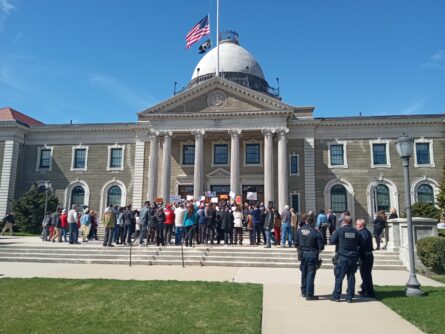
A view of the Roslyn Viaduct Bridge. During the construction period, three lanes of traffic will be in operation for traveling motorists.
|
According to Janet Galante, a task force member and former mayor of Roslyn Village, that body has been seeking a public hearing on the status of the renovation project for over a year. The renovation falls under the domain of the New York State Department of Transportation.
Ms. Galante said the DOT has changed the design concept of the bridge, especially its operations during planned construction on the structure. Originally, the bridge, Ms. Galante said, was to have four lanes operating during construction, which itself could last up to 30 months. Now, the DOT, Ms. Galante claims, is working with a three-lane design for the bridge during construction. "We can't sustain that," Ms. Galante said, speaking of local traffic.
The former mayor also said that DOT officials are not making all their plans available to task force members.
"Just like with residents of the Roslyn School District, we don't want the community subjected to a bunch of lies," Ms. Galante said.
In addition to the lane situation, task force members are not satisfied with current DOT traffic studies. "We're not engineers, but the numbers don't add up," Ms. Galante said of such studies.
The Task Force held a meeting Wednesday night, July 21, to communicate their frustrations with DOT personnel. In addition to Ms. Galante, Peter Zuckerman, a trustee with the Village of East Hills; Gerson Strassberg, mayor of the Village of Roslyn Harbor; Wayne Wink, a councilman with the Town of North Hempstead; and Jack Russo of the Roslyn Water District were in attendance.
Such local officials have long asked the DOT to conduct a "balloon" test for the three-lane road they plan to construct on the viaduct. They also expressed safety concerns. Specifically, they worry that a three lane bridge will cause so many traffic problems that cars will be forced to drive through residential neighborhoods in high numbers during times when area children are on their way to school or just playing in their neighborhoods.
Transportation acknowledged that the viaduct bridge would indeed have three lanes open during the construction period. She said that the new bridge, once completed, would have four lanes in operation, in addition to having sidewalks and shoulders constructed.
"Originally, we tried to keep four lanes open," Ms. Peters added. "The new design of the bridge will be more cost efficient. It will be a smoother ride for people. It will be easier to maintain in the long run. The one drawback is that it will be constructed with three lanes rather than four. We did an in-depth analysis and there is a minor difference in the impact on traffic with the three lanes."
During construction, she continued, there will be a reversible lane open for rush hour traffic, a 24-hour towing service available to "remove any incidents," and a transportation management specialist to oversee the whole operation "24/7."
DOT officials have said that they expect to award a contract in the summer of 2005. Construction work would then begin in the winter of that year.
The renovation project is simply a matter of addressing some obvious problems of the current bridge. First constructed in the late 1940s, it now is considered a have an "outmoded" design. An overhaul is necessary to maintain the bridge's long-term structural integrity. The renovation project will entail replacing the bridge's entire 2,220 sq. ft. steel structure. The DOT has estimated that the total cost of the project will be in the $60 to $80 million range. A reduced construction time could also cut down on those projected costs.
The Bridge Task Force started holding meetings in November 1999. Over the past several years, the task force has held up to 25 meetings, mainly to discuss the project design, its impacts on the community as well as proper aesthetics.
Initially the Department of Transportation (DOT) announced the project and said that four lanes would be open while the viaduct was reconstructed. Later, when the DOT reversed itself, East Hills Mayor Michael Koblenz expressed concerns over the "viability of the viaduct project."
In December 2003 Mayor Koblenz wrote to all surrounding mayors questioning whether three lanes would be sufficient to handle the traffic without serious disruption, backlog and shortcuts which would clog the secondary road. East Hills Mayor Koblenz suggested retaining an independent professional traffic consultant to analyze the DOT reports and suggest the most prudent course of action.
In response to his communication, Roslyn Harbor Mayor Gerson Strassberg and Roslyn Estates Mayor Susan Ben-Moshe joined in the effort to retain a consultant. A well-established firm was chosen which is Schneider Engineering LLC and it has analyzed the reports, studies and traffic flows reported by the DOT. The consultant attended the last meeting held by the DOT and questioned many of the assumptions made by the DOT.
New York State Senator Michael Balboni has been a key contact who is trying to resolve the matter immediately. Assembly Member David Sidikman has said he is concerned over the serious bottleneck that would be created and the inconvenience to residents. North Hempstead Town Supervisor John Kaiman has also expressed his reservation over whether three lanes will suffice for the heavy traffic flow on Northern Boulevard.
In response to the issue Mayor Koblens said, "We can't take any chances that more cars from Northern Boulevard will cut through our neighborhoods as alternate routes. This issue is not just about delays for two years or more, it is about a possible disruption to our lifestyle."