After years of planning, the Village of East Hills is ready to go forward with a bond referendum for its proposed "Park at East Hills."
The village has set Wednesday, Oct. 8 as the tentative date for a vote on a $17 million bond act for the purpose of demolishing parts of the former Air National Guard site and then constructing a state-of-the-art outdoor park.
Prior to the vote, the village has also scheduled Monday, Sept. 15 and Tuesday, Sept. 16 as the dates for public hearings on the bond vote. Both meetings will feature a slide show on the proposed park, to be followed by public comment sessions. The meetings will begin at 7:30 p.m. and will take place at the Roslyn Middle School on Locust Lane off the Long Island Expressway service road.
After the public meetings, the village board of trustees will make a formal resolution on how to proceed with the referendum.
A combination of the "lowest interest rates in decades" plus the village's own high (Aa3) credit rating from Moody's has, in part, convinced village officials to go ahead with the public meetings and the tentative referendum date.
In the recent past, votes on the bond act were put on hold, with village officials citing both the county's "fiscal dilemma" and the ongoing countywide assessment of residential properties. Some village residents also questioned the wisdom of a bond vote during such perilous economic conditions.
"Now...after a county budget has been put in place and the overall impact of reassessment to our residents had very little effect, it is the first opportune time to offer our proposal," said East Hills Mayor Michael Koblenz, in giving two other reasons are also why the village is going forward with the referendum.
However, the proposed park is a scaled-down version of the village's original proposal. In the past, the bond act was estimated at $28 million, a number significantly higher than the $17 million that village residents will vote on.
In all, village officials claim that the new proposed park represents a site that is "50 percent" smaller than the original proposal. According to Mayor Koblenz, village officials have eliminated the indoor pool with indoor diving, a fitness center, new village offices, a new courthouse, an in-line roller hockey rink, and "many other more costly facilities."
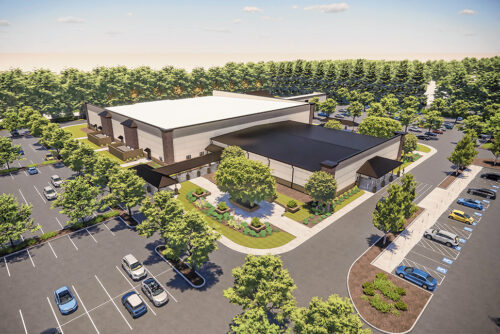
Still, the proposed park will be the same "all state-of-the-art" outdoor facility that village officials have long wanted. The proposed park would include an outdoor swimming pool, six tennis courts, two playgrounds, fields with baseball and softball with three overlapping soccer fields, two regulation-sized basketball courts, bicycle paths, nature trails, a hill for snow sledding, an auditorium, a seniors' lounge, and an amphitheater area.
Security matters for the entire facility would be met by the use of 6th Precinct satellite office at the entrance of the park, electronic surveillance, photo identification cards for village residents, and the presence of a caretaker who will live on the grounds and monitor security.
Also on the financial side, village officials said that low interest rates would mean that the total estimated annual cost for the park for the average East Hills homeowner would is $758.62. However, with "potential 43 percent tax savings," the cost would be reduced to an estimated $432.52. Village officials have long claimed that a park will increase property values, a notion seconded by several local real estate agents.
While making their pitch to local residents for a new park, village officials also stress the need to "transform the military base," which they claim is on property that contains "asbestos-filled barracks, old Air National Guard offices and buildings, and neglected or discarded military facilities." Up to one-third of all costs related to a new park would be directed toward demolition work, plus re-grading projects on the current property.
If the bond act is approved, the village would hold groundbreaking ceremonies this winter. Demolition and site preparation would begin in spring of 2004, with basketball and tennis courts, among other facilities to be in operation by the fall of that year. The village has set the summer of 2005 as the completion date for the entire park construction project.
After the Cold War ended, numerous, small-scale military bases around the country began closing down. East Hills officials were aware that the Air National Guard base could, in time, also be shut down.
If that happened, village officials were also concerned that the site might be replaced by "low-income housing, a major commercial post office processing facility, or...a drug rehabilitation center." And indeed, the Department of Housing and Urban Development did express an interest in the property as a future site for low-income housing.
Consequently, the village moved quickly to purchase the facility from the U.S. Air Force. With help from Rep. Gary Ackerman, congressional committees approved the idea of a village purchase. Eventually, the village did purchase the property for a cost of a little over $3 million. On Dec. 9, 2000, the property was officially transferred from the Air Force to the Village of East Hills.
Several years ago, when the village announced its desire to build a park on the Air National Guard site, it formed citizen committees to draw up plans and drafts for a proposed new park. Even though the scope of the project has been reduced, the work those volunteers did laid the groundwork for the park plans that East Hills residents will soon vote on.