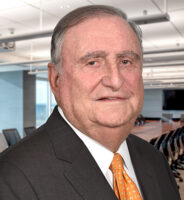
Former Israeli Prime Minister Ehud Barak traveled to Roslyn last Wednesday night to give a talk to a crowd of 830 people at Temple Beth Sinai, where he gave a somber, but hopeful address on both the ongoing war against terrorism, and prospects for peace in the Middle East.
The talk was the third program of Temple Sinai's Adult Education Committee's Distinguished Lecture Series. Other speakers have included Nobel Prize winning author Elie Wiesel and former Secretary of State Henry Kissinger.
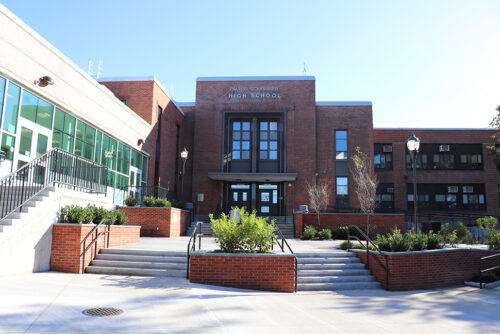
Before the talk, Mr. Barak met with several Roslyn High School students, whose own knowledge of the international scene impressed the former prime minister. Although many of Mr. Barak's predictions were grim, he still managed to leaven his talk with moments of humor. He joked that the current situation, uncertain as it may seem, reminded him of the old Chinese curse, "may you live in interesting times."
Before he got into politics, Mr. Barak was a longtime veteran of the Israeli military. As such, he has real life experience in combating terrorism. He was, for instance, only 22 years old when he first was part of a commando raid against terrorist forces. Those efforts were successful, but Mr. Barak acknowledged that if someone had told him that three decades later, terror would still be a fact of life not only in Israel, but throughout the world, he "wouldn't have believed it."
Mr. Barak admitted that the war against terrorism would be a "long struggle," maybe one lasting half a generation. It will involve, he further acknowledged, tragedy and success. Many innocent people may lose their lives before the anti-terrorist forces prevail. Indeed, Mr. Barak's talk featured some chilling scenarios. "Can anyone doubt that the same terrorists [who bombed the Pentagon and the World Trade Center] would use chemical or even nuclear weapons if they had access to them?" he asked. The terrorist's goals, he added, are three-fold: To drive the United States out of the Middle East, to oust "pragmatic" Arab leaders, and to "destroy Israel."
But continuing his cautious optimism, Mr. Barak also declared that the United States, under the administration of George W. Bush, has an "A team" at the helm and is in "good and promising hands" for dealing with terrorism.
In discussing the war on terrorism, Mr. Barak used an analogy to the "war on piracy" that took place in the early 19th century. Modern day leaders should deal with terrorism the way "our forefathers" dealt with high seas pirates of centuries past. It took a good 20 years, he recalled, for the civilized nations, including the United States, to work in concert and beat back that earlier threat.
Mr. Barak recalled his own experience in commando raids that took place in both 1972 and 1973, the latter a matter of retaliation for the massacre of Israeli athletes at the 1972 Munich Olympics. Such recollections were not without their humorous side. In 1973, Mr. Barak recalled that his colleagues and himself all disguised themselves as women while tracking down suspected terrorists. Their mission accomplished, Mr. Barak went home to his family, equipped with a suitcase full of women's clothes and mascara still smeared across his face. His wife, needless to say, was mighty suspicious of Mr. Barak's baggage and appearance. Then a radio report told of the commando raid and Mrs. Barak became considerably relieved.
Laying out a policy against terrorism, Mr. Barak quoted America's third president, Thomas Jefferson, whose own administration was involved in operations against those same high seas pirates. The price of freedom, Jefferson himself declared, is eternal vigilance. Toward that end, Mr. Barak said that immigration controls should be tightened. In addition, money-laundering operations should be shut down, and certain privacy issues will have to be revisited.
Furthermore, the entire airline industry needs to undergo major reform. Mr. Barak noted that El Al, the Israeli airline, has air marshals placed undercover on every flight. He predicted that other nations would soon adopt similar security measures for their aircraft.
Looking at the international scene, Mr. Barak said he saw hope for reform in Iran, but little such prospects for neighboring Iraq, especially among its current leadership. He called on the United Nations to set even higher standards for future weapons inspections in that country.
Turning to prospects for peace, and his own experiences as prime minister, Mr. Barak said that while he had reservations about negotiating with the Palestinians, he still offered his own peace plan, one presented at Camp David, Maryland during the final months of the administration of Bill Clinton.
Even though Mr. Barak was highly critical of Palestinian leader Yasser Arafat for not accepting the plan as at least a starting point, the former prime minister still believes his plan will eventually bear fruit. He claimed that any future agreement will look "very similar" to what was negotiated at Camp David. He was also hopeful that a different, more flexible Palestinian leadership will emerge in the future.
As with other Israeli leaders, Mr. Barak laid out the demographic realities facing his country. There are, he said, 10 million people in a region that includes 6.5 million Israelis and 3.5 million Arabs. Two scenarios, neither of them sustainable to Mr. Barak, are a "Balkan-like situation" or a South African-style system of apartheid. Another is the challenge of a future with "two states, two nations" living in peace with each other.
Throughout his talk, Mr. Barak reiterated that current problems, whether they be terrorism or difficult peace negotiations, are not insurmountable. Israel, he said, is tough enough to make its way through the present dilemmas. It has, in fact, "passed through much tougher challenges" in its modern-day existence. Creating a better future "won't be easy," still its prospects remain "very promising." He called for a policy where Israel will continue to strike against terror, but also leave the door open for negotiations.
ROS Barak JS