News Sports Opinion Obituaries Contents
News

After a long wait, members of the 1701 Roslyn Grist Mill Committee have learned that monies set aside by Nassau County for renovation of the Robeson-Williams Grist Mill are finally being made available.

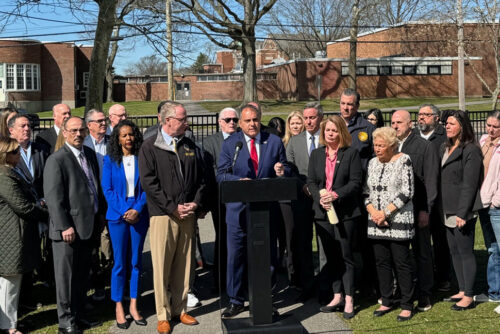
Left to right: Dr. George Williams, Janet Galante, Legislator Craig Johnson, Paula Aridas, and Harrison Hunt.

Dr. George Williams, chairman of the committee, said he was recently contacted by the county and told that monies have been released for the consultant firm of Douglas A. Wilke to begin drawing up final design plans for the renovation project. Mr. Wilke's firm has also completed a thorough survey of the Grist Mill building. In the fall of 1998, a $2.65 million bond act was approved by the Nassau County Legislature. In addition, legislators in Albany allocated $50,000 toward the renovation efforts.

"I am pleased to announce that the county will be proceeding with the design phase of the Roslyn Grist Mill restoration project," said Nassau County Legislator Craig Johnson. "This is the next step in a process that will restore one of Roslyn Village's oldest landmarks. It also marks a milestone for the many residents who have worked diligently to preserve part of our local heritage. I look forward to working with the community as the restoration process continues."

Janet Galante, former mayor of Roslyn, also expressed satisfaction that the project can move forward. "Although Nassau County faces difficult decisions, I feel confident that the county executive and legislator are well aware of the significant history not only for the residents of Roslyn, but for all local citizens," Ms. Galante said. "I look forward to the day when the red ribbon is cut and we can proudly say that the committee's goal was accomplished." During her last term as mayor, Ms. Galante declared Grist Mill restoration as one of the top priorities of her administration.

For her part, Paula Aridas, co-chair of the committee, thanked Legislator Johnson for meeting with members of the committee and continuing to monitor the county's commitment to honor the capital improvement bond.

Before the bond act passed, funds were available for only remedial repairs on the building, located on Old Northern Boulevard. The campaign for Grist Mill renovation began in March, 1997. At that time, Dr. Gordon Jacoby, a research scientist at Columbia University, told members of the Roslyn Landmark Society that time was running out for any effective renovation work on the structure. The wood from the Grist Mill, Dr. Jacoby claimed, was "born" in 1680. As such, the wood structure is fragile and deteriorating and the necessary work to save the mill had to be done soon.

In August, 1997, a major fund raiser was held at the George Washington Manor. The event attracted up to 250 people, each of whom paid $30 just to attend. The evening featured 150 items and gifts placed on the auction block. Such corporate heavyweights as NBC, Loews/Sony Theaters and The New York Times contributed items, as did several local small businesses, including the Roslyn Deli, Jolly Fisherman, Diane's Restaurant, Friend of A Farmer, and Giordino Cafe.

Over the winter, the Grist Mill committee collected over 1,000 local signatures, imploring members of the county legislature to vote for a bond act. The petition noted that the Grist Mill serves as a "significant historical landmark that is a valuable part of the rich colonial heritage of Nassau County."

In addition, the Roslyn Landmark Society, the Nassau County Museum and the Grist Mill committee all joined forces to compile an exhibit illustrating the workings of the Grist Mill and the use of the building as a popular Tea Room in this century.

The existing mill was built in the early 18th century by Jeremiah Williams. It measures 25 feet wide by 50 feet long. The entire building is made of oak. Its most unique feature is its utilization of an Old World Dutch construction style. No such mills of that design exist in Europe today. Furthermore, the Grist Mill is one of the last known surviving Dutch-type water mills left in America.

When the bond act was approved, Dr. Williams said the foundation of the entire mill would have to be lifted to the same level of the road in order to protect it from the water in Hempstead Harbor. That, along with some exterior renovations, is a top priority. Renovation workers also hope to restore the wheel so that the mill may function, at least to some extent, as it did for over the past two centuries. The first phase of the renovation effort has simply been to stabilize the building. The next step was to prepare the building for a new outer covering. Dr. Williams has acknowledged that the entire project will take several years to complete.


LongIsland.com Logo
An Official Newspaper of the
LongIsland.Com Internet Community


| antonnews.com home | Email the Roslyn News|
Copyright ©2001 Anton Community Newspapers, Inc.
All Rights Reserved.

LinkExchange
LinkExchange Member

Farmingdale Observer Floral Park Dispatch Garden City Life Glen Cove Record Pilot Great Neck Record Hicksville Illustrated News Levittown Tribune Manhasset Press Massapequan Observer Mineola American New Hyde Park Illustrated News Oyster Bay Enterprise Pilot Plainview Herald Port Washington News Roslyn News Syosset Jericho Tribune Three Village Times Westbury Times Boulevard Magazine Features Calendar Search Add An Event Classified Contacting Anton News