Preservation efforts in Roslyn are about more than keeping historic homes intact. They also concern the well-being of old neighborhoods. Such concerns have caused the Roslyn Preservation Corporation to address the impact the proposed Roslyn Viaduct Bridge renovation will have on the Mott Avenue-Layton Street neighborhood in the village.
Since the mid-1980s, the neighborhood, according to preservation members, has made a comeback following a period of decline that started in the late 1940s, one due to the construction of the Northern Boulevard approach to the viaduct itself. The West Shore Road improvement project of the early 1960s further reduced the size of the neighborhood as several houses along Old Northern Boulevard and West Shore Road were demolished. However, restoration efforts that took place in the 1980s helped both the neighborhood and several of its more historic homes to retain much of their original character.
In a "preservation alert," the Preservation Corporation now claims that the new viaduct will "likely have a negative impact" on both the historic district and the village itself. The organization further claims that the proposed widening and straightening of the western approach along Northern Boulevard will "substantially" reduce or eliminate the "narrow buffer of trees and shrubbery" which separate Mott Avenue from Northern.
In addition, the memo states that a larger viaduct will "straddle several important scenic vistas and block views of the Harbor and Waterfront." The village's Master Plan, preservation members point out, has designated the area of the viaduct a "Key Scenic Vista." However, the New York State Department of Transportation (DOT), the memo adds, "did not consider the fact that the new structure would block even more of these vistas than the present viaduct."
The Preservation Corporation hopes the DOT will work to reduce the scale and impact of the new viaduct to address its visual impact upon both Hempstead Harbor and the historic district. The organization also hopes the DOT will do the same when considering Northern Boulevard expansion and what that may mean to the Mott Avenue-Layton Street neighborhood.
Donald Kavanagh, an attorney and Preservation Corporation member worried about the survival of the Mott-Layton neighborhood. The neighborhood had made its comeback thanks to the renovation of several then-decrepit houses. However, that neighborhood's land area is now being imperiled. "If enough land is taken away from this neighborhood, then it won't be viable anymore," Mr. Kavanagh said. Again, the possible reduction of the buffer between Northern Boulevard and the neighborhood itself is a concern to preservation groups.
In addition to issues such as land and views of the harbor, there are also concerns over noise levels. Right now, noise from traffic is "pretty imposing" for residents in the Skillman Street neighborhood, Mr. Kavanagh said. "We hope it doesn't get any worse."
The Mott-Layton neighborhood stands on land that once had been home to the Mott family farm. In June 1872, Silas Mott sold his holdings to Frederick M. Eastman and Benjamin D. Hicks, who soon filed subdivision for residential development. By the mid-19th century, the village was increasingly becoming home to numerous craftsmen, laborers, and shopkeepers. Up until the 1930s, Mott-Layton had settled into a solid neighborhood of craftsmen and working class families before post-World War II upheavals made more renovation necessary.
Konrad Klauer, a longtime resident of Mott Avenue and member of the Bridge Task Force, recently answered several of the Preservation Corporation's concerns in a letter to The Roslyn News. Mr. Klauer said that recommendations have been made to save as many trees and vegetation as possible in the West End in the Mott-Layton neighborhood. He also said that viaduct expansion will only have a "minimal effect" along Mott Avenue and that new support columns will not have a negative effect on scenic vistas. Furthermore, the renovation project will put area pigeons "out of a home," thus, in Mr. Klauer's view, make any residential or business expansions more pleasurable for the occupants. "What is even better is that we will no longer have to look at the existing rusting hulk," Mr. Klauer stated. In order to receive 80 percent federal funding for the proposed $80 million-plus project, the Bridge Task Force had to meet higher criteria, including a guarantee that the new structure could move traffic for the next 80-plus years.
Mr. Klauer claimed that there was some misinformation in the Preservation's Society report. "It's not our goal to get people upset," he said. Mr. Klauer also said that the renovation project would include a new park for the area that will be the site of the Forest City Daly senior housing development. "There will be a continuous green area from the Grist Mill to the Daly project," he said. "Things will get cleaned up, things will be enhanced." He admitted that if trees were cut down and nothing put in their place, then that would create problems for the Mott-Layton neighborhood.
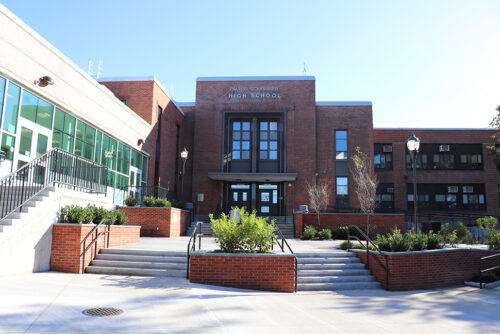
Concerning noise levels, Mr. Klauer said that all the data on that issue has not yet been completed. Barriers on the Mott Avenue side of the viaduct might be necessary to deflect any added noise, he said. However, Mr. Klauer reiterated that no decision is even close to being the final one concerning this or other issues. He urged local residents to attend a public meeting on the subject to be held Tuesday, July 26 at Roslyn High School. From 2 to 9 p.m., there will be information on the viaduct renovation on display. From 7 to 9 p.m., a public hearing on the project will take place.
The DOT has also declared replacement of the current bridge necessary due to its age, outmoded design, and its "long-term structural integrity." The DOT acknowledges that the current bridge does not pose a threat, but there are enough deficiencies to mandate that the structure be replaced. The DOT hopes to have a final draft of the project completed by the fall of 2002. Construction may begin either the next year or 2004. Whenever construction does begin, it is expected to last for 30 months.