Authors and publishers alike always hope to find catchy titles for their books. Roslyn Harbor resident Walter H. Stern has succeeded at that in his latest book, bluntly entitled Will America Self-Destruct? The paperback has been published by the Writers Club Press, an imprint of iUniverse.com, Inc., Lincoln, NE.
|
|
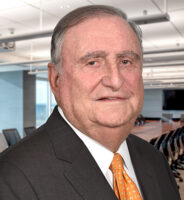
WALTER H. STERN
|
The thesis of Mr. Stern's book is that the United States has been blessed with a remarkable document, the Constitution. Over the years, however, numerous missteps, propelled in part by "the combined forces of desirable pluralism run amok" have compromised that document, in the process, "fraying the fabric woven by the founding fathers." Mr. Stern lists both the missteps and remedies to ensure a stable republic into the 21st century.
Mr. Stern has lived in Roslyn Harbor for the past 15 years. Before then, he was a longtime resident of Glen Cove. His professional life has included stints with both The New York Times and Mobil Corp. Mr. Stern worked as a real estate reporter for The Times from 1948 to 1961. He then went into a business venture with the longtime Times columnist William Safire, who then was in the middle of a successful career in public relations. Their own public relations firm counted Richard Nixon as one of their clients. In 1969, after Mr. Nixon was elected president, Mr. Safire went to Washington with the new president. Mr. Stern then did some public relations consulting, wrote several books, including one on real estate investing, before moving to Mobil in 1976, where he worked until his retirement in 1987.
In Glen Cove, Mr. Stern was president of that city's Boys Club and was also involved with the Lincoln Settlement House. He was also Commissioner of Assessment and Taxation for the city. Also, on the political front, Mr. Stern, back in the mid-1960s, was campaign chairman for the congressional candidacy by William Casey. Mr. Casey, a longtime friend of Mr. Stern and also his Roslyn Harbor neighbor, lost that campaign but went on to serve various posts in the Nixon Administration and later on was a very visible CIA director under Ronald Reagan. Mr. Stern remembers Casey as a "great guy, a brilliant lawyer, and a good friend" who displayed great skill when dealing with the media.
Mr. Stern continues to do pro bono public relations work for both the Long Island Holocaust Center and Long Island Cares, while also serving as a trustee for the Nassau County Museum of Art. "If you don't stay busy like this, you'll go brain dead," he quipped, speaking of his busy life after Mobil.
That life includes writing and publishing his new book. "The point of the book," Mr. Stern said, "is that we've got a great country obviously, [and] a magnificent Constitution. But we've been overstretching the Constitution."
In his book, he cites the emergence of "professional politicians" taking over, not just in Washington, but on all levels of government. Mr. Stern claims that politicians see their time in government not as something temporary, but as an "income-producing career." A politician he does admire is Rep. Carolyn McCarthy, someone whom Mr. Stern believes is not in politics to make money, but who hopes to accomplish certain things in Washington (i.e., gun control). When and if Rep. McCarthy succeeds, she will, in Mr. Stern's estimation, retire back to Mineola, rather than hang around in Washington. That mind-set, he claims, is badly needed in more politicians.
Like Theodore Roosevelt, Mr. Stern is not enamored of the idea of "hyphenated Americans." He dislikes the term "melting pot," while characterizing another term, "Native American" as just plain silly. As with other commentators, he hopes for an re-emergence of a common culture to unite the nation's citizens. On a similar subject, Mr. Stern writes that continuing ambivalence about what constitutes separation of church and state should not lead to "state-sponsored anti-religionism."
Concerning foreign affairs, Mr. Stern worries that American sovereignty is being compromised by numerous treaties and global organizations. "Every treaty chips away a little at American sovereignty," he said, noting that the United Nations, over the past several years, has tried to influence the United States into fighting wars that nobody wants them to fight. Americans should reject notions of one-worldism, such as the kind envisioned by the European Union.
In conclusion, the author calls for his fellow citizens to live up to the responsibilities of freedom. Term limits, likewise, should be self-imposed. Politicians should either vote for their own term limits or promise to leave office after a certain amount of time. George Washington, Mr. Stern observes, understood this, while Franklin Roosevelt, who successfully sought a third term in 1940, turned out to be something different.
In all, Mr. Stern allows for some cautious optimism. "America is not likely to self-destruct any time soon," he writes, "but the pitfalls are always there. We have the will and the competence to avoid them. We have the resources, both material and intellectual, to blaze a trail to eternal glory. We have the structure of government to make it feasible. What we need to enhance is the discipline with which we conduct ourselves as citizens of a shrinking world."