|
|
School board members listen to Oyster Bay High School teachers demonstrate their skills. From the left are: Sydney Freifelder, Laura Seinfeld, Donald Zoeller, Robin Dando and Superintendent of Schools Dr. Phyllis Harrington.
|
At the Tuesday, April 1 Oyster Bay-East Norwich School board meeting, resident Grace Searby cautioned the board that the 2008-2009 budget would be hard to explain to residents. Board President James Robinson said he hoped she would help get the message out. What is important to let residents know is that if the budget were defeated the contingency budget would both cost taxpayers more, and would also constrain the administrators in relation to student programs.
When the budget was adopted, there was applause and resident Barbara Sullivan-Parry said, "Yea!" "Print that! It might be a first," said Mr. Robinson.
The board adopted the 2008-2009 school budget of $45,700,036. It represents a budget increase of $2,033,991 which represents a total 4.7 percent budget increase. It represents a 3.3 percent increase plus 1.4 percent debt service, down from the original 5.1 percent increase proposed at the beginning of the budget process by Superintendent of Schools Dr. Phyllis Harrington.
Mr. Robinson explained, the original budget proposed by Dr. Harrington called for a 3.7 percent increase plus the debt service (interest on the bond to renovate the high school and add on to the Vernon school and do work on the administration building that was voted on two years ago) of 1.4 percent. Those two figures added up to 5.1 percent. From that point, Mr. Robinson said they looked at the budget and discussed how to reduce it.
He said, "There are people in the community who want to see an increase: people who are in favor of the developing technology to enhance children's learning. The board evaluated all these things." He said people come up to him and say, "I want this extra program" and "Please add this teacher." But the bottom line, he said, is that the budget now represents a 3.3 percent increase. He said they made sure they "looked under every stone" and tried to make sure that the rate of growth of the budget happens as slowly as possible, after months of discussion.
The budget figure is below what the contingency budget would be if the residents voted down the budget twice. The contingency budget allows an increase of 3.36 percent, higher than the district's 3.3 percent. If the district were on a contingency budget they would be allowed a 3.36 percent increase and would still have to pay the debt service of 1.4 percent bringing the budget to a little higher than the proposed budget - with residents actually paying more and students getting less.
Another feature of the budget vote is the need to get voter permission to spend Capital Improvement Funds that the community voted on to put into an account for future repairs. It allows needed work to be done - with funds already gathered - and therefore there is no need to go out and borrow the funds and paying interest on a loan.
In this case the problem is to be sure voters understand that the referendum is for permission to use existing funds not for permission to add to the tax burden. Inherent in the Capital Improvement Fund is the concept that districts must take care of their facilities and not allow them to decline as a way of reducing a budget [which has happened in the past if readers remember what happened at the Birmingham School, when not repairing a roof allowed water damage to the building].
Ms. Searby suggested the wording of the referendum include telling the voters how much money is in the Capital Reserve Fund - which is currently $2,511,714. While the board thought it was a good idea, there was concern that the language of the referendum should follow legal rules to be clear and understandable. The full disclosure will be in the budget brochure, the board said.
Proposition 2 states that the board should be authorized to spend funds from the Capital Reserve Funds, "established by the voters of the district" on May 16, 2006. The district proposed to use some of those funds: $280,000 to renovate the Vernon community track [when the track was first approved the board explained that it would need maintenance over the years.]; they need about $500,000 to replace windows at the Oyster Bay High School [the high school at one time considered restoring the casement windows but the project had too many inherent problems and therefore they embarked on a system of replacing the drafty windows.]; and $21,291 to purchase moveable bleachers for the athletic programs.
Speaking of the debt service, Ms. Searby said next year the debt service will be doubled, according to the audit report. Interim Assistant for Business Sydney Freifelder said that was not the case. She said the bond is being paid in two payments plus a small addition next year so that it therefore would have no drastic impact on the budgets.
Ms. Searby asked how many windows would be replaced at the high school and the answer was that the bid states "not to exceed a certain number." First the needed work will be evaluated and then the final decision made.
That was when the board voted to adopt the budget and Ms. Sullivan-Parry responded positively. It was assuring that Ms. Sullivan-Parry gave a resounding approval of the budget because she had questioned the Undesignated Fund Balance.
It was Grace Searby who first questioned the district retaining the 4 percent Undesignated Fund Balance of $1,832,561, as suggested by New York State. She asked that the board consider returning more of it to the taxpayers. Board President Robinson said the trustees questioned the need to retain the funds and first made sure they were forecasting the need for money, as best as possible. They are returning $500,000 of the funds to reduce the budget. The rest of the funds, he said are: still the taxpayers' money, but in a "different shoebox."
Board Vice President Robin Dando added, "We follow the state's guidance because we can't anticipate what next year will be like." She said without those funds available for an emergency repair the board would have to reach into funds for school programs to pay the bills. Mr. Robinson said if the funds aren't needed they will be available to reduce the next year's budget. He added that the fund doesn't accumulate - it is computed each year in relation to the budget figure.
That was where Ms. Sullivan-Parry, an attorney, brought up the current state of economics in the country. "Did you discuss this with your advisors?" she asked. "Bear Sterns is the top of the iceberg. What advice have you been receiving?" She asked if anyone knew the state of foreclosures in the district and how that would affect taxes and the district said they would investigate to find the answer.
Mr. Robinson said they had not been advised about that issue and wondered if the fund therefore should be larger. Ms. Sullivan-Parry answered, "I think that it is a very conservative number."
Mr. Robinson added another consideration to the equation: State aid isn't set as yet and state aid might be cut in the middle of the year as has happened before if funds are not available. That is why they are accepting the state's figure of 4 percent retention. Ms. Freifelder said the state delayed payment on special education when they didn't get sufficient funds to pay the schools.
"Look at what the two county executives are doing," commented Ms. Sullivan-Parry. "They are stopping highway police patrols when the roads are owned by the state."
Back to the discussion on taxes, Mr. Robinson said some people want a zero increase but that is not going to happen.
Added to the tax levy is the amount need by the Oyster Bay-East Norwich Public Library. Their funds are voted on as part of the school district budget vote set for May 20. The library budget is for $1,857,883, less their Appropriated Fund Balance of $100,000, and less estimated receipts of $50,000 for the amount of $1,707,883 to be raised by taxes. [Residents of all ages can take advantage of the savings available by borrowing books, DVDs, CDs and tapes for their enjoyment and education without having to expend additional cash. As long as they return the materials within the required time and don't lose materials for which they must pay. Otherwise, it is a free service to all district residents.]
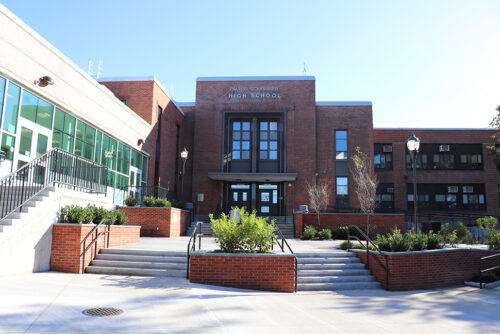
Dr. Harrington added to the discussion by working to finalize the district's calendar. The board needs to vote on the BOCES budget on Wednesday, April 16 so there will be an 8 a.m. meeting to discuss that issue. The board will hold its re-organization meeting on July 1. "If the state budget comes in by that time we can set the tax levy," she said. If the state doesn't approve its budget for that meeting, the board may have to wait until the Aug. 5 meeting. At that meeting they will have to approve the contractors' bills as they complete construction at the Vernon and high school where new science rooms will greet students in September.
As the meeting ended, trustee Dolores Greico complimented the Roosevelt Elementary School where she visited a reading workshop. She said, "I never saw so much excitement from the staff as well as the children. It just goes along with how important the programs are that we fund."
Ms. Searby added that the school announcement board was misleading. She thought the discussion that evening was to have been the progress of construction at the high school, not programs at the high school. Trustee Keith Kowalsky commented that they might need a bigger announcement board to give the full message.
The meeting had been long, but informative - it ended at around 11:20. It began as Oyster Bay High School Principal Dennis O'Hara showcased his staff as they demonstrated the way they have embraced modern technologies to make their teaching more effective for students. It showed that the district is active in giving extra help to students.
What became apparent was Principal O'Hara's appreciation of his staff. He said staff development is the key to improving schools. He said as the norm of "master teachers" increases, they bring along student achievement in their wake. The presentation opened up the classroom teaching methods and explained some of the technology that is able to include the Internet in its scope.
Just as young people are able to surf the Internet for information - so too can the school teachers find just the right enrichment needed to make the young people focus on learning.
As Dr. O'Hara put it, it is a win-win situation. He thanked the board for its belief in the new technologies.