News
Steve and Barbara Pollock with Jim Bruns, TRA president.

Dan Burden of Walkable Communities spent Friday, March 14 and Saturday, March 15 working as a facilitator to help the community decide what it wants to do with Firemen's Field, the site proposed by the Theodore Roosevelt Association for a TR Presidential Museum and Research Center. Currently Theodore Roosevelt Association President Jim Bruns said he proposes to reduce the size of the museum and put the research center and TRA offices at another site.

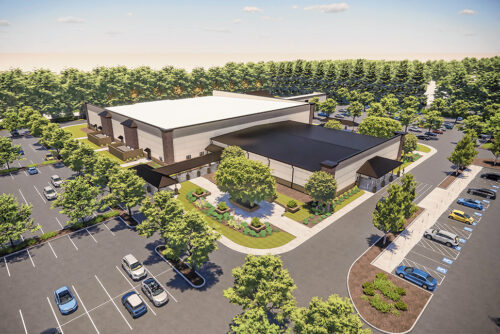
The museum was first proposed at 100,000 sq. ft., but in response to community input it has been reduced to 70,000 sq. ft. with a footprint of 35,000 sq. ft. needing 234 parking spaces.

At the walking audit of Firemen's Field, Judy Barnett asked Dan Burden, "How do we get the town to implement a parking plan: It's been seven years in the trying."

In response, Mr. Burden asked if anyone from the town was attending the tour, and added that Town Commissioner of Planning and Development Jack Liebert was not able to attend and no staff person had been sent to the event. He added that working with governments on Long Island was a most difficult and convoluted process. He said, "I'll deliver the most complete vision I can and you have to fix things."

Ralph Fumante suggested a bike rack and a jitney being possibilities for the future of the hamlet.

Mr. Burden approved of the idea and said, "You want people to park once and having a jitney is a good operation. They should be reliable and make frequent trips." [At the Canavan Center he showed pictures of a few types of jitneys.] He said in Paris they put in a bike credit card system. People pick up the bikes, travel and leave them anywhere. The system reduced the car traffic by 54 percent. "With gas at $7 a gallon, there is an incentive," commented Mr. Fumante.

Irwin Tantleff said 43-years ago the town faced the same parking issues. "We lack self-determination which is always a part of the issue," he said.

Mr. Burden told a story that showed that a town without a local government was able to show its determination to fix its problems by coming before its legislators in great numbers whenever they wanted to make a point - and they were successful.

Main Street Association President Bill Sheeline asked how the proposed museum would fit the site. Architect Edward Erfunt who was assisting Mr. Burden on the walking tour, looked back in the direction of the downtown area and said, that the cupola of the post office and the flag at the Derby Hall Bandstand were visible from Firemen's Field. He said that standing in Firemen's Field, they were very close to the center of town and that the most parking available to be utilized, was there. He suggested the St. Rocco Festival and Oyster Festival could be held on the other side of the railroad tracks, in TR Park. He said he saw the Oyster Bay Railroad Museum plans with another passageway from the heart of the town into the park and called the railroad a barrier. Charles Doering reminded the men of the park's deed restrictions. They said, "We heard about the carousel." [To have the carousel the deed had to be challenged. The issue divided the community.]

Bill Burke said, "We don't need this large a facility - Firemen's Field - for the festivals."

Mr. Erfurt said the hamlet has a wonderful collection of buildings, but there is no fancy gateway into the park and no anchor for the town.

Carla Panetta added to the discussion saying, people come to the WaterFront Center but these potential customers don't get down into town.

Someone commented that the proposed museum was seven times the size of the post office, and requires dedicated parking and asked if Mr. Erfurt thought it could be possible in Firemen's Field.

Mr. Erfurt said, "It would fit, at two stories and 35 feet high." He pointed to where people had parked their cars and said that was about the space the 35,000 square feet footprint could be located. He said it is about the size of Nobman's and Townsend Square: that it would take a half-block-plus parking. [Without any renderings of the proposed museum, Mr. Burden used the Theodore Roosevelt Elementary School to stand in for the TR Museum in his presentation at the Canavan Center. The recent Donald Trump proposal for the new Boardwalk Restaurant at Jones Beach which has been in the media, also gives an indication of the size. Mr. Trump's building is 72,000 square feet. It is being built on a flood plain which puts restrictions on the design of the building, including no basement.]

Mr. Erfurt said if the planners used some of their suggestions, the town could pick up more parking throughout the town, helping to eliminate some of the concerns about the lot. He said, regardless of what happens on the site - Firemen's Field is a huge environmental problem, and it needs resurfacing and cleanup.

Mr. Burden added that Friends of the Bay would come out to address the huge environmental issues involved, which includes nearby flooded basements, artesian wells and sump pumps. He added that there were new environmental rules for development.

In a telephone interview, Robin Kreisberg, Friends of the Bay executive director, said, "FOB is looking forward to the environmental study of Firemen's Field, that will fully assess any impact on water quality and the environment. That's what we are looking for and will make no decision before the information is provided."

At the walking tour audit, Mr. Burke commented that nothing has changed in Firemen's Field for 30 years and said the town is not motivated to fix it. He said, what is needed is a spark and that the museum could be that spark to improve Firemen's Field. He called it an opportunity for the community. He said the museum was the only impetus to drive the project of repairing the field. He added it was a good idea to use "smart parking" which would increase the number of parking stalls for the rest of the lot.

Bill Sheeline commented that the museum will have a security force and that people will be coming and going.

Mr. Burden said, "You can have it all but you need energy invested in the project. Only an important spark - and this museum is a spark to force something beneficial - will work."

Ms. Barnett asked how the infrastructure of the hamlet would be affected by the museum. Mr. Burden said his job was as a facilitator, and that the research would come afterward. He said, "You haven't gotten good information yet on the vehicle trips, the school buses, the tour buses."

MSA member Irwin Tantleff, said the traffic at his former Foodtown location was between 900 and 1,000 cars a day. He said the museum traffic would be infinitesimal. He added the hamlet had no anchor store since Foodtown relocated to Pine Hollow Road.

Rob Brusca commented that as an anchor, the supermarket draws people from the community - the 10,000 people already here. The proposed anchor tenant, the museum - would draw from a much larger radius including the Metropolitan area.

Mr. Burden said the traffic issues must be addressed but added, "Don't design out of fear." He said the fear of the automobile is dominant in the country. He said after the tragedies of 9/11; a bridge down in Tampa; and the Olympics in Los Angeles: everyone was concerned with traffic and he said, 'Traffic figured itself out."

Mr. Burden saw the opportunity for workforce housing along Maxwell Avenue, saying the hamlet needed some community development putting land back into use, looking at an almost empty lot on Maxwell Avenue with boats, trucks and cars parked in it. He said some people cut their taxes by leaving land alone so that the taxes are lower. Architect Erfurt pointed to one of the smaller houses on Maxwell Avenue and said it was possible to put in 13 or 14 of them along the block. Mr. Burden called the small buildings adequate for housing.

As they talked about the need for affordable housing, someone commented that the hamlet was doing its share: that 46 percent of the housing is rental.

Mr. Burke disagreed with the need for workforce housing. He said what was needed in the hamlet was high-end housing to bring in the kind of customers the merchants need.

Mr. Erfurt said the workforce housing would be for young professionals and baby boomers, who are retiring and want smaller houses. Both groups want to live in small compact urban settings, he said.

Someone asked if there should be more houses built in Firemen's Field and added, it is zoned for 24 residential lots.

By now the group was heading into TR Park where people complained about the town's fence surrounding the park that someone called part of the town's homeland security effort.

[A town spokesperson said it is not part of their homeland security effort, that it has been there for some time and is simply "privacy fencing" for the park.]

At the tour, Mr. Burden said the fence was taller than it needed to be and doesn't make the park safer. His suggestion was that cars could drive into the park through the new entrance area proposed in the Oyster Bay Railroad Museum plan, and that they could park in spaces north of the railroad line, inside the edge of the park. He envisioned a single lane of 90-degree parking spots, to the left and right of the Oyster Bay Railroad Museum's proposed new entrance into the park.

Mr. Burden also suggested the park needs a master plan. The Town of Oyster Bay is involved in creating a Master Plan for the park, and in a telephone interview, a town spokesperson said, "It is a work in progress. Developing a master plan takes time for getting input. It is not a complete product. There is nothing to talk about as yet."

Ralph Fumante suggested that having the parking along the fence made more sense than having parking up front in TR Park, where there should instead be places for people to enjoy the waterfront, including children in their playgrounds.

That was about when the group left to meet again at 2 p.m. in the Canavan Center at St. Dominic High School.

During the discussion there, several people mentioned alternate sites for the museum including the Capone property; the Eastern Waterfront area; including some land the town leases, that is currently being used for storage.

Most interesting were the large sheets of paper that recorded people's comments on what should be done in town. They were given 10 colored sticky dots to put on the charts to record their approval of issues and ideas. It showed that people are aware of what needs to be done in the hamlet.

• Reduce speed limit downtown to 15 mph - 9 dots.

• Taller museum building is better - 6 dots.

• A smaller footprint - proper size/scale - one dot.

• Involve the entire community - 18 dots.

• Create a planning entity - 8 dots.

• Beautiful signage for way-finding - 15 dots.

• Cleanup Route 106 - 55 dots.

• Substitute Visitor's center at LIRR and put museum on Eastern Waterfront with places to stay and dine - 36 dots.

• TRA track record - "Give them a chance for a third project," said Mike Rich. 1- Sagamore Hill, 2- TR Park, 3 - the TR Museum - 70 dots.

• Parking for customers first - 19 dots.

• Bring culture to the community - 28 dots.

• Access to the waterfront - 18 dots.

• Don't roll up the streets at 7 p.m. - 19 dots.

• Expand business down to the park - 1 dot.

• Whole hamlet view of comments - 3 dots.

• Re-design TR Park - Master Plan Vision - 10 dots.

• Healthy retail business - 7 dots.

• More facts - 8 dots.

• More street signs - 5 dots.

• Enhanced mass transit - 12 dots.

• More action - less discussion - opportunity is now - 30 dots.

• Develop Eastern Waterfront walkway, east to west - 46 dots.

• Clean up trash - 13 dots.

• Group to work with government - 15 dots.

• Private property owners motivated - 6 dots.

• No tall buildings - 9 dots.

• No building in Firemen's Field - explore other sites - 29 dots.

• Nothing extravagant for TR - 1 dot.

• Replace all lost parking - 1 dot.

• Economic development zone - 8 dots.

• Next generation needs to rally around - 2 dots.

• Parking for existing users of Firemen's Field vs. tourists/outsiders - 14 dots.

• Town center 100 percent location - 16 dots.

• Route 106 issue - 29 dots.

• Increase foot traffic - 23 dots.

• More trees and landscaping - 43 dots.

• More walkable - 29 dots.

• Support bicycling - 13 dots.


LongIsland.com Logo
An Official Newspaper of the
LongIsland.Com Internet Community


| antonnews.com home | Email the Oyster Bay Enterprise Pilot|
Copyright ©2008 Anton Community Newspapers, Inc.
All Rights Reserved.

LinkExchange
LinkExchange Member

Farmingdale Observer Floral Park Dispatch Garden City Life Glen Cove Record Pilot Great Neck Record Hicksville Illustrated News Levittown Tribune Manhasset Press Massapequan Observer Mineola American New Hyde Park Illustrated News Oyster Bay Enterprise Pilot Plainview Herald Port Washington News Roslyn News Syosset Jericho Tribune Three Village Times Westbury Times Boulevard Magazine Features Calendar Search Add An Event Classified Contacting Anton News