|
|
Roger Bahnik of Mill-Max Mfg. and Boys & Girls Club co-president with TRA President Jim Bruns.
|
Main Street Association President Bill Sheeline introduced the topic of the proposed Theodore Roosevelt Museum at the MSA annual meeting on Oct. 30 at the Doubleday Babcock Senior Center. He said, "The carousel is on hold because of a wonderful proposal for Oyster Bay," - the TR Museum - which he said will set the tone for the revitalization of Oyster Bay. Theodore Roosevelt Association President Jim Bruns was their featured speaker.
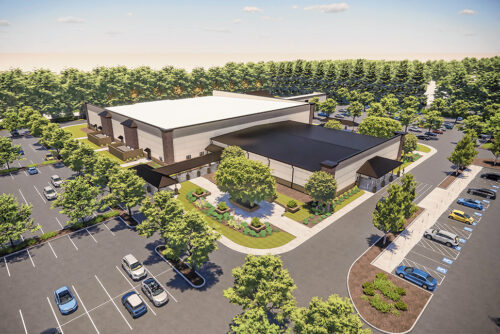
The proposed museum would be located at Firemen's Field and would consist of two two-story buildings: an 80,000 sq. ft. to 100,000 sq. ft. museum and a parking garage. Town attorneys are looking at which zone a museum would be designated. The current site is zoned residential and a change of zone is needed. A town spokesperson said it would be in either General Business which is 35 ft. or Neighborhood Business which is 30 ft. They are also looking at such items/concerns as solar panels which are allowed over the required building height.
Jim Bruns said when he first joined the TRA as president, he thought Washington D.C. would be the location of the museum. "But when I came to Oyster Bay and began to work with the local citizens and the Town of Oyster Bay, I realized Oyster Bay really had a lot more to offer than Washington. It became a no-contest. They sold it. I went back and looked in a book about TR where he said to his wife Edith, shortly before he died, "You'll never know how much Sagamore Hill means to me."
Mr. Bruns explained his reasoning quoting historian David McCullough who made a presentation at the Truman Library. "There he said it was very simple - that to understand the man you have to understand the place. The place where he came home to rest and restore himself. So really, Oyster Bay makes the most sense. I was offered Firemen's Field and it just clicked. It made the most sense," Mr. Bruns said.
He reminded listeners that the TRA was begun in 1919 and chartered in 1920. "They gave TR Park to the citizens of Oyster Bay. Located here, the museum would be facing and adjacent to that park," he said.
Mr. Bruns said he is working with Senator Schumer and his staff to electrify the Oyster Bay branch of the LIRR to New York and back. He hopes to have a small bus to carry about 15 passengers from here to other historic locations such as Raynham Hall Museum, the TR Sanctuary and Sagamore Hill. He said it not only made good sense to have the museum here, but it was long overdue. "The 26th President has no national museum to tell about the creator of the 20th century and who made the presidency what it is today," he said.
Mr. Bruns sees the museum as being between 80,000 and 100,000 sq. ft. - less doesn't do it, he said, adding that a national museum needs at least 80,000 sq. ft. The cost would be between $50 million and $100 million for a "one of a kind state of the art museum with special features and unique exhibitions. He said, "If we continue our progress with due diligence, as with the signing of the Memorandum of Understanding, they will probably save one year on the timeline and could have the ribbon cutting ceremony in about five to five and a half years. It will take about three years to build the museum."
Mr. Bruns said he expects to raise $35 million from corporations; $25 million from individuals; $17 million from foundations; $5 million from the Roosevelt family; some from the government and the rest gathered through direct mail campaigns, etc. He looked out at the audience and cheerfully told them he accepted checks, cash and money orders to help create the TR museum. During the next six months there will be engineers' survey, soil samples taken, and environmental assessment made; a traffic study and an economic assessment report is also planned.
Mr. Bruns said he was not opposed to questions and would "answer every question." He said in December or January he would be moving from his offices in Nassau Hall in Muttontown and moving back to Oyster Bay to an office on Audrey Avenue. Mr. Bruns said people were invited to visit and call him. "We want to be as open as possible - transparent. I've built museums before in my life and I hope this is the last and the greatest," he said.
He was asked why they had chosen Firemen's Field over Sagamore Hill. Of Sagamore Hill, Mr. Bruns said, "I am notoriously brutally frank," as he commented on dealing with the federal government to whom the TRA gave Sagamore Hill.
He said asking the federal government to be able to put the proposed TR museum at Sagamore Hill requires following a process. "You can't ask for the site specifically. You ask Congress for a site and they debate over what is the best site. They offer what they chose for use. That is if it gets out of committee. If they offer you a site and you say no - it is over. Congress may never offer Sagamore Hill as a site, so we chose to accept Firemen's Field - a beautiful piece of land," he said.
Earlier in the evening Philip Selleck, interim superintendent for Sagamore Hill National Historic Site said putting the proposed Theodore Roosevelt Museum there was difficult. He said, "It is a case of red tape, that I wouldn't go into describing."
Another man commented that the choice of Firemen's Field was a disaster, because it has one road in and out. He suggested that private property at Sagamore Hill can be purchased and would be a better site. Mr. Bruns disagreed saying, "Firemen's Field was adjacent to Theodore Roosevelt Memorial Park, had easy access from the train, has good parking and has a beautiful vista of Oyster Bay Harbor."
Several other concerns were brought up by Louis D'Arpa who said that parking is needed by the Oyster Bay-East Norwich school district at Firemen's Field for athletic events; that it has many uses in the community; and there is a drainage problem that the town hasn't fixed for many years.
Mr. Bruns said the drainage problems will be solved by an environmental engineer adding that the system has no back flow protector which would stop the flow into the parking lot when the water in the harbor gets high. In answer to the gentlemen's query if the town would pay for the remediation, Mr. Bruns said, "It is our mitigation problem if it is on our site."
As to parking, Mr. Bruns said they are adding a number of parking spaces - as they are proposing a two-story parking garage as well as a museum building. He added that they will not close off parking to residents - in relation to its other uses. He said the museum needs 350 parking stalls.
In relation to the school comments, he said there is an education value of having a TR Museum in Oyster Bay and said there will be a 415-seat auditorium.
Rob Brusca asked what visitation is expected at the museum. Mr. Bruns said, "I need 100,000 visitors over 360 days a year. During the school season they would get about 15 cars and four school buses during the school term and therefore not in the summer."
He said, "One hundred thousand visitors sounds big but you have here in Oyster Bay a high school with 703 students who come and go 180 days of the year which would account for 123,000 visitors - and they are absorbed and you don't even know they are here. Sagamore Hill gets 60,000 visitors and I need about 40,000 more. You have 200,000 visitors at the Oyster Festival and you don't know it on Monday."
Mr. Bruns said the economic impact of the museum would be about $24 million to $30 million a year in economic development. There will be a $4 million payroll which will add purchasing dollars to the town as well as town taxes. He said, "Any dollar spent in Oyster Bay pays a sales tax which bounces back to the town. There is a tremendous economic incentive to have a museum in the community." He said the Smithsonian brings in over $12 million per museum, with several museums in its system. Mr. Bruns said the tax benefits would come from people spending money locally; payroll taxes; and local purchases by that staff.
Rob Brusca commented that the new museum is 10 times the size of Sagamore Hill with 50,000 to 60,000 visitors - would that imply that the TR museum would get 10 times more visitors? Mr. Bruns said that Sagamore Hill has the house, the Old Orchard Museum as well as the entire site and setting. There is also a trail to the beach and the field next to the museum that is used by the Rough Riders for an encampment during special events. Sagamore Hill is 83 acres.
Mr. Bruns said he has discussed partnering with Sagamore Hill. "If we do outside activities we will do them at Sagamore Hill. If they need inside space they can use us. It will be a symbiotic relationship. The educational facilities will include a distance learning center with such guests as Michael Beschloss [an American historian specializing in the American presidency] and David McCullough, [historian and winner of two Pulitzers]," he said. Both men are regulars on C-Span.
With the distance learning set ups, Mr. Bruns said students can ask questions of the presenters during the weekly programs.
Another benefit of having the museum located in Oyster Bay is that there will be a discounted fee for local residents; TRA members; Friends of Sagamore Hill members; as opposed to visitors who will pay the full fare, he said.
Mr. Bruns asked the rhetorical question - will the 60,000 visitors to Sagamore Hill come to the TR Museum and answered that - "almost all will in a dual pilgrimage. If it was a library only - the answer would be no. But I've been deliberate not to have only a library. There is a TR collection at Harvard, [and one at the Library of Congress in Washington, D.C.]. Museum and library visitors are two different things. The museum-goers pay an admission; the librarys are considered public and since the time of Benjamin Franklin [who created our first library system in Philadelphia] - libraries have been free.
"Another attraction to the museum will be its exhibits," he said.
Bob Bartellotti asked about the style of the building and Mr. Bruns made it clear that he didn't envision a brushed aluminum and sparkling glass building. He suggested it be somewhere in the area of a Queen Anne; Richardsonian; and Beaux Arts style. "No stone towers - those styles are just to set a vision," he said.
Mr. Bruns said in a telephone call that he envisions a 35 ft. high building of two-stories. He was not pleased with the rendering of the proposed museum that appeared with a letter to the editor in the Nov. 8 issue of the Enterprise Pilot. He said however, "If the town believes that it is appropriate to be higher than that - with parking underneath - if it is seen as an advantage to the town to put the museum on columns so the underneath can be used for the Oyster Festival and St. Rocco's we are willing to listen to that and look at it, but it is not our plan." [This newspaper had quoted Mr. Bruns in the Oct. 4 issue as saying the museum would be about the size of the Oyster Bay Post Office - which is inaccurate. The post office is approximately 6,000 ft. per floor. According to government records the building is 10,101 sq. ft.]
Charles Gaulkin asked which part of the 3.5 acres of Firemen's Field he proposed to use? Mr. Bruns said at the present time he didn't know. He said they would avoid the firemen's strip as much as practical. They have been looking at the possibilities including putting it closer to the school's field. There are issues in the field such as the 20 ft. high firemen's arch, the railroad and engineering issues to be dealt with.
In a telephone interview Atlantic Steamer Fire Company Chief Frank Ozol said their only concern about having the TR Museum at Firemen's Field is what happens to the firemen's tournament track. This summer there will be a tournament here for the entire Fifth Battalion which includes 11 fire departments. Chief Ozol said, "Are we going to get to retain our track in perpetuity or where will we have it? We shouldn't have to go to Syosset or Bethpage to practice. The town gave the property to us; promised it to us and I certainly would not like to lose it. Beekman Beach would not be big enough for the tournament track." Firemen's Field is also used for parking during a tournament.
At the meeting, when asked what will be in the museum Mr. Bruns said they were making bubble diagrams. Included in the plans are areas for guards, curators, the collections will be in the middle of the building for safety; 30,000 sq. ft. for the exhibits; with 6,000 sq. ft. for each changing exhibit. He said, "It will be highly interactive. That takes up a lot of space." There will also be classrooms, offices, an atrium, food service, and parking.
His goal it to make it a LEED "green" building. He said, "We will treat waste water; and use flushless toilets," and added making the LIRR train electric with no change at Jamaica; and with a shuttle bus that uses metro gas - which is non-polluting.
Ed Minicozzi, who owns a great deal of Oyster Bay real estate, asked Mr. Bruns what he would like to see happen in the rest of the hamlet. Mr. Bruns said, "What you do is up to you. I'm not a developer. We want to build a museum and to do the best job we can. What you do with the rest of the town is up to you."
Someone asked if the museum would be too near the homes surrounding the parking field.
Rob Brusca said the proposed museum would be the biggest complex in Oyster Bay. He added, thinking aloud in terms of visitation: the Lincoln Museum which is 100,000 sq. ft. gets 500,000 visitors. Sagamore Hill is one tenth the size of the proposed museum and gets 50,000 to 60,000 visitors and is closed on Monday and Tuesday during half the season so the estimates for the TR Museum, as big as the Lincoln Museum, might be low at 100,000 visitors a year. Mr. Brusca added his concern at the loss of parking for the community and school athletic events.
Mr. Bruns said the museum will be open from 10 a.m. to 5:30 p.m. and that the students play after school so that they might arrive at about 4:30 to 5 p.m. for games as his people would be leaving. He added that TR Park itself has about 230 spaces that are not used during the winter months. He said, "We did an aerial look at parking in Firemen's Field and saw an average of 15 cars there." Mr. Brusca questioned the time frame of the aerial viewing of the lot.
A voice from the crowd added that the City of Springfield, Ohio, where the Lincoln museum is located, is 12 times bigger than the hamlet of Oyster Bay.
Stan Spiegelman, Oyster Bay Civic Association vice president said, "Can a 10,000 resident hamlet take a museum. That's our main concern."
Mr. Bruns said he had no crystal ball but added that there would be meetings like the one that evening, on a quarterly basis. "We are only in the study phase of looking at traffic and environmental issues. There is no complete information yet. It is all estimates and projections at this time," he said.
MSA President Sheeline closed the meeting and suggested that when thinking of the potential of the museum for the hamlet, take the concerns and think about solutions for them. "Think about what works and allows us to do this," he said.
Oyster Bay Town Supervisor John Venditto took time from his busy schedule to talk about his involvement with the proposed Theodore Roosevelt Museum and Library at the Oct. 30 annual meeting of the Main Street Association.
Supervisor Venditto said when Jim Bruns and Norm Parsons (TRA Interim president) told him about the museum, "I thought the Boston and Washington D.C. sites were strictly business, but the hamlet of Oyster Bay as a site is very personal. This is Oyster Bay that Colonel Roosevelt said was his favorite place on earth. It seems appropriate to put his museum in Oyster Bay."
He said he signed the Memorandum of Understanding because it was an integral part of convincing the national TRA that it was an expression of their intent to put the museum in Oyster Bay. A significant component of the decision, he said was talking to Sagamore Hill and others before he signed the MU.
But Mr. Venditto added that the town government follows its established procedures. He said, "We believe strongly that it belongs here but we do things here 'the Oyster Bay way' unlike other towns and counties. We don't leap before we look."
He said they will deliberate the issues and listen to those in opposition, talk to residents, and that while he knows there is never a decision that makes everyone happy, they will try to do the greatest good for the most residents. They will have technical experts look at the environmental impact, the traffic, noise and garbage generation. "It is important because the Town of Oyster Bay respects the quality of life of residents. Now it's time to get to work. We never sacrifice speed for accuracy. We will get community input, and expert opinions regarding the wisdom of putting the museum in Oyster Bay. I and the board go in with an open mind," he said.
He acknowledged the issues of parking in the hamlet and the use of Firemen's Field by the Oyster Bay Fire companies. He said, "No one will dispossess them. They enhance our quality of living. Whatever they need - it will happen. Those who put themselves in danger for the public will have to be okay with the decisions.
"To this point I have not seen a deal-breaker," said the supervisor.
Still he said he would listen to residents who are concerned about issues. He ended by saying, "We have the potential to do something very great for our hamlet and the Town of Oyster Bay - but I threw away my crystal ball a long time ago."