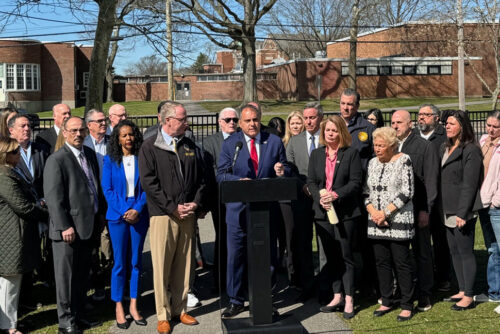
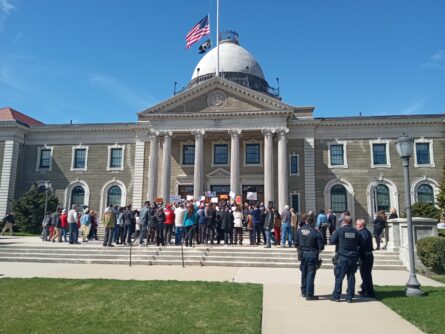
On Tuesday, June 27 at the Doubleday Babcock Senior Center, a public meeting was held to discuss the U.S. Fish and Wildlife Service's draft Comprehensive Conservation Plan and Environmental Assessment for the Long Island National Wildlife Refuge Complex. This draft plan is an outline to help the U.S. Fish and Wildlife Service prepare for the future management of the Long Island National Wildlife Refuge Complex over the next 15 years.
The Refuge Improvement Act of Congress requires that all national wildlife refuges have a management plan in place by 2012. It also requires that the public be included in the decision making process. The U.S. Fish and Wildlife Service began public scoping sessions for this plan back in 1997, including several meetings in the Oyster Bay area. Senior Refuge Manager Thomas Bonetti said, "The planning process usually takes three years. However staff changes and also the highly concentrated amount of refuges in the Long Island area made it challenging to generate this draft plan quicker. The final plan should be adopted this fall."
The goal of the complex is to "protect significant habitat for migratory birds, threatened and endangered species, and other native wildlife." There are nine locations on Long Island that have National Wildlife Refuge status, including a 3,204 acre site in the Oyster Bay area. The other sites on Long Island make up the rest of the more than 6,200 acres in Suffolk and Nassau counties. They are Amagansett, Conscience Point, Elizabeth A. Morton, Lido Beach Wildlife Management Area, Sayville Unit, Seatuck, Target Rock and Wertheim. Outside Long Island there are actually only three other wildlife refuges in New York State.
The Oyster Bay site includes most marshes, wetlands, and bay bottom of Oyster Bay Harbor and Mill Neck Creek and also part of Cold Spring Harbor. The Oyster Bay site is unique in that 78 percent of it is bay bottom; over 100 bird species have been documented, including over 20 types of waterfowl. The Oyster Bay area is particularly important as a winter habitat for black ducks and shorebirds. In addition to red-tailed hawks, American kestrel, merlin, and sharp-shinned hawks, ospreys are also observed in Mill Neck Creek along the marsh. The area also has fascinating mammals, reptiles, and amphibians. In fact, the area is believed to have the largest diamondback terrapin turtle population on Long Island.
There are several other reasons that the Oyster Bay Refuge is significant. The refuge provides 40 percent of New York's hard shell clams and 90 percent of the state's oyster crop. It serves as a way of life for many local and small clamming and fishing businesses. It is also home to Flower Oyster Company, the only commercial oyster farm in New York State.
Greatly adding to the significance of the Oyster Bay refuge is that Sagamore National Historic Site, the homestead of President Theodore Roosevelt, is surrounded by the waters of this refuge. In 1903, President Roosevelt founded the first national wildlife refuge on Florida's tiny Pelican Island, which sprouted the conservation movement in the United States. Today there is a refuge within an hour's drive of every major American city. A representative of the Roosevelt family was in attendance at the meeting.
Mr. Bonetti briefly explained the three proposed alternative management approaches. Option A is a "no action alternative," thus continuing to operate under the current management plan. Option B is the favored alternative that would enhance protection and management of endangered plant and animal species. It would also increase and improve opportunities for recreation on the refuge complex, including a new recreation center. Option C is a "stricter approach" that would significantly decrease visitor services, not add any new hunting programs and focus on biological resources. This means that wildlife and nature would only be interfered with if there was an unhealthy balance or if it needs to be protected. Plans would proceed for new offices and the recreation center.
Refuge Manager Deborah Long added, "We are the only land management agency worldwide with a specific wildlife focus. The proposed main objectives of the plan are to shape how wildlife is managed in the refuge system, sustain healthy habitats for wildlife and to build relationships with the public. We do not have the same relationship with the public as the parks service does."
To help build public understanding of the refuge system, the US Fish and Wildlife Service is exploring adding public educational and recreational programs at the Long Island National Wildlife Refuge Complex. There was some concern in the audience about what this means to traffic flow to local towns near the refuge sites and both the locations and type of satellite offices that the U.S. Fish and Wildlife Service wants to open.
Ms. Long said, "Wertheim, in the town of Shirley, is currently where headquarters is located. The Option B preferred plan includes a new headquarters and visitor center to replace the existing office at Wertheim. A 10,000 to 11,000 square foot facility is proposed that can handle groups such as school children. Wertheim is located in the middle of the Long Island refuge system on the east side of Carman's River. It's a central location for staff from across Long Island. Currently there are about 500,000 visitors across all the refuge locations on Long Island without any place to centralize the educational aspect." Mr. Bonetti added that only about 30,000 more people are expected throughout the year at the proposed visitor center in Wertheim.
In response to a question about specific locations that they are looking at in Oyster Bay Ms. Long emphasized that they are just exploring the possibility of creating a staff office in cooperation with local interested partners. These partners could include New York State Department of Environmental Conservation, the Town of Oyster Bay and Friends of the Bay. She said, "There is no identified location in Oyster Bay. Our small staff is spread thinly across Long Island and we want a bigger presence in Oyster Bay. The goal is to build relationships with Kyle Rabin and groups like Friends of the Bay."
Kyle Rabin, executive director of Friends of the Bay, made a statement during the public comment session. He said, "The town recently acquired Mill Pond Overlook and this could be an opportunity for the Wildlife Service to do outreach and put up kiosks...There is a need for more signage and funding. Friends of the Bay would be willing to help find funding and do mailings, especially to avoid any potential cuts to this program. We would like to see more enforcement from the Wildlife Service for habitat and water quality that effect the refuge. A lot of pollution in the bay relates to stormwater runoff and overdevelopment..."
Mr. Rabin also asked how Option B would have an effect on recreation and shellfishing and what affect climate change may have on the plan in a few years. Oyster Bay's refuge is unique in that it serves as a marine refuge rather than the more typical land refuge. As a marine refuge the Oyster Bay area supports a variety of aquatic-dependent wildlife, especially migratory waterfowl. Mr. Bonetti explained that the actual makeup of Oyster Bay's refuge is from mean high tide and below and that this plan is adaptable as new circumstances arise. It could also be revised within the next 15 years as Congress changes funding or other measures that alter implementation.
Larry Weiss, commander of the Oyster Bay Power Squadron, is trying to get the message out that recreational boaters are not the main source of the pollution. He said, "The Power Squadron is very anxious to help and will team up on any of these projects. There is some concern about sewage from boats, which is rare but seems to be directed at boaters." Mr. Weiss hopes that recreational boaters do not become the targets of further outreach and that pollution coming from upland stormwater runoff will be looked at more closely.
Ms. Long said that there are no immediate plans to change access to the Oyster Bay Refuge or the number of boats on the open waterways. Nevertheless, she asked that everyone look at the impact of boating. Before any changes are made user groups, like the Power Squadron, the Baymen, Flower's Oyster Company, etc. will be brought in to discuss any changes that might affect them.
There are six identified priorities for wildlife-dependant uses of the refuge. They are hunting, fishing, wildlife observation, photography, environmental education and interpretation. While there are no plans at this time for hunting in the Oyster Bay Wildlife Refuge, there was still some debate in the audience, particularly about deer hunting. As a practice, the service typically does allow hunting of overpopulated wildlife that negatively alters refuges. On Long Island the main nuisance wildlife of focus are deer and resident Canada geese.
A flier was offered to the audience that explains that there are a large amount of resident Canada geese that negatively impact plants in the wetlands and lands adjacent to the refuge. In a scenario where the geese are affecting the ecosystem the service could allow hunting. Professor William Crain of the City College of New York made several comments about hunting, particularly deer hunting at Wertheim Refuge that he thinks could be applied to other wildlife and parts of the refuge complex. He stated that deer hunting has been ineffective at controlling deer populations. In the case of Wertheim, he thought hunting was approved without any scientific baseline as to whether it works. He concluded, "Hunting is inhumane. If we knew them better we'd see that each is an individual with his or her personality. It's time that we start showing empathy and respect for living beings that share our environment with us."
Laura Stevenson of the New York State Department of Environmental Conservation asked about controlling invasive species both in the refuge and other sites. She asked that everyone in the audience look closer at this and work together to manage it. Under Plan B, efforts would increase to control non-native species, such as Phragmites and mute swans. In communities near marshes and areas that these species thrive, there could be more outreach not to use insecticides and to educate the public on the effects of stormwater runoff.
Invasive species are a critical threat to the refuges but they also exist in developed areas. They displace native plant and animal species and break down wetlands and other vital natural habitats. Phragmites (common reed) are presently the focus. One of the Complex's employees called them "public enemy No. 1." Phragmites choke over plants and other wildlife by out-competing native species for light, water and nutrients needed for a healthy ecosystem. In many areas, they have broken down the natural diversity of plants and other wildlife. They also tend to grow on the sides of ditches.
It was mentioned that most of the Oyster Bay refuge is in good shape, there have been effects in the Mill Pond area where it enters Oyster Bay Harbor through the Mill Pond Creek. Salt marshes were abandoned for mosquito control about 30 years ago. The marshes are now dried out and Phragmites are filling the void. The US Fish and Wildlife Service is trying to revitalize marshes. They are using GPS plotting to locate mosquito habitation and locate other areas where it is suitable to bring back fish and other wildlife.
In some areas of the refuge complex Phragmites have been successfully reduced. In a 30-acre area of Wertheim Refuge the coverage has been reduced to less than two acres. About 15 different native plants have replaced the Phragmites. The goal for next year is to reduce the coverage to 5 percent in a 200-acre area. Waiting on tidal flow to flush Phragmites out is a natural but time-consuming effort. To get rid of some of them quicker and stop the loss of other vital habitats a combination of mechanical methods and herbicides is used. They are not used in fresh water areas where wildlife can be drastically affected. Furthermore, the draft plan does call for controlling invasive species by partnering with affected landowners and state and local government agencies.
The current public comment period lasts for 30 days, which will end on July 19. There were two other public meetings held in June at Dowling College, Brookhaven Campus and at the Morton National Wildlife Refuge, Sag Harbor. The US Fish and Wildlife Service is accepting comments that are written, emailed, or snail mailed. Ms. Long said, "The public can comment after July 19 because adaptive management is part of the plan's vision. We have to continually deal with new opportunities but this plan is meant to help us get focused. You can call anytime to tell us what you like and don't like."
At the close of public comment many staff members will look at consequences and compare the three alternative options. They will then present their findings to Marvin Moriarty, regional director of the Refuge Complex. Mr. Moriarty will make the final decision.
Copies of the proposed comprehensive conservation plan can be downloaded from http://www.fws.gov/northeast/longislandrefuges/. The draft plan is also available in book format and also on CD at the Long Island National Wildlife Refuge Complex headquarters. They can be reached by phone at (631) 286 0485 or e-mail at longislandrefuges@fws.gov.