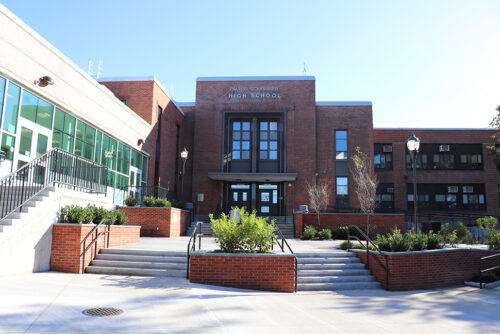
Oyster Bay-East Norwich School District residents will head to the polls on May 16 to consider the proposed 2006-2007 school year budget. District administrative staff and the board of education held the first of several public meetings on Feb. 4 at the high school library to educate the public on the proposed budget and to also show the hard work they did to produce a conservative package. The focus of the full day meeting was to gain public input. There were about 60 people in attendance.
Sydney Freifelder, interim assistant superintendent for business presented the recommendations from the school district. This was the first time the budget proposal was presented publicly. Ms. Freifelder gave about an hour-long PowerPoint presentation followed by a brief page-by-page explanation of each section of the budget and expressed that the proposed budget looks like any of the other 56 school budgets in Nassau County. She said, "The Uniform System of Accounts is what all New York State school districts use to create a line item budget. This standard process helps with auditing school districts." All attendees were given copies of the presentation and draft budget with the account codes so that they could follow the discussion.
After the presentation there were several hours of open discussion between the public, the school board, and district representatives. Each member of the public was given approximately three minutes to present questions and comments. There was also a question box where the public could put questions in if they did not want to speak or if they could not stay for the whole meeting. These questions and their answers will be posted over the next few weeks on the district website, which is www.obenschools.org.
The current budget for the 2005-2006 school year is $40,075,540. The proposed budget for the 2006-2007 school year is $41,700,392. This is an increase of 4.05 percent. There are approximately 1,650 students enrolled in the district. This number is not much higher than the 4 percent mandated when on an austerity budget. One resident questioned the small difference and whether or not it would matter if the budget passed. Ms. Freifelder along with the school board and District Superintendent Phyllis Harrington all expressed that going on austerity comes with strict guidelines from New York State that are so cumbersome that it makes sense to pass this conservative budget.
This will be an important year for the district to get out its message following a challenging year where the school district was on austerity after the budget failed twice.
Nassau BOCES was hired by the district to perform some public relations work that would help the district get this message out. BOCES will create palm cards, talking points, and a final brochure for the district. It will receive $5,000 for publicize the bond and $5,000 to publicize the budget.
After explaining the comprehensive effort by school district staff and administration to create the budget, Ms. Freifelder expressed that roughly 71 percent of the draft budget consists of salaries and benefits to staff, which is generated through collective bargaining with the unions. She also said that the school district works in partnership with many other school districts to receive a break on insurance through New York State. Ms. Freifelder said, "If this were an open market we would pay 20 percent more and this helps to collaboratively keep costs down."
According to Ms. Freifelder many other costs are mandates from the federal and state government and also facilities maintenance costs, including growing costs for oil and utilities. Some other unfunded mandates are "asbestos [abatement], playgrounds, and safety training, fire marshal inspections, and other required inspections." There are also some BOCES School fees that the district has to pay. Dr. Harrington said, "BOCES provides wonderful services, but we have to pay whether or not we use its services."
A new federal mandate this year is that the district has to provide special education services to students of private schools operating in the school district for those children that do not live within the school district boundaries. The schools mentioned were St. Dominic Elementary School, St. Dominic High School, and the East Woods School. Dr. Harrington explained a scenario where a student lives in Syosset, but attends East Woods School. The district would be able to bill the Syosset School District for auxiliary expenses, but not administrative costs or salaries of teachers and other necessary staff, which are the greatest costs to the program. Two new special education teachers will be hired this coming year for this reason due to an increase in students because of the new mandate. There will be approximately 65 new students in the special education program next year. Dr. Harrington said, "I understand that special education costs have increased by 12 percent, but it is out of our hands. I can guarantee that our staff is very competent."
Ms. Freifelder and Dr. Harrington mentioned several times throughout the hearing that all staff and board members were asked to hold the line on expenses and to look seriously at what resources were truly needed before making requests to the 2006-2007 budget process. Everyone was asked to take a sincere look at "salaries, supplies, materials, desks, equipment, and services and to make only necessary requests." Dr. Harrington also said that teachers were asked to really go through their closets to find supplies that could be used again next year before requesting new ones.
The school district raises the funds for the mandates, salaries, and benefits, through the general tax levy. As a public entity the school district cannot seek revenue generating programs. The proposed increase to the general tax levy is 4.74 percent. The average assessed value of a home in the school district is $854,000 this year. Ms. Freifelder used this value to explain how this would affect individual homeowners, but expressed that the formula for assessing homes will be decreasing over the next few years so this figure could change. The estimated Class 1 tax rate for next year is $7.63 per $100 of assessed valuation. If this rate holds true the estimated yearly tax increase for next year would be $326 or $6.26/week or $.89/day. There are no increases for capital improvement funds this year. There has not been any figure for this since the 2004-2005 school year. School Board President James Smiros said that they "can't afford to budget light and still make capital improvements, but at some point the figure will be brought back or the buildings will fall apart."
Some programs that were added back into the school programs for the 2006-2007 school year are: PSAT and SAT courses, overnight trips, study abroad programs, intramurals, and club activities. Quite a few parents were very happy to see the SAT program in the budget. There was some discussion about splitting the seventh and eighth grade indoor sports into two separate teams for each sport. It appears that girls' volleyball is the only sport that has enough kids truly qualified for both team levels. One parent expressed that this is the age where most children are introduced to indoor sports for the first time and that this helps find athletes to play indoor sports such as basketball at the high school level and beyond. Several board members expressed that competitive teams are the goal and that the athletic policy explaining the seventh and eighth grade program can be found on the district website.
There was some contention among the audience about not reinstating driver's education and some of the summer programs. Driver's education was not offered last year under the austerity budget and is not slated to be brought back again for the 2006-2007 school year. Some audience members created scenarios whereby a drivers education program could pay for itself or generate revenue for other programs. The audience was reminded that as a public entity the school district cannot seek revenue generating programs, but did not explain how it can accept commissions from vending machines in the cafeteria. There was also some debate about what types of intramural and club activities should be brought back next year. One parent with support of several other parents asked that each activity be analyzed before they are brought back to existence.
There was no discussion about not bringing back night adult education courses. Two other summer programs that parents would like reinstated are literacy and band. A number of parents requested that the $50,000 summer literacy program be brought back. They said they have seen substantial growth in their children who attended the program in the past. One parent expressed that summer band usually has students from private schools attending and that it is a nice way to showcase our schools to others.
Some parents would like to see more teachers hired for elective courses so that their children can compete better for college placement. Currently, students are assigned to more study halls than usual. It was requested that many study halls be replaced with electives that would boost a grade point average and show college admissions offices more diversity in the types of courses that the applicant has taken.
A new budget line was added to enter into a five-year lease at a cost of $150,000 per year to replace outdated computers. Ms. Freifelder explained that the below market lease is a way that large computer companies give back to schools and that the fee is only a small part of the costs incurred by the computer companies. Several members of the public asked that instead of spending the money on the computer lease that the district look into providing better and more computer instruction to students.
Currently, there is no longer a keyboard instruction class offered. The district staff periodically re-evaluates reinstating the program. If revived it was not clear how or what grade to implement it in. Kevin Wessel, a freshman at Hofstra University, who has a sister in 11th grade and a brother in eighth grade at the high school, expressed that he went to a private high school where he received comprehensive computer training and feels frustrated that his siblings and peers in college do not have solid computer skills to succeed in college and in life.
The next public meeting will be held on Feb. 28 in the library at Oyster Bay High School at 8 p.m. The purpose of this meeting will be to review public comments and any changes made since the Feb. 4 meeting. There will also be greater discussion about what items are being put back in or taken out of the budget and better figures on the bond will be revealed.