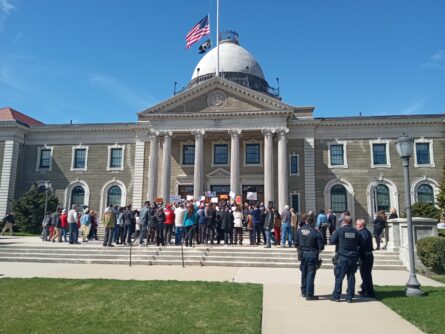
Marching behind the Oyster Bay Preservation Group (OBPG) banner in the American Legion Independence Day parade was appropriate for people concerned with what has been happening in the village. The OBPG was formed in May of 1990 in response to the growing threat of demolition and change to the historic hamlet of Oyster Bay. It hoped to keep Oyster Bay's heritage alive.
The marchers are planning a meeting, possibly at the Oyster Bay Community Center where residents can thrash out what has been happening, in hopes of getting the Town of Oyster Bay to hold a moratorium on the Zoning Board of Appeals granting variances. Developers are pushing the legal limits of existing zoning laws and changing the look of the historic hamlet. What is happening is visible on Kellogg Street, Summers Street and Burtis Avenue as houses are being demolished and new ones put up.
Charles Doering, a Kellogg Street homeowner said, "They are ruining my block, which was one of the nicest blocks in Oyster Bay. The Town of Oyster Bay has to start enforcing the existing laws. They don't have to 'rollover and play dead' when someone wants a variance. The town has to enforce its laws. Large houses are being built with three-foot side yards, which is legal, but with the size of the new homes it no longer looks adequate. This town needs an architectural review board to see the effect on the hamlet of what the existing laws can be pushed to allow," he said.
Mr. Doering said, "The brokers are selling property to people out of the area and they have no sense of the historic nature of the hamlet. That beautiful two-family house on Kellogg Street is going. No one builds that type of house anymore. It has a barn in the back, just like Wilbur Youngs house had a barn in the back. I wanted to buy the Tom Denley house at 89 Kellogg Street the week before he died. I wanted to put additions on the side of the house to make it a little larger but I would have kept the charm, and I never would have taken down the Norway maple and the Dogwood trees. This is slash and burn building. There are no creative solutions to keep the historic nature of the homes."
A good example of what can be done, using the Town of Oyster Bay's Landmark law happened in Locust Valley recently. The Town of Oyster Bay Landmarks Preservation Commission gave permission for a landmark house on Buckram Avenue, next to the railroad bridge, to maintain the original house, but build a very large addition behind it. The landmark law allows change to occur, it just tries to keep the landmark house intact as a reminder of the historic nature of this community.
Oyster Bay resident Rita Pecora read a letter to the zoning board at the hearing on June 23 expressing her grave concern for this hamlet. She said, "At this time, approvals are before you for #46 Park Avenue where, again, a new, oversized house will be jammed onto a smaller substandard lot. There is another house on Summers Street that is presently being torn down, and rumor has it that a local builder has approvals for two new over-sized homes. Number 89 Kellogg Street, a little charming oldie, has been sold and is to be replaced by a 4,800 square foot new construction. Rumor has it that the house located next door, #93/95 Kellogg, a beautiful side by side duplex home, has been purchased, is going to be torn down for who knows how many new homes. Take a drive by these two properties and see if you have any feelings about giving this your blessing ... lovely older homes being gone forever."
In their letter to the editor, copies of which they have presented to Oyster Bay Town Officials, Benjamin Jankowski and Kathryn A. Prinz said, "As residents of this community, we are calling upon you to stop the madness of residential subdivision and the destruction of charming old homes by the town zoning board, which is not taking into account the wishes of our community at large. There are many of us who feel this way, and we want our voices to be heard too. We ask for a moratorium to halt all subdivision and future residential construction until these issues can be addressed. If this does not stop now, we will continue to lose historic Oyster Bay, one house and one great tree at a time."
Mr. Jankowski and his wife Kathryn Prinz and Rita Pecora are organizing the meeting to discuss the issues they have brought up. They will shortly announce the date, time and location of the meeting. In the meantime they have been talking to elected officials about the parameters of the problem. Mr. Jankowski spoke to Charla Bolton, Preservation Advocate for the Society For the Preservation of Long Island Antiquities.
Bob MacKay, director of the Society For the Preservation of Long Island Antiquities said, "Tourism is Long Island's number two industry and increasingly, people are interested in heritage tourism and Oyster Bay is certainly dripping in history and maintaining that historic character and ambiance is a great way to continue to make the hamlet vibrant commercially and a great place to live."
He said, "You often see at the village level, the architectural review board combined with the landmark board working together. This week the New York State Heritage Areas are meeting upstate, and here in historic Oyster Bay, with a great deal more to blow its bugle about than a lot of communities, it is time people woke up and took advantage of it. We know the architecture definitely provides the sense of place that everyone feels in Oyster Bay. It is eroding through lack of controls."
Mr. MacKay said the importance of preserving architectural history is spreading. "In the town of Brookhaven we landmarked four historic homes. They did their first African-American historic district with a group of houses in Setauket. Roslyn Harbor is having a moratorium. Bellport has a new landmark preservation ordinance. The landmark rolls are spreading and it is good to see Oyster Bay focus on this. The Town of North Hempstead has received Certified Local Government status." The CLG status opens the door for federal funds for preservation. These grants provide funding for historic resource surveys, public education programs, design guidelines, and local preservation plans.
Mr. MacKay said, "There is so much worth preserving in Oyster Bay and so much to capitalize on, it's hard to understand why the town's progress has been glacial. Complicating all this is the lack of home rule for the hamlet. Cold Spring Harbor has a movement to incorporate. Their civic association is working on it."
Right on target, Mr. Doering said, "People are sleeping in Oyster Bay and not waking up to what is going on around them. We need a mayor, we need self government. This place is going to be history in another year and a half. It is not going to be historically pleasant. Several years ago Oyster Bay was recognized as a great little town that needed a little help. Now every piece of open space available is being taken up," he said. "Something has to be done."
In announcing the formation of the Oyster Bay Preservation Group in May of 1992, Stuart Chase, then director of Raynham Hall Museum said that the OBPG would focus on three areas related to local historic preservation: advocacy for preservation; awards for preservation efforts; markers for historic sites and buildings. The group was a joint venture of the Friends of Raynham Hall, Inc. and the Oyster Bay Historical Society.
Their purpose was to educate the public of the importance of historic preservation in the village of Oyster Bay, through increased awareness and special activities. Laurie Kunkel, the local representative for the New York State Office of Historic Preservation visited Oyster Bay and made a photographic record of the architecture in the hamlet. She praised the residential area for preserving so many fine examples of architecture in the local streets.
The group celebrated National Preservation Week with special programs. They presented historic markers to the Visiting Nurse Association on South Street, the Matinecock Masons, the Townsend & Winslow House and The Printery when they began the program. At their May 13, 1992 meeting Lloyd Adams, the assistant counsel for Historic Preservation with the New York State Office of Parks, Recreation & Historic Preservation, came from Albany to talk on "Landmark Designation: What Does It mean?"
The Oyster Bay Historical Society (OBHS) held a public forum to take the cobwebs off the concept of preservation . It was presented at the opening of their series on architectural preservation on Nov. 20. The panel discussion proved that the public has large gaps in their understanding of both landmarking and preservation and the OBHS and Friends of Raynham Hall Museum said they would plan another forum to present those concepts to the public, but a date has not been set for that event as yet.
Tom Kuehhas, director of the Oyster Bay Historical Society has been the official keeper of the OBPG banner. He was preparing signs for the Monday, July 4th march on Friday, July 1. He said John Collins, a longtime member of the Oyster Bay Landmarks Preservation Commission is going to march with the group.
Mr. Kuehhas, an Oyster Bay hamlet resident said "I think people are getting fed up with what is happening in the community with all the subdivisions being made. We chose to live in Oyster Bay for a reason and it's being eroded. What made Oyster Bay such a unique town is slowly disappearing and it is about time we all band together, make our voices heard and do something about it."