|
|
Immersat antenae for transmitting images back and forth by satelite.
|
By Dagmar Fors Karppi
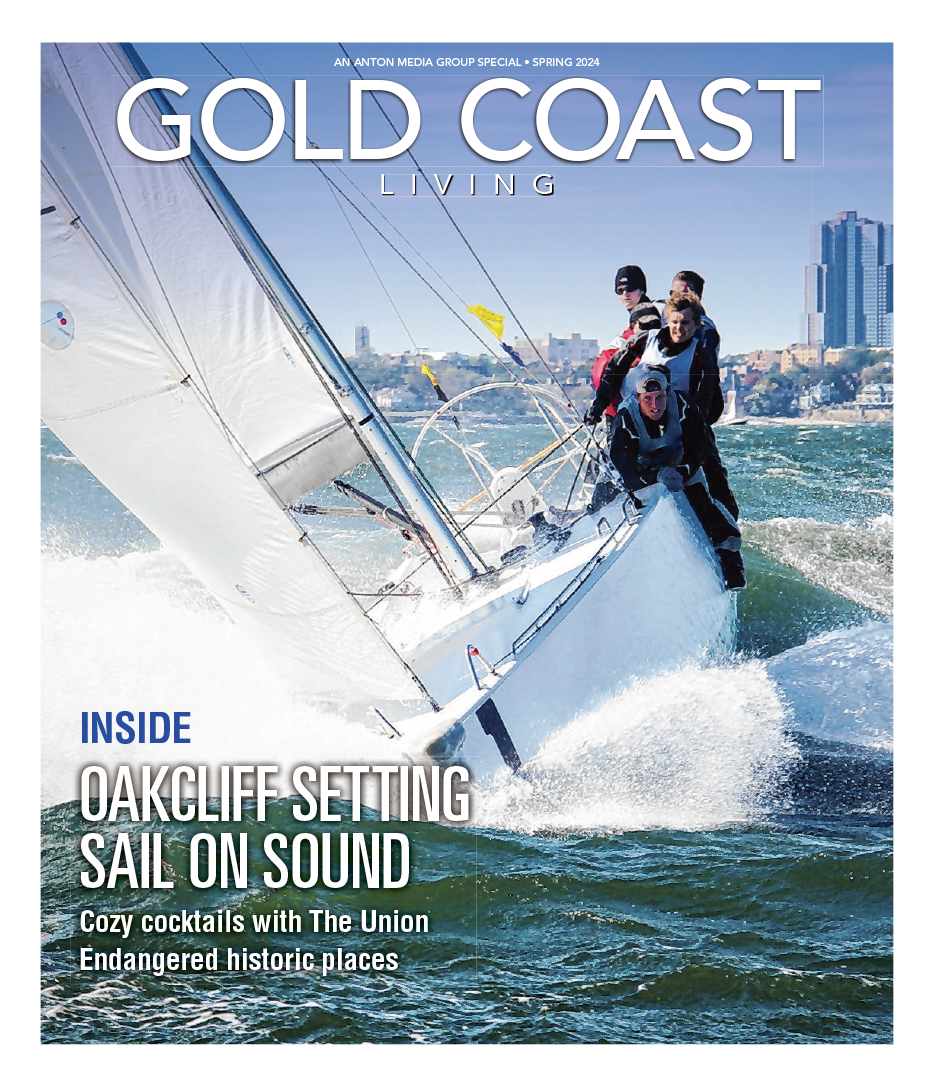
Oyster Bay was the crucial pit stop for Bernard Stamm who broke sailing's monohull trans-Atlantic record. The 37-year old Swiss was proud that he and his crew of three: Christophe Lebas, Jean Baptiste L'Olivier and François Scheeck were able to beat the record of a boat twice their size.
Bernard Stamm's Open 60 Armor Lux - Foie Gras Bizac broke the record for a crewed monohull on Feb. 7 as they passed Cape Lizard off southwest England that morning. The race is 2,924 miles.
The new record is eight days, 20 hours, 35 minutes and 35 seconds. The previous record was eight days, 23 hours, 59 minutes and was made by Robert Miller's 147-foot ketch Mari-Cha III, with a 22-man crew in October 1998.
Mr. Stamm utilized the facilities of the Oyster Bay Marine Center and staff in preparing his boat for his record setting run.
Úquot;He's a fantastic person and he set a fantastic record and he did it in the middle of winter,Úquot; said John McGrane. Úquot;He was told by other boaters who came here in 1997, to come to Oyster Bay and he would be taken care of really well. We do the sailboat rigging. Our facility has very deep water. Their boats draw a lot.Úquot;
Initially, Bernard Stamm was racing in the single handed around the world race called the Vendee Globe. Ten days into the Vendee Globe, Bernard's boat suffered major damage to his auto pilot and steering system and he withdrew from the race.
After repairing the systems in the Cape Verde Islands, the boat was moved to Guadeloupe and then to New York to prepare for the trans-Atlantic record attempt.
Bernard was referred to Oyster Bay by the crew of Christophe Auguin's Geodis a previous boat which broke the trans-Atlantic record in 1997.
Geodis and its crew also prepared for their attempt at the Oyster Bay Marine Center, and were very happy with the warm reception they received from the people of Oyster Bay and Bayville.
Prior to departure, Bernard Stamm was in constant contact with a meteorologist in France, looking for the best possible weather scenario for his attempt.
These conditions actually had to be through North Atlantic storms, whose winds would propel the boat to extreme speeds to meet their goal, said Mr. McGrane.
Before leaving, Bernard said he would need at least three days of consistently traveling at 18 knots. He actually got one day over 19 knots consistently. They have probably also broken the 24 hour record for distance traveled with a day's run of miles, said Mr. McGrane.
Bernard Stamm left Oyster Bay late Saturday night, Jan. 27, to the starting position at Ambrose light just outside New York harbor. They started Sunday, morning at 9:38 a.m. and finished off Cape Lizard, U.K. on Friday morning Feb. 2. Their time of eight days, 20 hours and 55 minutes and 35 seconds breaks Mari Char III's record by almost three hours.
Attempts at the trans-Atlantic record even in warmer times of the year are extremely dangerous. In 1998 the Italian boat Fila capsized while approaching Europe and one crew member was lost. Úquot;The skippers and crews are pushing themselves and their boats to extreme limits in these trans-Atlantic attempts,Úquot; said Mr. McGrane.
Bernard knew it would take something extra to beat Mari Chas III's record, hence his attempt in the middle of the winter when North Atlantic conditions are the windiest.
Bernard's boat Amor Lux-Foie Gras Bizac is an open 60 ft. class boat used in special long distance single handed races. Built in carbon fiber and having a special canting reel, the boat is one of the fastest monohull sailboats in the world.
The mast, hull, deck and fin for the keel are also made of carbon fiber. Úquot;It is an extremely expensive boat and extremely light, as a result,Úquot; said Mr. McGrane.
Úquot;Bernard truly deserved this conquest even in his statement to the press right after finshing, his great humility shines,Úquot; said Mr. McGrane. He only had praise for his crew, the volunteers who helped him build the boat, the designers of the boat, his sponsors and the volunteer support crew. Before leaving Oyster Bay even with his hurried schedule in preparing the boat, Bernard would stop and answer any questions passersby would have about his wild looking boat, said Mr. McGrane.
More information on Bernard and his boat can be viewed at www: bernard-stamm.com. It says Úquot;Mr. Stamm left the shores of Lake Geneva, where he was born, to land on the Brittany coast, to be close to the sea. Bernard Stamm is Swiss and can be understood in four languages (French, English, German and Italian). However the language he best understands is the language of the sea.Úquot; He has covered over 80,000 nautical miles in his career.
Úquot;Possibly his first job as lumberjack, gave him a natural resistance and exceptional determination: he must work and he only rests when he collapses. These qualities give him the necessary strength to go up to and beyond the edge,Úquot; according to his Internet site.
To view day by day charts and commentary of his trans-Atlantic run, go to the French version of the web site and click on Úquot;ActualitesÚquot;.
Mr. McGrane said they had someone translating for them. Úquot;It was incredible they were following his trip. Day to day they charted his position and there was a commentary, including live satelite photos of the ship. The story is on all the international sailing sites on the Internet.
Úquot;Its a very big thing in Europe,Úquot; said Mr. McGrane. Úquot;In France it's a big sport and in Europe they get big sponsorships that you don't get here.Úquot;