I would like to make a few comments in response to Mr. Clark's March 23, letter to the editor and Mr. Rizza's March 30, article "Does Mineola Get a Bad Rap?." I also want to invite Mr. Clark and Mr. Rizza and interested citizens to the board of education meeting on April 7, 8 p.m. in the Willis Avenue School cafeteria, where we will be discussing the results of the State tests.
Some of the points I would like to make are as follows:
One of the purposes of State assessments is to ensure that NYS Schools are accountable for meeting year-to-year goals for improving student learning and achievement in the content areas across the curriculum from elementary to high school. In Mineola, we have also been assessing students during "off years" and our plan for continued improvement involves assessing the progress of the same students over time. The State assessments compare growth among different groups of students.
* The recently published results represent the 2003-2004 school year.
* With the exception of our eighth grade special education students in Language Arts, all of our students met and in most cases well exceeded the State standards.
* The district is committed to reducing the performance gap among our general education, special education and ESL students. Starting with the 2003-2004 school year, each building advanced plans for improving student achievement for all students and those students most at risk. Each building has met and exceeded their goals for improvement.
Studies on the characteristics of students who perform well on State tests have several common traits. Aside from the findings that students from suburban and homogeneous communities test higher than other groups, the number one finding is that students who perform well on State tests are good readers. From our information, it is clear, historically and today, that we have a portion of our population with difficulty in reading and language development. In the past 2 - 3 years the district has been proactive in attempting to correct this.
1. After a year researching our reading and language needs, the district has implemented a comprehensive Pre-k - 6 reading program that builds skills through literature aligned to the NYS Learning Standards. The 2004-2005 school year is the first time in which all of our buildings are aligned in reading, writing and language and accompanied by staff development. I am confident that many of our parents are seeing a different type of student work from their children.
2. With the exception of the 8th grade ELA and Math, and to a certain degree, our fourth grade ELA, our student performance is on target. Nevertheless, in all but a few cases, most of our students have advanced from level 1 to level 2, low level 2 to high level 2 and from levels 2 and 3 to levels 3 and 4. This information is not reported in the Report Cards. As we plan for providing developmental reading and our new reading program takes "hold," the State test results will improve.
I appreciate Mr. Rizza's article focusing on the difficulties of balancing "statistics" with year-to-year performance of unlike groups in the context of improving schools. I also appreciate Mr. Clark's concern that we should be doing better given the resources we have. However, the context for improvement focuses on each student meeting their individual goals for improvement. On a step by step basis we will see the kind of growth people expect from the school system. There is no magic wand that will improve reading overnight.
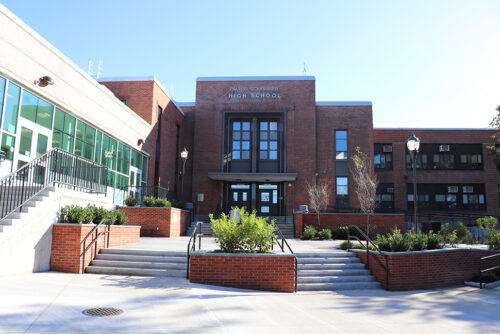
The use of "cohort" data is very confusing because of the many factors that can influence the percentage that is used over a 4 year period. A fact about our high school is that we provide a rigorous and balanced educational program where recent graduates are now attending universities such as Harvard, Princeton, New York University, Carnegie Mellon, Syracuse, University of Pennsylvania, RPI, and Fordham. Finally, our success rate of students attending two year colleges or entering the work force in career oriented positions will be assessed as part of our overall improvement plan.
The overall quality of a school system is more than State test scores. Our students have excelled on our playing fields and performing stages with many of our teams and individual students being recognized by the County and State for exemplary performance. The structure of district programs, guided by faculty, enables many students to give back to their community in terms of service and to those in need. From our K-Kids to our Student Service Center, coupled with each building's approach to community service, our district is an excellent example for neighborhood schools and communities. The diversity in our community and schools makes the learning experience all the more powerful and pertinent for all students.
At the end of the day, I am very proud of our students' work and performance. They have met the goals for improvement set by their teachers and by the state of New York. I stand by my administrators and teachers in deep appreciation of their commitment and dedication to advance a stronger school system for the sole purpose of serving our students.
Very truly yours,
Lorenzo Licopoli, Ph.D.
Superintendent of Schools