The tenure of Jack M. Martins has not been a quiet one. In fact, it has been one filled with tough decisions. From the time he became mayor in 2003, Martins found himself immediately having to put the village on the right path to fiscal stability and while doing so, made other changes that have affected village government.
|
|
Mayor Jack M. Martins recognizes John DaVanzo at the American Legion Mineola Memorial Post #349 installation dinner on Friday night as Commander Sal Cataldo looks on.
|
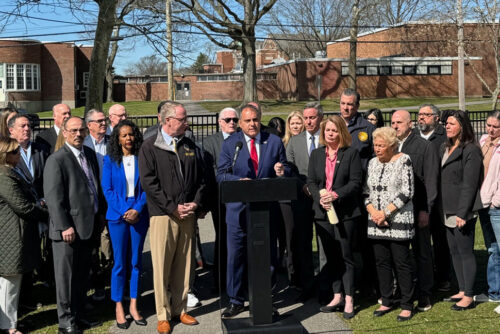
On Tuesday, Sept. 21, the Mineola Chamber of Commerce sponsored the mayor's state-of-the-village address in which Mayor Martins updated village residents and businesses on finances, the village's infrastructure, public safety and economic development.
During Mayor Martins' tenure, much has been made about open government. One of his main goals as mayor was making government more accessible to the residents of Mineola.
Upon becoming mayor, Martins immediately started holding village work sessions, which are sessions held before public meetings and hearings to conduct village business out in the public meeting room in front of residents. They had been held in a conference room in village hall.
Mayor Martins then began taking advantage of the village's television equipment that was given to the village as part of the franchise agreement. Meetings began being televised on Channel 18.
Mayor Martins also pledged a website and a bimonthly village newsletter, which he delivered on.
A major part of the Martins' administration thus far has been dealing with the village's fiscal situation. During his address, the mayor pointed out that in April 2003, when he took office, the village had a debt of almost $33 million, $20 million of which was in short-term debt that had to be converted to long-term bonds. The mayor's 2003-2004 budget included a provision to convert all of the village's short-term debt into long-term bonds to lock in a low interest rate on all of the debt. "It's like having an introductory rate on your credit cards and having the rate expire. In our case, the rate was expiring on $20 million of the $33 million and we had to brace for the higher rate. We went to Moody's and were able to refinance the $20 million and secure the lowest rate in village history," he said.
The mayor also pointed out that it wasn't just the debt the village had to get a handle on. The village, he said, has a $1 million operating budget deficit from the previous budget year (2002-2003) and the village budget was structurally unsound. "The village had gotten into a habit of borrowing money to pay for non-capital, everyday expenses...The reality is that not only does all of that borrowing have to be paid back, it has to be paid back with interest," the mayor said, adding that in 1993, the village's total debt was $3 million whereas in 2003, it was close to $33 million. As a result, according to Mayor Martins, 25 percent of a village property tax bill goes to paying the debt.
One of Mayor Martins' most important initiatives was putting on end to long-term borrowing. The village board and the mayor voted for a debt management plan that eliminated borrowing as a option to pay for every day expenses. "We went a full year without borrowing anything at all. In fact, as of today, the village's total bond indebtedness is already below $30 million," he said. "I am in no way advocating paying for capital items in cash. What I am advocating is that everyday items be paid from our budget, that we show fiscal restraint and responsibility by not taking on projects that have not been budgeted," he said. "Through careful fiscal practices, we have broken the village's cycle of unhealthy reliance on borrowing to pay for everyday expenses."
According to the mayor, the village has cut overtime by over 2,000 hours and more than doubled the interest the village receives on deposits. Mayor Martins also reported that as of May 31, 2004, the end of the village's 2003-2004 fiscal year, the village had a positive fund balance of $341,000.
In his state-of-the-village address, Mayor Martins also spoke about economic development. He acknowledged that there are pressures facing the budget from things such as labor negotiations, tax certioraris, rising health insurance costs and state mandated pension contributions.
Mayor Martins said the challenge will be to come up with ways of increasing revenues without relying simply on village property taxes.
Mayor Martins said the village is working with Congresswoman Carolyn McCarthy, Senator Michael Balboni, Assemblywoman Maureen O'Connell, Assemblywoman Tom DiNapoli, County Executive Tom Suozzi, County Legislator Richard Nicolello and Supervisor Jon Kaiman in hopes of obtaining a fair share of available government grants.
The mayor also reached out to the public for ideas in coming up with alternatives to raising revenue streams so that the village can continue to have its services without putting an additional burden on taxpayers.
The village has committed and continues to commit significant resources to the Downtown Revitalization Project, Mayor Martins said.
The village has obtained streetscape improvements on Jericho Turnpike, between Willis Avenue and Mineola Boulevard. The project is set to start in the spring and will provide brick pavers, benches, trees and improved lighting in the areas consistent with prior improvements done in the downtown area.
Mayor Martins also expressed satisfaction in the completion of the Mineola Boulevard Bridge and thanked Senator Balboni for his efforts on the bridge and the downtown area.
Mayor Martins also spoke about future projects. One project on the horizon is the Roslyn Road Grade Crossing Elimination Project, which is set to begin in early 2005. The project is scheduled to take approximately 18 months and will result in the village acquiring a new parking field at Roslyn Road and Second Street for approximately 70 vehicles and one on Second Street just east of Main Street for approximately 100 vehicles.
The MTA-sponsored intermodal center, a 1,000 car parking garage and bus depot to be located near the Mineola train station, is scheduled to begin in spring 2005.
Mayor Martins complimented the efforts of the water department and the water system, which provides water from five wells, each of which collects water from over 400 feet below the surface.
One thing the mayor did address about the village is some of its roads have become dilapidated and badly in need of repaving. Mayor Martins said the village has enough money budgeted to resurface one mile of road per year. The village is comprised of 36 miles of road. Mayor Martins said a challenge will be to address road repairs while continuing to pay down the village's debt.
Mayor Martins said the eradication of illegal housing would continue to be a focal point for his administration. During the last year, the village's building department issued hundreds of violations for illegal housing, which were prosecuted and resulted in the elimination of illegal apartments throughout the village, the mayor said.
Mayor Martins also pointed out that during his first year in office, the building department processed nearly 900 building permits with an estimated cost of construction of $13.5 million, which is an investment in the village.
Mayor Martins also thanked the members of the village staff, all of the volunteers who help keep the village safe, the trustees - Deputy Mayor Larry Werther and trustees Lou Santosus, Linda Fairgrieve and Paul Cusato - as well as all those who serve on the village's committees and commissions for their hard work and support. He also thanked the citizens of Mineola for making the community one of opportunity and cooperation. "We can overcome any obstacle and accomplish any goal," he said.