News Sports Opinion Obituaries Contents
News

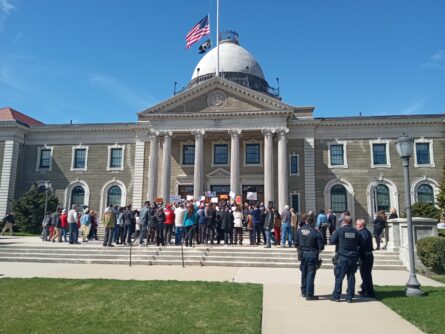
Verizon Wireless, a popular cellular phone service company, has submitted an application to the Village of Mineola for the purposes of erecting nine four-foot high cell phone antennas on top of a 91-foot high Long Island Power Authority (LIPA) utility tower located in the village at the intersection of Betty Lane and Arlington Road. Many of the residents who attended last Wednesday's public hearing on the application expressed concerns and reservations, citing health and safety issues as well as what the project might mean to property values.

Representatives from Verizon feel placing antennas at the location will eliminate what they term as a service efficiency gap. In order to eliminate this deficiency gap the antennas would be installed giving Verizon users a continuous flow of service in the area.

Verizon feels the LIPA tower is an ideal location because it is zoned in a non-residential area and does not require a cell phone tower to be built since the LIPA tower already exists. "Placing antennas at this tower at the height that is proposed will allow Verizon to eliminate the service deficiency gap," said Verizon attorney Alfred Amato.

It was explained that cell phone towers must be placed at different distances for continuous communication. Verizon customers in that gap, which includes a portion of Mineola, either experience interference or a loss of service, the company believes. If the plan is approved and Verizon installs the antennas, the company believes a lesser deficiency gap would exist east of the Village of Mineola.

In addition to the antennas, Verizon's plan also calls for a fenced in compound of 20 feet by 38 feet to house a 12-foot high equipment shelter, which would be checked by a technician once every four to six weeks, as well as a gas generator and batteries in the event of power outages and surges. The generator would be remotely monitored 24 hours a day, seven days a week.

Several experts testified on behalf of Verizon as to the safety and impact on the community the antennas would have. Verizon's experts testified that the antennas would not affect the aesthetic look of the community nor would they affect property values. However, the biggest question concerning the residents present at the hearing was that of health and safety.

Since a question remains about whether waves emitted from cell phones are, in fact, safe, several residents expressed uneasiness about living next to tower with cell phone antennas attached to it.

Lou Cornaccia, who has worked in the wireless industry for the past 12 years, testified on Verizon's behalf that the proposed installation of the nine dual ban antennas pose no danger to the residential area that is adjacent to the LIPA tower. However, the analysis of emission levels taken to determine that the antennas are safe was only based on theory. According to Amato, there is a way to test for emission levels from the antennas, but only after they are installed.

Cornaccia said, though, that the emission levels produced in the theoretical analysis are 10 to 100 times greater than the actual emission levels would be.

Several residents, however, were not convinced as they expressed concerns having to do with additional wave emissions from the antennas and what effect they may have on the welfare and health of those living near the town if the antennas were to be installed.

It was made clear during the hearing, though, that the village board was precluded from denying the application based on the regulation of environmental effects of the radio frequency emissions from telecommunications facilities as well as the regulation of radio signal interference of the users of the radio frequency spectrum since the Federal Communications Commission (FCC) has jurisdiction over both instances.

"The board is quite aware that its decision cannot be based on either of these two factors," said village attorney John Spellman.

From Verizon's perspective, the company feels it is taking advantage of an existing LIPA tower in a commercially-zoned area to better serve its customers without endangering residents of the surrounding area or affecting real property values.

However, some of the residents of the surrounding area don't see it that way. It is the fear of what is not yet known about a relatively new technology that has residents concerned.

Walter Crosby of Maple Place, a 40-year resident of the village, said he has watched a number of neighbors succumb to cancer over the years. "I can't say it's from antennas. I can't say it's from emissions, but we don't need this in our neighborhood," he said.

One Mineola resident who is a single parent of three children pointed out that Verizon and LIPA stand to gain monetarily by the project. "But what is the community gaining other than possible danger to our children?" she asked.

The most interesting exchange of the evening, however, came when Deputy Mayor Lou Santosus asked why the antennas couldn't be installed on a LIPA tower located on the Wheatley Hills Golf Course instead of next to a residential area. Site locater John Gomez of Verizon answered by saying that Verizon had approached the golf course. However, Gomez said the golf course wasn't interested. Santosus responded by saying, "neither are we."

Village of Mineola Mayor John P. Colbert felt uneasy that Verizon could not reveal how many sites exist in the Mineola area with antennas that the company uses to form its network for continuous phone service. The facilities surrounding the proposed site, which the proposed antennas would communicate with, are located in Carle Place and at an office building on Old Country Road in Mineola. However, Amato was uncertain if there were any other locations with antennas in Mineola.

Verizon also declined to reveal how many complaints the company has received from customers within the gap of deficiency or how much money would be paid LIPA for the use of the tower.

Mayor Colbert was also concerned about increasing waves in the area of the antennas. The mayor was told by Natalie Noel, an electrical engineer for Verizon, that waves would be increased by a one-mile diameter around the site of the antennas or a half-mile in every direction from the site. Amato said, however, that the frequency waves in the area as a result of the installation of the antennas would still be below FCC regulations. Cornaccia reiterated that the waves emitted from the antennas are safe, saying that they are less intense than those emitted from household items such as microwave ovens, cordless phones or baby monitors.

Mayor Colbert said the village would reserve the decision on the application. The village plans to retain its own professional consultation to analyze the proposed installation of the antennas with the cost being passed on to Verizon. At the March 7 public meeting, the board plans to announce when the hearing will be reconvened.


LongIsland.com Logo
An Official Newspaper of the
LongIsland.Com Internet Community


| antonnews.com home | Email the Mineola American|
Copyright ©2001 Anton Community Newspapers, Inc.
All Rights Reserved.

LinkExchange
LinkExchange Member

Farmingdale Observer Floral Park Dispatch Garden City Life Glen Cove Record Pilot Great Neck Record Hicksville Illustrated News Levittown Tribune Manhasset Press Massapequan Observer Mineola American New Hyde Park Illustrated News Oyster Bay Enterprise Pilot Plainview Herald Port Washington News Roslyn News Syosset Jericho Tribune Three Village Times Westbury Times Boulevard Magazine Features Calendar Search Add An Event Classified Contacting Anton News