By Jessica DeStefano
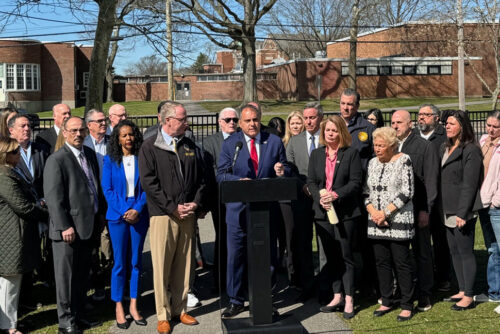
Residents showed up in record numbers May 6 to meet the five candidates seeking to fill three positions on the Massapequa School Board. "Meet the Candidates Night," hosted by the PTA and mediated by the League of Women Voters, was successful in aiding community members in making an informed decision when they head to the polls May 21.
Below are excerpts from the candidates' biographies, together with answers to some of the community's most compelling questions.
Thomas Joachim has been a resident of Massapequa for 26 years. He has one child currently in high school, and one who is a high school graduate. He earned a BA from Iona College in 1963 and an MBA from Adelphi University in 1978. He has worked as a substitute teacher in the New York City school system, an auditor for various international and domestic banks, and a compliance officer for foreign international banks. He has sat on the board of directors for the Massapequa International Little League for the past nine years, and was president for the past six.
Joachim's educational philosophy is that every child should have equal opportunity to obtain a good education. During times of fiscal constraint he would consider educational programs, especially in math and science, essential. If forced to consolidate, he would consider only non- educational programs. He supports the district's proposed budget.
"I am analytical, open-minded, fair and able to make good business decisions," Joachim stated. "My dedication, hard work and honesty are quality assets that I can contribute to the board."
Joachim's stance with regard to teacher's salaries is, "To keep the teachers happy, to have good education, you have to pay. Sometimes you have to give a little to get the best." He sees the most important issue facing the district is to prepare young children to go out into the world. "It is important they get a quality education."
However, Joachim also stressed increased accountability throughout the district. "We need accountability across the board for every single professional person in the Massapequa district," Joachim said. He also encouraged stricter teacher evaluations. "When you have a class of 25 kids and half are failing, I don't think the kids are stupid. You have to ask the question, is the teacher prepared to present the curriculum to the kids, and if not, why not? That is an issue that seems to be going by the board."
Paul Dashefsky has been a resident of Massapequa for 45 years. He has one child who is currently a high school student, and one who is a high school graduate. Dashefsky earned a BA from Columbia University in 1976, graduated from the University at San Francisco School of Law in 1979. He is an attorney in private practice specializing in labor and employment law. He was formerly an attorney with the NYC Board of Education. Dashefsky served as trustee, vice president and president of Temple Beth Shalom. He also coached Massapequa Coast Little League.
Dashefsky's educational philosophy is to provide every possible and reasonable opportunity for youth to excel in education, and to provide a foundation for goals after high school. During times of fiscal constraint he would still aim to maintain high levels of classroom offerings and instruction. He would look to consolidate through the use of electronics and shared media. As an experienced labor attorney who has represented school districts, Dashefsky claims to be "...in a good position to evaluate proposals and programs from central administration and to decipher vague and misleading proposals and reports." He supports the proposed budget.
Regarding teacher salary, Dashefsky thinks teachers should be paid a proper and fair salary. "It's a shame that teachers are in the bottom of most of the salary steps. There are a lot creative ways to cut the health insurance burden for everybody, there are ways to keep costs down and still make it a fair contract for everyone."
Dashefsky claimed to be a proponent of open government. "Where is our money going?" is a question he repeatedly raised. "Our tax rate is close to the county average, per pupil expenditure is below the county average, and yet our teachers are mostly at the bottom of the county. Where is the money being spent? Is it going to central administration? Is it going to landscaping? Is it going to beautification projects? I believe that money belongs in the classroom with the students and teachers."
The major problem he sees facing the district is the population outgrowing the facilities. He suggested that the school board did not use the proper foresight when deciding to open the Ames Center for ninth-graders three years ago. "What they should have projected back then was that in three years the population would outgrow the facility, so whatever millions of dollars were spent to retrofit that school, now they will have to spend even more money to make it a sixth-grade center, or something to that effect. We can't have central administration hiding facts, giving misleading facts. We rely upon their judgement."
Scott Brown has been a resident of Massapequa for three years. He has two children in Massapequa elementary school. Brown earned an A.A.S from Nassau Community College in 1983, a BS from the New York Institute of Technology in 1986, and an MS from New York Institute of Technology in 1990. He has been an engineer for NY Power Authority for thirteen years, a Cubmaster for Cub Scout Pack Number Five, and is currently a manager in the Massapequa Coast Little League Rookies Division. Brown has also been a mentor to a middle school student at Joan of Arc Public School in Manhattan as part of the NYS mentoring program.
Brown's educational philosophy is to strongly promote and encourage active student-teacher involvement, which supports the student to learn and develop at his or her own pace. "Teaching the student is more than just K-12. It is about instilling a love for education so that the student wants to keep learning after school and throughout his/her life."
During times of fiscal constraint, Brown would cut programs not aimed at the direct education level. School busing, school lunches and afterschool programs would all be targeted. "I would form a small committee of parents, school board members and staff to develop proposals relating to consolidation."
Brown feels that by having attended a small private high school, he was made aware of the benefits of having a small class size. "By combining the best ideas from a private school, with enhanced public school activities, such as music, art, athletics and special needs, this is the contribution I hope to bring. In achieving this, each student will feel special." Brown supports the proposed budget.
Brown said that teachers' salaries "...are one of those things where it depends on what side of the fence you are sitting on." If elected to the school board, he claims he will fight for proper education, and the best teachers the district can get. "I don't want to overpay them, but I don't want to underpay them. I also want to look at how many teachers are leaving because the salary is not high enough."
Brown sees apathy of some parents in Massapequa as a big problem, and he said he would try to increase parent involvement if elected to the board. Growing enrollment and increased reliance on new technology were other challenges he saw as facing the Massapequa District.
Christine Perrino has been a resident of Massapequa for 15 years and has two elementary school kids, and one pre-schooler currently in the district. She earned a B.B.A. from Pace University in 1986, and has a background in sales and marketing, with 13 years of experience as a representative/manager in fashion industry. She has sat on the executive board of Young People's Cultural Arts Workshop of Massapequa since 1995, and has been a treasurer since 1998. She is an active member of RJ Lockhart PTA, and treasurer for the past two years. She currently holds the budget council seat for Massapequa PTA.
Her educational philosophy is that all children have the ability to learn and should be challenged to reach their utmost potential. She believes that during times of fiscal constraint, all of the ongoing curriculum initiatives are essential to maintaining the current level of education in the district, including the arts. She would look for greater insight before deciding how a consolidation in any program would impact students.
"With my own children attending district schools, I can contribute a parent's perspective on our ongoing educational programs. This perspective coupled with my long-term business experience in sales/marketing in NYC will assist me in being an effective board member." She supports the proposed budget.
Regarding teacher salaries, Perrino believes in compensating teachers for their commitment and still keeping in mind what the community can afford to pay. "The price of health insurance is skyrocketing," she said. "We need to really look at the increase in cost and work more closely with the teachers to find a long term solution to this issue." The primary problem she sees affecting the district is space constraints. "We need more information as far as exactly what programs we want to go forward with before we make the decision of how we are to combat space restraints. Along with that comes funding, it's going to cost money to make room for the children."
A challenge she saw facing the district is making sure all students meet the new NYS standards. "When the students leave the district, whether to go to a university or to begin their careers, they must leave with all the advantages that they will need to become adults in this workforce and contribute to our society the best way they can."
Richard Krebs has been a resident of Massapequa for 21 years. He has one child who is a high school graduate. Krebs earned a BS in human resource management from the University of New England. For the past two years, he has worked as the assistant director of Youth Programs for Suffolk County Department of Labor. He is currently a representative to County Youth Bureau, a BOCES advisory board member, and a representative to the Long Island School to Career partnership.
Krebs' community activities include a 12-year membership in the PTA, school board trustee '94-'97, former cubmaster, chairperson of PTA Council Budget Committee, and former Little League coach. He also served on numerous school board committees. His educational philosophy is that all students are entitled to reach their full educational potential. "To build a vision of the future, our district must develop a shared understanding of the need for change, along with a shared vision, both of which require ownership. The community, educational and support staff and the students need to share together in discussions about where we'd like to be in five years, 10 years and beyond."
In times of fiscal constraint, Krebs stated any new program that may be proposed by administration, unless state mandated, would have to be weighed and compared to the costs incurred in running the program. To consolidate, he would consider sharing some services with other districts, as was done in the past.
Krebs has attended at least 95 percent of all school board meetings for the past 10 years. "I am well aware of the issues the district faces year to year. I am an experienced trustee. I have been an active member of the community and a 12 year member of PTA." He supports the district's proposed budget.
With regard to teachers' salaries, Krebs said, "The cafeteria plan has been offered in Massapequa for years and teachers don't all pay the same toward health insurance. The thing that is important to realize is that in contract negotiations, it's not just about salary and benefits--there are a lot more issues included there. I am not privy to what is going on in the current negotiations, and I think it is something where you really need to look at the whole picture."
Krebs sees students' futures as a major challenge facing the district. "Eighty-five percent of the students in kindergarten will be working in jobs that don't exist today. It was shocking to realize that the way people work will greatly vary in the next 16 years." One problem the district is facing, according to Krebs, is the lack of state funding for some of its mandated programs. "I also think a problem in Massapequa is the lack of parent participation in the education of their children. Sure the overcrowding is an issue, and it is something the board has addressed, it is not something that has come upon us overnight."