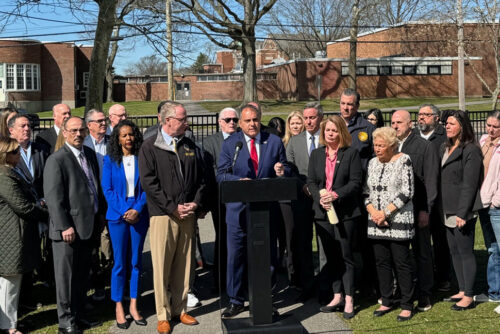
With dreams of warm spring days and green lawns approaching, a group of Nassau County residents gathered April 3, at the Great Neck Library to learn the "cutting edge" of organic lawn care from the environmental group Neighborhood Network. This group was instrumental in the passage of the new Neighbor Notice of Pesticide Spraying law that is now in effect.
Gone are the days when chemical pesticides were the only option for a green lawn. As people become more aware of the harms of pesticides, new "green" products are being produced to meet the demand for safer ways to control lawn pests, and organic landscapers are emerging as well. The audience was treated to pictures of recycling lawn mowers, soil microbes, and products such as milky spore and nematodes that kill those pesty lawn grubs. It was a colorful feast of alternatives to the lawn chemicals that the chemical industry spends millions of dollars advertising every year.
The forum was called "Four Steps to a Toxic-free, Organic Lawn," and was one in a series of 12 being held across Long Island. The goal was to show that while organic products are not direct replacements for specific chemical products, that having an organic lawn can be (almost) as simple as following the familiar synthetic "four step" programs. Organic programs are based on a whole set of strategies that work with nature to create ecological balance, rather than interfere with natural processes that would normally keep pests in check. For example, there's more to your dirt than you may want to know - one teaspoon of rich, organic soil supports the life of literally billions of microbes that help to make soil nutrients more available to plant roots, control turf diseases, and help to break down thatch, a common problem on chemically treated lawns. That's because when we apply pesticides or synthetic chemical fertilizers, we kill off these beneficial soil friends. Even earthworms do our lawn an important service by aerating the soil and fertilizing it with their castings.
In essence, organics work. The audience saw for itself that the proof is in the green color demonstrated by several pictures of lawns right here on Long Island, all maintained organically.
"While many people are concerned about the dangers of pesticides, the DEC recently reported that suburban pesticides use in Nassau and Suffolk is even higher than in the agricultural areas of the state," said Laura Weinberg of the Great Neck Breast Cancer Coalition. The group joined with the Lake Success Environmental Commission (LSEC), and the Neighborhood Network, an island-wise environmental organization, in sponsoring the event, in order to show people that organics are better for several reasons. One of the top reasons is our precious sole source aquifer. As Rosalind Zitner of LSEC pointed out, "These are public health issues that transcend boundaries and affect all of us."
Neal Lewis, the main presenter, and executive director of the Neighborhood Network went on to say, "We are all aware that our source of drinking water is right below us on Long Island, but we keep using lawn chemicals unnecessarily. Safer tools are out there in Long Island stores, and organic landscapers are available, so it's just a matter of making the switch and learning how to do it right."
Lewis explained that many lawn pesticides have well-documented health effects on humans such as neurological damage, potential reproductive effects, and even cancer risks. Children are especially vulnerable to the effects of pesticides because of their behavior of playing on lawns and putting hands and toys in their mouths. But it's also because of their relative size, and because their immature bodies have a lesser ability to filter out toxins than the adult body can. Humans aren't the only ones harmed either; the presentation showed how birds, fish, and even those beneficial insects like ladybugs can be harmed by pesticides in the yard. Birds also help us control insects so we want to attract them to the lawn, not reduce them.
1. Changes in Maintenance Practices
Proper maintenance includes mowing high (at about 3") so that grass can grow a deeper, stronger root system and will shade out weed seeds. Always leave the clippings to naturally return nitrogen to the soil. Using the right grass seed is important; tall fescue blend is usually best for this region. Also, water infrequently but deeply, so as to encourage deep root growth. Light watering encourages roots to grow shallow, but watering too often can encourage fungal disease. Soils rich in organic matter are usually better able to hold water anyway.
2. Promoting Soil Life
If you fear our soil might not have enough healthy microbes, you can actually buy what are called "microbial inoculants" at your garden store. Another good way to add microbes and organic matter is through the use of compost. Compost is key to any organic lawn, and is available through various town pick-up sites around the island or from companies such as LI Compost. Since it can be heavy and requires some effort to apply, you can either make or buy liquid compost too, which can be easily sprayed. The final touch is organic fertilizer. The importance of organic versus conventional fertilizers is that they release nitrogen slowly - chemical fertilizers quickly release more than is necessary so much runs off. Look for bags with low "N-P'K" ratios such as 8-2-4, which refer to the amounts of nitrogen, phosphorus, and potassium, respectively.
3. Soil Amendments
Soil amendments are items which add trace elements your soil needs beyond the big three N-P-K, such as rock dust minerals, Kelp extract adds vitamins, plant growth hormones, and trace minerals which boost plant vitality. Kelp is a great product to help your lawn fight off the mid-summer stresses. Soil amendments also include items that balance pH - a familiar one is lime, which reduces soil acidity. Pelletized, calcitic lime was recommended. Testing your soil can help you save money on products your soil may not need, and soil testing kits for pH can be purchased inexpensively at local garden stores.
4. Organic Pest Control
The presenter joked about how it sounds like we can make an Italian pizza out of our yard when talking about some of the innovative products that rid our yard of pests. For example, garlic oil has been used for centuries for many purposes, including to rid dogs of fleas. Well, Long Islanders would be interested to know that it also repels mosquitoes, the much-loathed nuisance and disease vector. Several brands of garlic oil formulations are now available in stores, and it can be sprayed around the perimeter of the yard to repel mosquitoes and other biting insects from your property. You may smell it for about a day, but the mosquitoes will smell it for two to four weeks! Hot pepper wax also repels a variety of insects from flowers and vegetables, and is available at garden stores.
Got pesky weeds? Well, there's hope - corn gluten is a very effective natural weed seed killer, and can be spread in a regular spreader. (If you plan to put down any new grass seed this year, you should wait about six weeks before putting down new grass seed after applying corn gluten.) It also has nitrogen in it which helps to feed your turf. Weed patches can also be pulled and then covered with a mixture of grass seed and compost so that the turf will out-compete any returning weeds.
One final item to note is the new Neighbor Notice of Pesticide Spraying law. The law took effect March 1 of this year, and requires even homeowners to place markers when applying lawn chemicals to the lawn. The law's main focus was to require professionals to give neighbors of properties they plan to spray at least 48 hour prior notice. This way you can take common sense precautions to protect yourself from pesticide drift. Look for signs at retail stores on this as well.
Even if you hire a landscaper, you can now speak knowledgeably to him and ask some important questions about his methods.
The night ended with a question and answer period with two organic landscapers from LIOHA (the LI Organic Horticulture Association), Steve Restmeyer, owner of Eco-logical Organic Landscaping, and Saxon Harrison of Earthworks Organics (who happens to cover the Great Neck area). Fortunately, for any homeowner not convinced that they can do-it-themselves, they can always call 541-4321, to get the LIOHA list of these local organic landscapers that use only the 100 percent organic methods described at the forum. Also, for further resources, Neighborhood Network offers a Resource Directory that provides a list of stores where you can buy organic lawn care products, and further tips and information on organic lawn care.
This Neighborhood Network educational forum will be presented at various other locations on Long Island. Scheduled presentations in the area include:
April 23: Robert Seaman Elementary School in Jericho, 7 p.m., co-sponsored by the United Civic Associates of North Oyster Bay.
April 30: Huntington Public Library, 7 p.m., co-sponsored by the Huntington Breast Cancer Acton Coalition.
May 2: Bar Harbor Library, Massapequa, 7 p.m., no co-sponsor.
For more information about organic lawn care, a list of organic landscapers, or to receive a free copy of the 2001 Law & Garden Resource Directory, call Neighborhood Network at 541-4321.