By Andrea Morale
The State University of New York (SUNY) Farmingdale is moving ahead with a plan to lease 70,000 square feet of land for the construction of a major pharmaceutical facility on its campus, after the deal was authorized by recently enacted state legislation.
The law allowing the unprecedented partnership between business and the state university system was sponsored by State Senator Charles Fuschillo, Jr. (8th Senate District - Merrick) and Assemblyman Robert Sweeney (11th Assembly District - Lindenhurst). During a groundbreaking ceremony at the future site of the facility on Monday, the legislators hailed the law as a bipartisan agreement that paves the way for the growth of the bio-technology industry on Long Island.
According to Fuschillo, the facility will employ 300 permanent high-technology staff-members, with each earning an average yearly salary of $70,000. SUNY Farmingdale graduates are expected to be one source of the pharmaceutical company's labor pool.
"All too often, we hear the cry that we educate kids here on Long Island, and that we have the finest talent pool, but we don't provide jobs. The Fuschillo-Sweeney law ends that today," Fuschillo said.
"Long Island is number four in hi-tech research regions. We're behind Boston, San Diego and San Francisco. Hopefully this law will push us to be number one, and create the 1-tech corridor," he added, referring to the anticipated development of the Route 110 area as a hub of hi-tech industry, "so that we can bring more hi-tech jobs to Long Island."
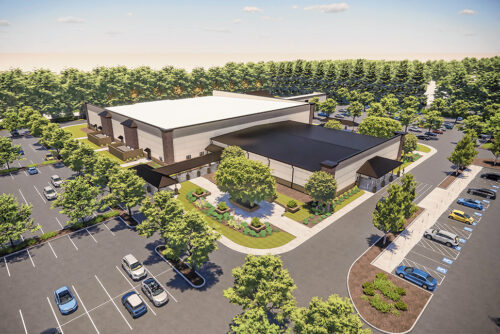
The pharmaceutical facility will neighbor a 50,000 square-foot incubator facility also being constructed on SUNY Farmingdale's campus. Known as the SUNY Farmingdale Broad Hollow Bioscience Park, the center of biotechnology is being managed by a board of directors appointed by SUNY Farmingdale and Cold Spring Harbor Laboratories, and aims to retain and attract bio-tech companies.
Broad Hollow Bioscience Park officials are negotiating the lease of the 70,000 square foot building with a leading pharmaceutical discovery company, OSI Pharmaceuticals. The company is expected to consolidate its current U.S. operations into the new facility by June, 2001. In addition to the hi-tech jobs that will be brought by its opening, construction of the building will employ 300 union laborers.
The economic impact of the first five years of operation of both facilities in the bioscience research park is estimated at about $200 million, according to Fuschillo. He added that the park is anticipated to generate over 1,200 jobs and attract or retain some 21 companies on Long Island, and will be an appealing home for bio-tech graduates and foreign biotechnology companies interested in establishing a U.S. commercial presence.
Assemblyman Sweeney noted that the legislation allowing the creation of the pharmaceutical facility on SUNY Farmingdale's campus is in line with the philosophy of the Jobs 2000 Act, passed by the Legislature as part of the state budget. The program authorizes the State University to develop related economic development facilities for research, development, products and services related to the mission or academic specialties of the campus sponsoring the project.
"One of the great assets that we have on Long Island, and in New York State is the SUNY system. When hi-tech companies are making decisions about where they want to locate in this country, one of the things that they look at is the ability to be close to and affiliate with a college or university. SUNY is one of the great assets that we have, and one of the great attractions that we don't use always to our best advantage in attracting and keeping hi-tech businesses on Long Island," Sweeney said.
"This project will create jobs on Long Island. It will help develop a stronger relationship between SUNY Farmingdale and hi-tech businesses, to the benefit of both. It is the type of project that we need to be doing, and I hope we will be doing, more of."
Dr. Michael J. Vinciguerra, provost and acting president of SUNY Farmingdale, thanked Senator Fuschillo and Assemblyman Sweeney for making the legislation a reality. "This was bipartisanship in government at its best because it put the best for the people above everything else. We're delighted to see the expansion of the park based upon on the legislation that both of you sponsored, and that passed and was signed by the governor. This is a new seed that's being sown on what was once farmland," he said, expressing enthusiasm about the college's role in the development of biotechnology on Long Island.
Vinciguerra noted that with the project, SUNY Farmingdale will continue its historic mission of supporting local industry. The college was founded in 1912 as an agricultural and technical trade school, and originally trained farmers to support the local economy. It has changed with Long Island's economic structure, and today is a four-year baccalaureate degree granting institution with programs ranging from aerospace, to dental hygiene, to horticulture.
"We pledge our full commitment to this endeavor, as we will work side by side with the tenants of this park, to prepare the workforce that they need to grow, and to use our students and our faculty, side by side on the research as they discover many new and important drugs," Vinciguerra said.