By Susie Trenkle
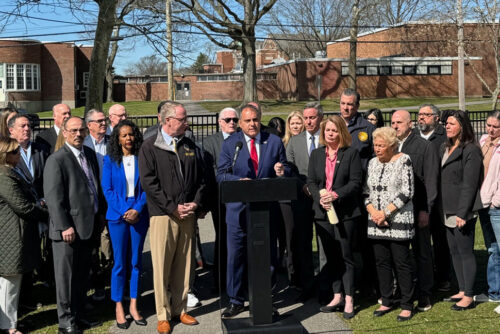
A community dialogue about the fate of Packard Middle School this past Monday included discussion about the educational needs of the students, the overcrowded learning environment, the aging structure, and the financial implications if the Plainedge School District decides to either refurbish or rebuild the middle school.
Concerns about the future of middle school, which was only built in the 1960s, were raised because it is not large enough to handle the increase in enrollment the district is expecting and because, while safe, the building needs much structural renovation.
Packard Principal Chris P'Simer spoke to the cafeteria-full of community members about the education needs of the students at the middle school and how those needs have changed over the past 10 years. She noted that 10 years ago the school was a traditional junior high, which had children in grades 7-9 attending, whereas today the school is a middle school which has students in grades 6-8. One example of a problem caused because of this change is that many of the lockers in the school are too high for sixth graders to reach.
Ten years ago, explained P'Simer, the curriculum of the school was departmentalized, whereas today it focuses on interdisciplinary study. The traditional teaching practices of 10 years ago have been replaced with varied instructional practices. Computers have paved the way to instructional technology and the emphasis on teaching has turned to an emphasis on learning in the last decade. Ten years ago the district was focusing on the Regents Action Plan, today they are dealing with the New York State standards, which includes various lab instruction in the classroom.
Much has been done to bring the middle school up to the new standards, but the school and district administration believes that Packard, as it now is, is not equipped properly for the students to reach these new standards in education. In an effort to do what they could, the middle school has added a ninth period to include support classes in ELA and Math and recognize that support will need to be added in science and social studies in the future. The middle school administration has changed the teaching strategies to have an emphasis on learning, through strategies such as cooperative learning. They have improved Library Media Services so there is more student-directed research, included the use of technology and used the team approach to teaching. Computer labs are currently used to capacity.
Many of the problems now facing the middle school are due to the design of the building. The science rooms are built as lecture-style classrooms with immovable desks, thus hindering lab work and group study, and allowing no room for computers. The technology room is not equipped for the new standards and is unable to collaborate with math and science.
A lack of space is another problem in Packard. There is no auditorium, the cafeteria is the sole large meeting place and cannot even fit an entire grade at a time. The enrollment is increasing and while this year is at 761 students, in 2001 the enrollment in the middle school will be up to 837, over 200 students more than the enrollment in 1994. This is a problem, explained P'Simer, because rooms are already filled to capacity.
The cafeteria at the middle school is at capacity for three periods and lunch starts at 10:17 a.m. for some students while other students are not able to get into the cafeteria until 1:06 p.m. While the school originally had two Home and Career rooms, one of those rooms is now being used as classroom space and the other is at capacity every period, with two classes in the room at one time during one of the periods. The general music room is needed for other classes and students often have to be out in the hallway for lessons because the performing music room is unable to accommodate all three performing groups. These are just a limited number of the issues facing Packard at this time.
Dr. John Richman, superintendent of the Plainedge School District then spoke to the audience about the physical issues at the school. Although, he stressed, the building is structurally safe, the concrete is crumbling, exposing the steel beams, there are leaks, it is not energy efficient and not handicapped friendly. With all the information laid out, Richman then addressed the issue of whether they should rebuild or renovate Packard.
Renovation of the building would include the replacement of all windows, additional academic spaces through destruction of turrets and reinforcement of the existing structural frame, which Richman noted in all likelihood would be necessary but is not included in the renovation figures they have formulated.
Building a new school would include: an auditorium, cafeteria, classrooms designed with a focus on learning, energy efficiency, and instructional areas that support middle school philosophy. The New York State Education Department recommendation was, "Building a new school would be to the district's best advantage."
The district has come up with what they stress are estimates of what these projects might cost. If a bond referendum is approved by July 1 of this year there is a 10 percent incentive on building aid from the state which would most likely not be there next year, which would mean approximately $5 million in savings to the taxpayers, according to Richman.
The cost of renovation of the building is thought to be approximately $25 million, not including any structural reinforcement that may be deemed necessary after the project has begun. This would cost the homeowner with a house assessed at $6,000, approximately $155 annually. A new building, based on an approximate cost of $40 million, would cost the average homeowner $248 annually. In addition to the renovation or rebuilding of Packard, the district would like to include in the bond renovations and improvements to the rest of the buildings in the district, costing approximately $10 million. With a new building and the additional renovations, the amount of the bond may be brought up to $50 million, at an annual cost to the average taxpayer of approximately $318.
School Board President Josephine Reder stated that if this state incentive is passed up this year, Plainedge may well never be able to afford this project again in the future.
Prior to voter approval of this bond the district has to obtain site variances from the SED, which will take approximately two months; draft an environmental impact statement which will take approximately two months; develop a design, four months; prepare construction document, four months; and obtain SED approval which will take about three months. With that timeline the board and administration expects to have the project ready for a community referendum vote sometime in March. Before that time they expect to continue to have a series of community dialogues about the project.
Following voter approval the bid process takes about one month; analysis of the bids takes about 2-4 weeks; the contract must be awarded; it will take about 3-4 weeks for the contractor to be on site following the contract award and then the building construction will take approximately 24 months.
Following the presentation by the district, many community members asked questions before they took a tour of the facility. One question had to do with the planetarium at the school and whether that would be reconstructed. Richman and an architect from Wiedersum Associates, the district's architectural firm, explained that since the district already had the equipment for the planetarium there was no reason why it could not be constructed.
The question that raised further questions and arguments had to do with where a new school would be constructed. Neighbors of the middle school were very upset to discover that, although there are no official plans as of yet, it appears as though the new school would be constructed next to the standing structure, closer to the houses. These residents were worried about how that would affect their view as well as their property value. Other concerns about that plan had to do with what would happen to the original structure and how the students going into the middle school would be affected by the construction. One parent questioned, with the placement of the new school if it would be safe for the students because it would be surrounded by the street on three sides. Administration assured the residents that safety would be of the utmost concern. Another concern had to do with the playing fields and how the construction of a new building on the existing playing fields would affect the teams. Reder explained that the district pays Town of Oyster Bay taxes and should have access to the town fields, which they currently do not make use of.
There were no definitive answers to many of the residents' questions because no plans have been finalized yet but the administration assured residents that they were looking into all the options and that the community would be kept informed.