By Susie Trenkle
On April 15, the Assembly Republican Educational Taskforce held a Roundtable Session in Merrick to discuss the concerns of teachers, parents, administrators, and legislators with regard to the new state standards and Regents standards.
|
|
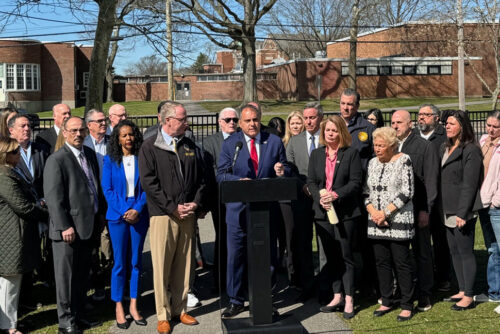
Legislators, educators, administrators and parents gathered to discuss the impact of the new Regents standards.
|
Since Commissioner Richard Mills and the Board of Regents announced their plan to increase educational standards by eliminating the local diploma, requiring a Regents diploma for graduation and changing the testing requirements for pre-high school students, many people have been concerned about how these changes would affect the students, especially those who might not be able pass the five Regents exams required to achieve a Regents diploma. It was these concerns that prompted Assembly Minority Leader John Faso to formulate an Educational Task Force this past January. The Chairwoman of this taskforce, Levittown Assemblywoman Kathleen Murray, has been going around the state, with fellow members of the taskforce such as Assemblyman Steven Labriola, of Massapequa, to discuss the concerns with parents, teachers and administrators in an informal Roundtable Discussion.
The Assembly Taskforce will take the information they have gathered and compile a report which they will present to the New York State Board of Regents. According to Labriola, the taskforce will issue both a summary report with their preliminary findings and a summary judgement based on those findings.
The Roundtable Discussion, recently held here in Nassau County, afforded assemblymembers the opportunity to hear from local educators such as Dr. Herman Sirois, superintendent of the Levittown School District; Dr. Marc Bernstein, superintendent of the Bellmore-Merrick School District; Toni McDonald, a 10th grade Global Studies teacher at Division Avenue High School in Levittown; and PTA Council Presidents Carol Giannattasio of the Massapequa School District and Kathy Dowling of the Farmingdale School District. In total there were approximately 20 people present for this discussion. Each of the people present expressed similar concerns for the students who would have to abide by the new Regents standards and testing requirements which will gradually be phased in through 2004, when the phase-in will be complete.
Murray asked several questions of those present, such as, "How are the teachers responding to the new standards?" and "Is retaking individual components of the Regents too little?" In response to concerns that the new fourth grade tests were putting too much pressure on the students, Murray asked, "What do you think highlighted this test?" Each of these questions was followed by frank answers from the parents and educators.
When asked if they thought this session was beneficial, educators and legislators alike responded in the affirmative. McDonald, who met Murray up in Albany when she took her Division Avenue students up there, responded, "Yes, I do. Kate Murray is very open to what we have to say and will bring our thoughts back to Albany. This is a chance for our voice to be heard." Sirois believes that this was the first real opportunity that educators have had to discuss concerns and issues that they have with regard to the new Regents standards. He added, "The State Education Department has not provided any genuine opportunity to discuss these very important issues." Labriola responded, "The sessions that we've been having are beneficial because it's allowing us, as legislators to learn the concerns of people in the education community, who are learning to live with the imposed standards by the Regents and we've been hearing their concerns."
According to Labriola both Carol Giannattasio and Kathy Dowling, who are PTA council presidents in his assembly district, told him that they thought it was very interesting to hear how the educators are struggling with the task they have been given and how they are implementing the fourth-grade testing and the eighth-grade testing.
Of particular concern to many is what will happen to students who can't pass all five mandated Regents. Labriola stated, "I am concerned, in particular, with the high percentage of local diplomas that students typically get and that many of these people with local diplomas go on to college. What happens to all those people who, maybe at a given time in their life, have other things going on? They may come from broken homes, there may be drugs involved, there may be other personal problems, family issues that impact and affect a student's ability to take a standardized test. I'm concerned that we are focusing too much on this test, when it is not the full measure of a person." Labriola explained that as a parent and a legislator these are his feelings and he has heard these sentiments echoed throughout the state. He points out that everyone wants standards to be raised and students to excel, but how these results are achieved is another matter.
Labriola explained that what parents and educators across the state are saying is that adjustments to the new standards need to be made. He added, "The changes should be made before we start hurting the kids, if in fact we are hurting the kids. There is a great deal of concern about the drop-out rate because we're not going to have students waiting around to take another Regents test."
A sentiment that was repeated by both Labriola and Sirois was that these new standards were not designed for Nassau County schools, which are among the highest achieving schools in the state. The concern is not for the ordinary Nassau County student, who has not had a problem passing well over five Regents exams prior to the new standards, but for the special education students and the ESL students who just can't pass many of those exams. The new standards were designed with regions that have not reached a suitable passing rate in mind, said both Sirois and Labriola.
Another concern that many people have is what areas of education are going to suffer because of the new mandates. Are students going to have to give up fine arts or athletics to have additional tutoring to pass the Regents exams, asked Labriola. He went on to question what would happen to a student that might be the next Mozart, but is told he or she is a failure in life because they could not pass the Regents exams to graduate from high school. He asked, "What about all these educational experiences that these kids have in high school. The exams are not a full measure of an education."
These fears and concerns have prompted an unexpected move by the Assembly and Senate Education Committees. The two committees decided to hold a joint hearing about the new Regents standards on Thursday, April 22. The record of the committee hearing will be sent to the Board of Regents. Hearings such as these are not usually held, pointed out Sirois, unless the assembly and the senate have found problems with the way things are progressing. Labriola added, "Sometimes as a result of these [hearings] changes will be made and if they aren't made maybe we need to make legislative changes, which is not something we typically do." Unless the legislature determines that they need to get directly involved it will be the Board of Regents and the commissioner of education who will have the final say in how the education of the state's students progresses.