|
|
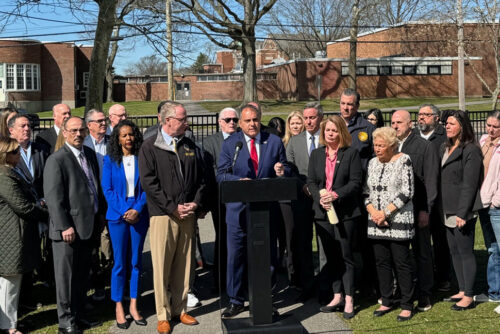
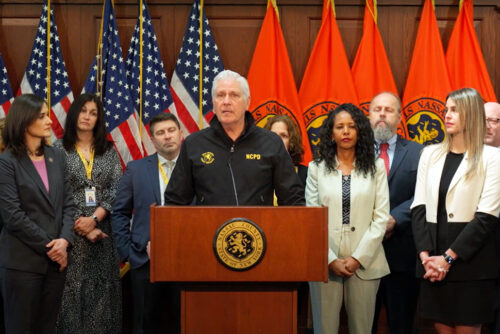
County Executive Tom Suozzi with members of his staff, the community and local government just prior to the bus tour of the Manhasset area. Suozzi says Nassau County has stopped growing and he is promoting his concept of a "new suburbia."
|
"With declining revenue and explosive expenses the solution has been to raise property and sales taxes," Suozzi said.
Nassau County has stopped growing, is now a mature suburban community and is experiencing major problems as a result. Nassau County Executive Tom Suozzi is delivering that message throughout the county, and in January targeted Manhasset and embarked on a bus tour with community members and conducted a town meeting in the evening. No physical growth results in little revenue growth, and as revenue is derived primarily from property tax and sales tax those sources will have to be increased, he said, unless other sources of income are found. Sales tax in Nassau County is already 8 3⁄4 percent, one of, if not the highest, in the United States. The county gets 4 percent of the sales tax. State and federal aid, another source of revenue, has gone down since the 1980s. Making matters worse the federal government shifts expenses onto the state and the state then shifts them to local government. With declining revenue and explosive expenses the solution has been to raise property and sales taxes, Suozzi said. What is needed is a plan for the "new suburbia," a long- term plan for the future. The challenges are real, he said, because Nassau County already has taxes 72 percent above the national average.
To remedy the situation Suozzi has begun to implement his plan for a "new suburbia" that focuses new investment in high skilled, hi-tech businesses, sports, entertainment and tourism in targeted locations. He intends to emphasize development on traditional downtowns, brownfields, and emerging minority neighborhoods. His plan also envisions new affordable housing for young workers and senior citizens, preservation of remaining open space, enhancement of failing schools and a transportation system that connects the "downtown of Long Island" to New York City and surrounding markets, which he has dubbed the "Nassau Hub." The hub roughly includes the EAB Plaza, Nassau Coliseum, Eisenhower Park, Source Mall, Nassau Community College, Hofstra University, Roosevelt Field, and Mineola county government. Mineola and Hempstead Village are important parts of the hub because of the railroad lines.
Suozzi acknowledged that Manhasset is, above all, a great commute into New York City. Other zones could benefit from his hub concept, but the spokes of the wheel will not affect Manhasset. Manhasset is predominately residential except for Northern Boulevard and Plandome Road and is an excellent place to live and to commute into the city.
Suozzi has carved the county into economic development zones which are politically insignificant sections that make perfect sense, and is taking his message of a "new suburbia" on the road, literally, by arranging bus tours followed by town meetings to promote his idea. During the bus tour, a fact finding tour, he learns what he can about the particular area's strengths and weaknesses, how the area might fit into his overall plan, what the residents want for their community, how they can form a partnership. The area crisscrossed on the January 12 bus tour was #5 on his map, defined by the borders of Manhasset, and it was his 28th economic development zone tour out of a total 35.
During the bus tour roads and small parks were discussed. There are four municipalities maintaining roads-state, county, town and villages. Eight percent of the county's budget is roads. The county owns small parks that Suozzi believes would be better managed and maintained by locals and he would like to exchange the parks for roads to establish a more efficient division of assets. He was asked what roads and what parks and responded any county road currently two lanes and not in an incorporated village. "We would like incorporated roads too," he commented, "but we are not there yet."
Some issues affecting Manhasset raised on the tour were traffic-there are more new cars now than new people, a need for more active recreational areas, subdividing property, destruction of trees, and a lack of affordable housing which, Suozzi said, has caused 20 percent of 18 to 35-year-olds to leave over a 10 year period. Ironically, the area was built as affordable housing after World War I, but no more. However, Manhasset is still the best commuter line. Without intervention, to keep Manhasset the way it is, Suozzi said, the natural evolution is that the property tax will go higher.
Nassau County, with a population of over 1.3 million, is larger than seven states and its $2.3 billion budget is larger than 16 states. Suozzi oversees a government of over 8,500 employees. But, Nassau County has stopped growing. In 1950 there were 400 thousand residents; 1960 1.2 million; 1970 1.5 million and today 1.3 million. As a result there is little revenue growth but expenses continue to go through the roof, including healthcare, salary and pension costs, often dictated by state law. State mandates governing Medicaid increase 15 percent each year.
Nassau County's assets are some of the most unique resources anyplace in the world, Suozzi said, there are beautiful north shore waterfronts, and south shore ocean beaches, tranquil parks, lovely suburban neighborhoods and great people. All of which make Nassau County a great place to live and play, he said, and his plan incorporates marketing the riches.
Suozzi is informing communities that "Nassau County offers residents and workers many different and unique environments: residential neighborhoods, historic downtowns, major commercial centers, and diverse parks and beaches. Quality of life is high, but Nassau County's built environment is feeling the strain of changing times. Auto dependency has grown dramatically, leading to increased traffic. Housing options have proven to be unaffordable to many. The population has aged and become more diverse, and extensive commercial development has ensured that Nassau County is no longer just a 'bedroom community' for New York City. To ensure that future generations enjoy the natural beauty and quality of life that citizens enjoy today, comprehensive planning must take place."
Around the hub Suozzi wants to invest in infrastructure improvements, transportation, housing, open space and schools. "The Kentucky Derby is important, why not Belmont?," he asked. People define communities by the downtown area, he continued, and some have a business improvement district, a manager for downtown to monitor litter, arrange concerts, and produce Santa.
Literature on the hub concept states that because of the high concentration of business and recreational activity in the hub, traffic congestion has dramatically increased in recent years. Projections estimate that left unchecked, traffic will increase 36 percent from 480,000 "person trips" in and out of the hub, to 650,000 a day over the next 10 years. That kind of volume has the potential to bring Nassau County's economic engine to a halt. That is why redeveloping the hub is so important. It was said "to be economically sustainable, our redevelopment must also be focused on sustaining our quality of life--preserving our open space, protecting our drinking water, and recycling and reusing formerly productive properties instead of gobbling up our previous few virgin ones." The question is how to keep things the way they are and grow, and, it was expressed often, the plan is to preserve suburbia and support target growth.
In 2003, the Office of Economic Development prepared a map that divides the county into 35 study areas known as Economic Development Zones ("EDZs"). Each EDZ consists of several communities that share certain characteristics, such as a community name, a major shopping area, or a school district. The EDZs have formed the basis of a series of 35 town-hall style meetings hosted by the county executive that solicit public input and respond to public concerns about the future growth and development of each area. By late 2005, Nassau County will complete the series of meetings and issue a report outlining its findings and recommendations.
At the evening meeting, Suozzi presented his plan then took questions. Some issues raised were: relocating the town offices on Plandome Road because that is valuable land that is not taxed. The offices also contribute to traffic and congestion and could be put to better use. A Bayview resident spoke saying Bayview Avenue is a county road, and dealing with the county you get the runaround. The county painted a yellow line down Bayview Avenue and stopped short just before the hairpin turn where accidents are more likely to occur. Plandome Road could benefit from better parking, facade improvement and more uniformity. Problems in Manhasset are not as great as in other communities, it is a wonderful place to work, an economic engine next to New York City.
It was also said that Great Neck has a vibrant downtown, as does Rockville Centre and Garden City. All have housing in the downtown area. Plandome Road was thought to be a little tired. A lack of sewers prohibits growth, but many at the meeting thought that was beneficial in order to retain the character of the town. Sewers are an expensive capital investment, and generally require a strong leader and consensus, Suozzi said. The need is to develop a consensus vision and then go forward. Identify the problems, gain consensus and prioritize.
Suozzi mentioned that dividing the county into 35 common sense municipalities makes it easier to be held accountable. Suozzi asked about folding all of Manhasset into one village with common zoning, code enforcement, garbage collection and when some hands were raised in agreement, Suozzi said, "that is the third rail of politics."