By Donald E. Harkness
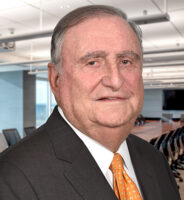
Dr. Donald V. Grote, former Manhasset superintendent of schools, died suddenly of a heart attack in his home in Santa Barbara, CA, on Thanksgiving morning. He leaves his beloved wife, Ethel, a son and daughter, the daughter's husband and their two children, one of whom spent at least one night a week during the past few years with Don and Ethel as he completed his undergraduate studies at UCLA.
Don was a brilliant educator. He came to Manhasset from Wilmette, IL, as a national expert on middle schools. From his initial interviews with the Manhasset Board of Education, the board and he expected that he would be instrumental in building a brand-new middle school or reorganizing and rebuilding our Junior High School into one soon after he settled in at Manhasset, where, incidentally, he purchased a charming colonial house on Dogwood Lane. Following his arrival in Manhasset, the board and community had second thoughts about the projected middle school because of the anticipated costs and opposition from a vocal minority (majority?) of the community. The project was put on hold and Don settled in at the task of making the quality of the educational experience of Manhasset's youth the central concern of everybody. And he did that to a fare-thee-well. His educational roots, cultivated, shaped and refined at Evanston, Winnetka, and Northwestern University, had always been solidly planted in curriculum development and instructional excellence. During his 12 years at Manhasset, that orientation had ample opportunity to flourish - under the rubric of individualization of instruction, learning styles, special education, Project Redesign (a NYS program designed to foster educational excellence for all children), and minority integration into the mainstream of our educational program. I may be forgiven if I say that under his tutelage these terms became real and powerful, unlike, sad to say, the empty slogans so often trumpeted by grant-seekers elsewhere in the country. As a result, educators, prompted by Teachers College, Columbia University, and NYU, came from far and near to observe our precepts and practices - exemplified in an ideal educational setting and executed by one of the state's pre-eminent administrative and teaching staffs.
In this brief tribute, we cannot devote sufficient time to a discussion of the host of enlightened and splendid instructional programs that Don either introduced or supported, but many of them are working hard today in Manhasset. I shall refer, in passing, only to four: racial integration, special education, curriculum development, and the arts. These were critically important issues to Don, and they became critically important issues at Manhasset under his guiding hand. Without dwelling on the all-important particulars, I shall say only that racial integration - in our case, the inclusion of African American youngsters into all aspects of educational life at Manhasset, was an all-consuming passion of Don's, exemplified in dozens of ways, including the fact that he attended and presided over interracial council meetings wherever and whenever they were held, and supported after-school learning programs. Black history, Focus meetings designed to improve interracial understanding, the Parent Child Home Program (a nationally famous early childhood verbal skills program which Manhasset/Great Neck piloted), and Maggie Grundman's Adventures in Learning after-school study center.
Similarly, he was far advanced in his understanding and advocacy of inclusiveness and individual learning in special education - not dissimilar in concept to the IEP's of today.
Manhasset owes Don an enormous debt of gratitude for the fact that as a curriculum expert he advanced significantly the notion that continuous updating of curriculum materials coupled with continuous updating of teacher skills, motivation and insight are the backbone of instruction. While he was superintendent, we never worried whether there would be sufficient money for curriculum development projects or staff development. It was always there, and he backed it fully. At least a dozen curriculum projects purred along every summer in high gear and teacher in-service workshops ran continuously throughout the year.
Finally, he was a staunch advocate of the arts, whether bringing gifted artists into the schools (as with the Lincoln Center troupe) or honing the skills, availability and reach of our own gifted professionals at both the elementary and secondary levels. I will not soon forget the weekends he spent attending every single musical, dramatic, fine arts and athletic event in the school and community. The man was indefatigable. Long after the rest of us had drifted into appreciative somnolence he was still there enjoying the passing parade and taking endless mental notes of everything for possible use later on.
He had a phenomenal memory, but, unlike most people, he remembered both the overarching summaries of a wordy discussion and the details. I shall never forget one meeting that I had with him a full month after an event that he had attended but I could not, for one reason or another. After the usual pleasantries, he summarized the meeting for me by repeating what was clearly a word-by-word recital of the entire dialogue - probably at least a half hour in length. Needless to say, I was astonished because I would probably not have remembered even the overall conclusions, let alone the details, after so long a hiatus.
Perhaps the overwhelming reaction felt by most people to Don was his courtliness and courtesy in an old-world way. I never heard a harsh, unkind or vulgar word escape his lips. He was the epitome of civility and thoughtfulness, no matter how uncivil his interlocutor. I recall distinctly a conversation that he had with a reporter who was trying very hard, very persistently and very boorishly to get Don to agree that the integrationists had gone too far in demanding black history and psychological understanding of minority attitudes and behavior by our professional staff. Don obviously disagreed. However, he never once lost his temper or composure but simply restated his position in clear, simple and unprovocative terms - and then offered the man a cup of tea. Needless to say, he won that argument, as he did so many, by the exercise of natural courtesy, sound reasoning - quietly articulated - and authentic good will. He was admired by the board, praised by the staff and idolized by the Manhasset Rotary. I think it's fair to say that his gracious nature and good works performed on behalf of the community and Rotary won him the respect of all Rotarians - one of whom, Tony Zino, a Rotarian of international stature, contributed his beautiful collection of African artifacts to the Manhasset High School as a direct result of his admiration for Don. He once told me that of all the people he had met in this world, he held Don Grote in highest regard for his intelligence, his kindness and his courtesy.
His meticulous attention to detail was legendary. Board packets reflected his personal style, which was very well-organized, very well-structured, and very clear. The board memorandum was a model of administrative precision, and no appointment ever crossed his desk without full back-up. Speaking of appointments, one characteristic clings to my memory. Unlike his predecessor, for whom I also worked, he believed in full documentation. He insisted upon detailed written criteria, written references, and written background reports. He left little to intuition and nothing to chance. He believed in and practiced the notion that the devil lurks in the details.
Don was quiet and reserved, regardless of the arena. He could attend a meeting without feeling obliged to say anything. He was content with himself without being complacent in the slightest. He knew that he did not come across as a "hale-fellow, well-met" backslapper and glad hander, and had no wish to assert that role. Nor, on the other hand, was he indifferent to or uncaring about other people's feelings, hurts and problems. No school administrator in my ken has ever been more generous or done more in a quiet, unobtrusive way for others - staff or community member - and kept it so close to his vest. Few, if any, of the staff or community ever knew about his personal philanthropies - and that's just the way he wanted to keep it.
Never one to promote himself, he would acknowledge everyone else's contributions and talents but remain silent about his own. His courtesy was not just the result of good breeding and happy circumstances in life; it was endemic to his soul. He simply did not see things in selfish terms and was distressed when others did. As George Singhel put it, he always respected your judgment, whoever you were, whether a big shot in the pantheon of the worldly or an unlettered simpleton. And he listened to you very carefully and thoughtfully. He had a native elegance of speech and couched the inelegances of other people's thoughts in appropriate language. He never pulled rank or asserted his authority, but was not afraid to state his position and act upon it forcefully and decisively. He was, as Chaucer put it so endearingly in describing the Knight:
And though that he were worthy, he was wys,
And of his port as meeke as is a mayde.
He nevere yet no vileynye ne sayde
In al his lyf unto no maner wight.
He was a verray, parfit gentil Knyght.
"Prologue" to The Canterbury Tales
Truly, he was a "very perfect gentle knight." We shall not soon see his like.