On Wednesday Oct. 11, the Town of Hempstead Board of Zoning Appeals held a hearing regarding a proposal by Josato Inc., to build 20 homes on two plots of land formerly known as Motor Parkway. In addition to the homes, 16 of which would need variances from the Town, Josato also applied to the Nassau County Planning Commission for a variance to build two roads, known as Marigold and Topaz, which would not fall under the county's requirements with regard to street width. The variances they would need from the town are because Levittown has a special zoning law, known as the Levittown Planned Residence District (LPRD). Under this ordinance, the lots proposed by Josato are not deep enough for houses.
In 1984, the developer Terra bought, in Levittown, two tracts of the so-called Old Vanderbilt Motor Parkway, and proposed to build two new streets, Marigold and Topaz. Since the parkway was not wide enough to accommodate 60x100 house lots required by the LPRD along a standard street, Terra proposed to build houses on substandard lots along substandard streets. The Motor Parkway is 135' wide and for an LPRD mandated lot 100' deep and a state mandated street 50' wide, the developer would need 150' so Terra was 15' short.
The Terra plans for Marigold and Topaz were rejected by the County Planning Commission, by the Board of Zoning Appeals, by the Appellate Division 2nd Department of the Supreme Court of New York State, and by the Court of Appeals in Albany, the highest court in New York state. They all upheld the LPRD zoning ordinance.
The counsel for Josato, formerly known as Terra, argued that the substandard road had nothing to do with the application the town was hearing about the plots of land, which under the ordinance would also be considered substandard but the Levittown Property Owners Association (LPOA), which served as the opposition in the case disagreed, noting that if approval is granted in the case of either the roads or the properties, it would set a precedent disregarding the LPRD.
Josato Inc. argued that laws have changed since 1984 and now the benefit to the applicant can be considered whereas in the past only the adverse affects on the surrounding lots could be considered, not the financial benefits to the owner. The LPOA countered this by citing the 1995 case of Sasso v. Osgood, which found "It is an erroneous belief that Town Law Section 267b provides a more lenient standard for the granting of an area variance because the term 'practical difficulty' was removed from the statutory language. There is no appreciable difference between the standard set forth in the newly enacted Town Law section 267-b (3)(b) and the familiar 'practical difficulty' standard." The LPOA went on to note that "Section 267-b (3)(b) empowers the board to grant and deny area variances in consideration of the 'benefit to the applicant if the variance is granted, as weighed against the detriment to the health, safety, and welfare of the neighbor-community by such a grant." The LPOA then quoted the findings of Terra v. Rose, which stated, "The record supports the conclusion that the public benefit to be gained by strict enforcement of the zoning restriction outweighs any private detriment which might be suffered by the petitioner." The LPOA and local residents then commented on the many detriments to the local community, if this were to be approved.
Many questions regarding the proposal were asked by Levittown residents. Paul Washburn, an Orchid Road resident question how far the road would be from their property line. It was explained that the road would be only two feet from their property line. It was discovered by residents that, though Josato representatives claimed that there would be a retaining wall, what appeared on plans to be a retaining wall was only an underground footing for a fence. It was also pointed out that there are no legal fences in Levittown so therefore Josato would need another variance for their plans.
Several Orchid Road residents complained about the fact that with a new road, their homes would now have two front yards. Gary Hudes questioned, if these homes had two front yards, how could they then have pools or sheds, which are only allowed in rear yards, noting that this would be a detriment to these homeowners. The safety of children playing in a yard, separated by only two feet of land from a substandard width road was also questioned. Karen Molinet pointed out that her house would have three side yards if Marigold were allowed to be built. Residents also opposed the loss of what is now green space, and Daphne Rus, secretary of the LPOA, noted that the Town of Hempstead has recognized this land as an historic site because it is where the grandstands were located in the days of the Vanderbilt Cup Races.
Rus also noted that in order to comply with the LPRD, Josato would need a property that is 150 feet, to provide the 100 ft. for the home property and the 50 ft. required for the road, thus leaving Josato 15 feet short.
Pete Bays commented on the fact that these new homes would also add to the overcrowding already being experienced in the Levittown Schools. "We're not sardines, we shouldn't live like sardines," he added.
Louise Cassano noted that when she interviewed William Levitt for the 40th anniversary, she spoke to him about the development in the area and at that time, 13 years ago, he told her that his concept was for open space, not for people to be crowded in.
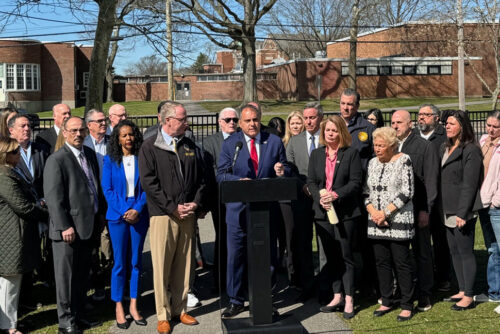
Many residents expressed a fear that the integrity of the LPRD would be forever jeopardized if these variances were granted by the Town, because it would be precedent-setting. Residents were so concerned about this possibility that dozens of them gathered at Town Hall from 9:30 a.m. to 5:30 p.m. when the hearings were finally concluded.
The board voted to consider both plots of land together, but as of press time have not yet handed down a decision on the case.