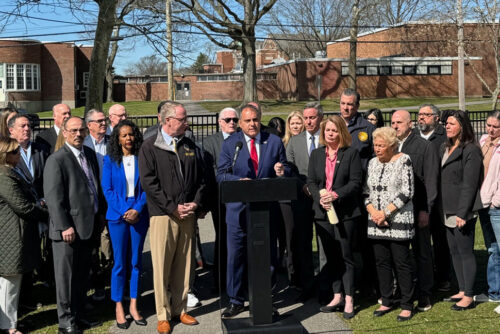
On Friday March 19, the Nassau County Council of School Superintendents, the Nassau District PTA, and the Nassau-Suffolk School Boards Association co-sponsored an event at Brookside School in Bellmore aimed at sharing information, educating, and lobbying local assemblymembers for more state aid for schools.
The lobbying effort was attended by representatives from almost all of the school districts in Nassau County, such as Levittown, Island Trees, Massapequa, Farmingdale, and Herricks. While all of the Nassau County assemblymembers were invited, because of scheduling conflicts the only ones in attendance were Kathleen Murray, Steven Labriola, Thomas DiNapoli, Maureen O'Connell, Jim Darcy, Marc Herbst, and a representative for Tom Alfano. A surprise guest was Suffolk County Assemblyman John Flanagan, the ranking member of the Ways and Means Committee.
Marc Bernstein, superintendent of the Bellmore-Merrick School District opened the legislative rally with a story about a boy at the beach who began throwing the starfish that had washed up on the beach back into the water. When asked why he was doing that when there were too many starfish for him to be able to throw them all back the boy responded, "It makes a difference to each one that I saved." The goal of this program, which is held annually, following the release of the governor's budget proposal, is to help all the children possible and make a difference in their lives.
Kathy Dowling, a representative of the Nassau District PTA and PTA Council President in Farmingdale, spoke about the communities needs and the need for Nassau schools to get their fair share. Dowling spoke of how the expectations of students have changed with the new Regents standards and implored the assemblymembers to help the local school districts financially in their quest to prepare students to meet these challenges. Dowling stated, "Our state aid has not kept pace with the demanding curriculum initiatives required to educate our children today. When appropriate and necessary funding is excluded from the governor's budget these costs will be borne by the local property taxpayer, potentially sapping support for higher standards." She added, "As parents we have fears and concerns with regard to these new changes in education. We also have the right, and more importantly, the responsibility to be vigilant in lobbying our local school boards, along with our legislators, for the funding essential for student achievement."
As a parent, Dowling spoke of the fears that many parents have that it will be their child who is lost in the shuffle if they can't pass that last Regents. This was a theme that has been echoed by many parents across the state since the new graduation requirements were announced by the state education department.
Dr. Herman Sirois, superintendent of the Levittown School District gave some background information about the quality, costs, and state aid in Nassau County's schools. One of the main problems regarding state aid, according to Sirois, is that there are many mistaken beliefs about Long Island schools that affect how much money state legislators are willing to spend on schools that they believe are already wealthy enough. Other mistaken beliefs affecting Nassau schools, he added, are the beliefs that the major cause of school tax increases in Nassau County are increases in school expenditures and that there needs to be legislation passed to curb school spending.
Sirois went on to point out that Nassau schools are superior in standardized test scores, high school graduation rates, college acceptances, daily attendance rates, SATs, Intel Scholarships, Regents exams, and other state tests despite the mistaken beliefs of upstate legislators. He added that besides being superior, Nassau Schools are also cost effective and pointed out that when adjusted for regional CPI (Consumer Price Index) they are only 2 percent higher than the state average, while being the among the highest in student achievement.
Another problem facing Nassau Schools, according to Sirois is that Nassau school costs have only increased 32 percent, while the taxes have increased 40 percent. The local tax increases are due mainly to decreases in state aid and unfunded state mandates. Less than half of the local tax increases are due to increases in school spending.
The president of the Nassau County Council of School Superintendents and Superintendent of the Wantagh School District added that the state also needs to consider the fact that regional costs are much higher on Long Island than anywhere in the state. This cost of living difference is something that is often not recognized by upstate legislators when considering state aid.
Some of the specific issues that were addressed by speakers were, the proposed tax levy cap, the STAR program, the special education formula, charter school funding, building aid, and BOCES aid, all of which are affected by the governor's budget proposal. Steve Witt, president of the Nassau-Suffolk School Boards Association spoke of the promises that Governor Pataki made in return for their support of the STAR program. He said that many of these promises have already been broken. He went on to explain that, on top of the broken promises and unfunded mandates, the governor now proposes a tax levy cap for districts whose budget increases over two years exceeds 140 percent CPI or 4 percent, whichever is lower. Those districts will then have a tax cap equal to 120 percent CPI or 4 percent, whichever is lower. It was pointed out that with the new unfunded mandates and cuts in state aid a tax cap may have to be put on many district budgets every year.
Alice Willet, executive director of the Nassau-Suffolk SBA, spoke about the governor's proposal to change the special education formulas by basing them on a percentage of total student enrollment, adjusted for wealth and poverty. The proposal would also limit the number of special education students to 2 percent per school. Willet asked, "Why should a percentage quota be used to determine the number of students to be served when federal and state laws require the committee on special education to determine the services the students should receive and their placement?" This, along with the governor's proposal to cut BOCES aid, change eliminate the selected aid ratio for building aid, and the problems with funding charter schools with public school money, were some of the major concerns raised by many of the speakers.
According to Pat Assortato, of the Nassau District PTA, "The implication here is that our children are nothing but sacrificial lambs to the bottom line of the budget. The governor's budget, if allowed to stand, will create a crisis in education in New York State. Over the long term, a failure to invest in education will have a devastating affect on our economy and our society as a whole."
Following the speeches by representatives of the many concerned parties sponsoring the event, assemblymembers were invited to share their thoughts on the budget, concerns raised, and what they can do to help their Long Island constituents.
Assemblywoman Kathleen Murray, while not directly speaking about the concerns raised at the lobbying event, told those gathered that in response to many of the concerns raised about the new educational standards since the unveiling of the state education department's plans, the Assembly has formed an educational standards task force, of which she has been named chair. She stated, "As we move forward in the budget process we will consider very, very seriously your concerns and fears."
Assemblyman Marc Herbst spoke about his disillusionment with the state education department and said that the bottom line for state ed is not the kids anymore because so many other issues have gotten in the way. He went on to say, however that despite this, "Long Island and Nassau County still have the best schools throughout the state." He warned the school districts that if they had any building projects they wanted to do, do them now, because soon the money will no longer be provided by the state if the governor's proposal goes through.
Assemblyman Thomas DiNapoli said, "We need to invest in a much more proactive and effective way in our children's schools. So many of the governor's proposals go in the opposite direction." DiNapoli went on to explain that the assembly has passed an Assembly Budget Resolution, stating their commitment to education and rejecting the governor's cuts in education and to add $650 million for schools into the budget. He then told those gathered that they need to go on to lobby the governor as well as the Assembly.
Assemblyman Steven Labriola, in response to the new Regents standards, stated, "A test is not the whole measure of a child, nor is it the measure of a school district." He said it is very important that this point get across to the Board of Regents. He went on to say, "They make policy initiatives and we have to live with them. Some of them are good, some of them we need to question and we need to find out whether or not they are going to serve our children well. We are going to carefully monitor this process, but it is going to be you, the grass roots, that's going to make changes where the Regents have gone wrong."
Ranking Republican on the Ways and Means Committee John Flanagan reviewed the implications of the governor's budget and what the Assembly's role in this process is.
A recurring theme throughout the event was the mutual respect between the Nassau County assemblypeople and their local districts. Many of the speakers spoke about how much the assemblymembers have helped them in the past and asked them, once again, to help Nassau County schools get the additional state aid they need. Assortato summed it up in this request, "Let's stand side by side to let the governor know that he should not deny our children the education guaranteed to them by the constitution of this state."