The People for the Purchase of Alva T. Stanforth, the local grass-roots organization that has been working since early January to absorb the moth-balled school building into the Elmont School District, is now offering to act as mediator in the dispute that has erupted between Elmont's school board and the board of education at Sewanhaka.
"There's no question that the People for the Purchase of Alva T. Stanforth would be very willing to try and mediate between the two districts to arrive at a meeting of the minds," said Richard Mastrocola, a spokesman for the group.
"While it seems that everyone is now getting caught up in this dispute, we believe that its important that this situation be resolved in such a way that it comes to a good end for the community."
The dispute that Mastrocola referred to is in the Letters to The Editor in this week's edition of the Illustrated News.
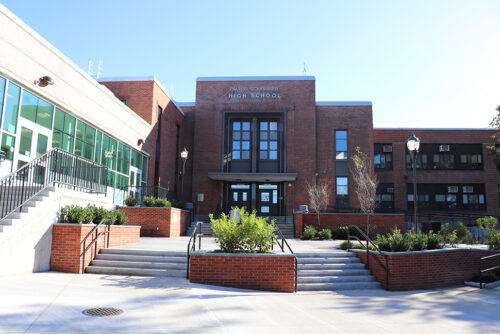
In February, 1998, in order to alleviate a growing space problem in its schools, the Elmont Elementary School District Board approved a contract that effectively cleared the path for the purchase of the Alva T. Stanforth building from the Sewanhaka School District.
All that was left to bring the purchase to fruition was a public vote on the bond issue to pay for it; a vote which was to be held this coming Sept. 24.
However, the Elmont School Board now maintains that an engineering study completed shortly after the contract was signed, indicates that the cost of rehabilitating the building have more than doubled since 1995, when an initial inspection of the building was done.
The cost of needed repairs and renovations, the Elmont Board contends, is now close to $11 million, up from the original $7 million figure written into the contract.
While many municipalities might respond to such a situation by simply issuing more bonds than it had anticipated, the Sewanhaka School District, for reasons of its own, insisted that a provision be included in the contract that would cap Elmont's expenditures on the building at $11 million, a figure encompassing both the purchase of the building and renovations.
Elmont is now crying foul, while Sewanhaka has hit back in its own Letter to the Editor, contending that its estimates on repairs were accurate and that the elementary school district needlessly inflated the figure on its own by desiring to augment an unnecessary "wish list" of improvements.
Whatever the case is in reality, the dispute has turned out to be a referendum killer.
The local finance law of New York State prohibits any school board from offering a bond in an amount insufficient to meet the cost of the project. That being the case, in light of the new figures Elmont is claiming as correct, the contractual cap on expenditures has become a legal barrier to the much-anticipated referendum.
Over the past several weeks, the Elmont board has publicly questioned the integrity of the Sewanhaka board, defiantly questioning whether Sewanhaka ever negotiated in good faith, and pointedly asking why the high school district allowed the empty building -- classified as a 137,000 square foot storage shed in State Education Department records -- deteriorate to the degree they claim it has.
In late June, the Elmont board requested that Sewanhaka increase the spending cap, opening the door to a larger bond issue and therefore allowing the referendum to be held as scheduled.
According to the Elmont board, Sewanhaka officials stated they would agree to change the contract only if Elmont paid an additional $1 million for the purchase, the price rising from $3 million to $4 million on a property currently assessed at $3,250,000.
On July 9, Elmont unwilling to pay more for the building than had already been agreed upon, the Sewanhaka board rejected the request for an increased cap.
More recently, members of the Elmont board and administration have accused Sewanhaka of failing to disclose pertinent information about the condition of Alva T. Stanforth.
Sewanhaka has responded by characterizing Elmont's various contentions as a series of myths.
To begin with, the Sewanhaka board has said, they stand by their figure for renovation costs -- a figure they've said was always $8 million, not the $7 million bandied about by the Elmont board.
This figure, Sewanhaka contends, would be sufficient to bring Alva T. Stanforth up to "basic operating condition."
The study conducted by Elmont this spring, they continued, aimed not to assess the cost of bringing the school up to basic operating condition, but up to "ideal form."
Lastly they contend that Sewanhaka's inspector visited the building at least twice during the negotiations of the sale -- and most recently on Aug. 5 -- and repeatedly found the building sound.
As for accusations of skulduggery, Sewanhaka's board said such underhandedness would be impossible, as two of the elementary school board's members also serve on the Sewanhaka school board.
"It's very difficult to say something responsible when it comes to what has transpired in recent months," Richard Mastrocola said. "As it stands now, the two school boards are fighting tooth and nail, and you don't really want to say anything, for fear that it will only cause more of a mess.
"The bottom line for our group is that the elementary school district has a space requirement that's swallowing it alive, and the proposed purchase of Alva T. Stanforth fills a real need here."
"The purchase and refurbishing of ATS really would be a very effective and satisfying way to resolve the space issue in Elmont," he continued.
As for the controversy, Mastrocola said simply that it has often left him scratching his head.