Several Taco Bell restaurants across Long Island were closed last week after an outbreak of E. coli 0157:H7 over the course of the past week. Last week, six Taco Bell restaurants within Nassau County were asked to voluntarily close down, discard their food and disinfect their premises. They include the Broadway and Roosevelt Field Mall restaurants as well as the East Meadow, Hempstead, Seaford and New Hyde Park locations.
As of press time, the Nassau County Department of Health received reports of nearly 81 Nassau County residents who became ill after eating at Taco Bell restaurants. Included are 10 people who were hospitalized, three with confirmed cases of E. coli. In Hicksville, there are nine reported suspected cases at the South Oyster Bay Road restaurant and one at the Old Country Road location.
While earlier preliminary test results of green onions were "presumptive positive" for E. coli, which prompted the company to immediately remove them from its 5,800 restaurants as a precautionary move, the New York State Department of Health earlier this week said there wasn't confirmation that the green onions were the source of the current E. coli outbreak.
The health department then looked to white onions collected Dec. 4 from a Taco Bell in Hempstead as the source but, on Dec. 13, the Food and Drug Administration (FDA) and Centers for Disease Control (CDC) confirmed that it had concluded a statistical analysis on the company's food ingredients that indicated lettuce appears to be the most probable source of the E. coli outbreak in New York, New Jersey, Pennsylvania and Delaware. The CDC reconfirmed that this outbreak is limited to these four states only, and that no person has become sick after eating at Taco Bell since Dec. 3.
"I want to reassure our customers that our food is perfectly safe to eat. Food safety is Taco Bell's number one priority and we have taken immediate actions to safeguard the public's health from the moment we learned of an E. coli outbreak associated with our restaurants ... We continue to be deeply concerned for those who have become sick," stated Greg Creed, president of the Irvine, CA-based Taco Bell Corp., on the company's website.
The CDC's analysis is based on a statistical probability after conducting interviews with those who have become ill. Lettuce is served in approximately 70 percent of all Taco Bell menu items, which increases the probability it is the source according to the CDC. Taco Bell hired an independent scientific laboratory, Certified Laboratories in Plainview, which conducted tests on more than 300 samples of all the ingredients served in Taco Bell restaurants. No ingredient, including lettuce and cheese, tested positive for the E. coli 0157:H7 bacteria. All cheese used by Taco Bell is pasteurized and because of this, it is highly unlikely to be the source of the illness, according to the CDC.
The lettuce supplied to Taco Bell restaurants in New York, New Jersey, Pennsylvania and Delaware was grown by various farmers and shipped to the company’s former produce supplier. The lettuce was rinsed, cleaned and packed, and sent to a distribution center in Burlington, NJ for shipment to all Taco Bell restaurants in the above-mentioned states. Taco Bell purchases less than 20 percent of the lettuce produced by this supplier. The remaining 80 percent of the lettuce is sold to others throughout the region. Taco Bell switched produce suppliers for the region to Taylor Farms on Dec. 9 as a strictly precautionary measure. All the lettuce sold in these restaurants today is from a different source, and anything sold prior to Dec. 3, the last date of illness related to Taco Bell, has long been sold or discarded.
"Lettuce is sold in approximately 70 percent of our products. We would expect the vast majority of those who ate at Taco Bell to have consumed lettuce, so we can understand how the CDC has concluded their statistical probability analysis," stated Creed. "In addition, we've been informed by the CDC and FDA that a handful of the people who became ill did not eat at Taco Bell."
He continued, "We are committed to our customers to supporting an industry coalition including government regulators, competitors, suppliers, and other experts so we can develop improved guidelines and procedures to safeguard the produce supply chain and public health."
E. coli 0157:H7 is a leading cause of foodborne illness and is often characterized by bloody diarrhea, abdominal cramps and little or no fever. People become infected in a variety of ways, especially by eating undercooked ground beef or contaminated fresh vegetables. Symptoms usually appear about three days after exposure, but can emerge anywhere from one to nine days.
Most people recover without specific treatment in five to 10 days. However, young children and the elderly may be at increased risk of developing hemolytic uremic syndrome, or HUS, a serious condition characterized by red blood cell destruction and kidney failure, that can result in death. Those who may be experiencing any symptoms of E. coli 0157:H7 infection should immediately seek medical care.
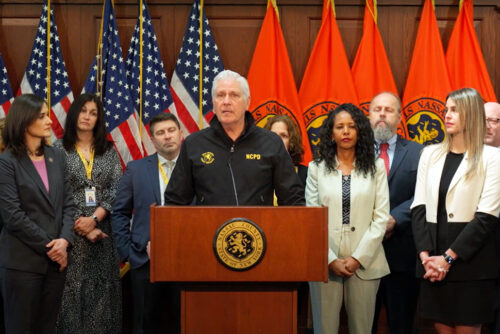
"We are taking every possible step to protect and inform the public as quickly as information becomes available," said County Executive Tom Suozzi during a press conference Dec. 6. "The county's health department has been inspecting the Taco Bell locations suspected of being involved in this outbreak and are making sure the proper procedures are being followed before they reopen." He added, "We are continuing to work closely with the New York State Department of Health, the Centers for Disease Prevention and Control, Suffolk County and Taco Bell to closely monitor the situation."
In response to the recent outbreak, Congresswoman Carolyn McCarthy (D - Mineola), in a prepared statement, said that this recent E. coli scare "must serve as a wakeup call to Congress to increase the oversight and funding for the responsible agencies. Federal efforts to monitor our nation's food supply have been hampered by jurisdictional restrictions and decreased funding for the Food and Drug Administration (FDA), the agency responsible for monitoring and testing non-meat food products. The reduction in funding for the FDA has caused 25 percent fewer on-site inspections of agricultural processors in 2006."
She continued, "Both the House and the Senate have introduced measures that will increase the safety of our food supply. I am a co-sponsor of HR 1507, the Safe Food Act, which will coordinate the federal inspection of food products. I will continue to monitor the situation and press for legislation that will fully fund the FDA and properly protect American consumers from contaminated food products."