News Sports Opinion Obituaries Contents
News
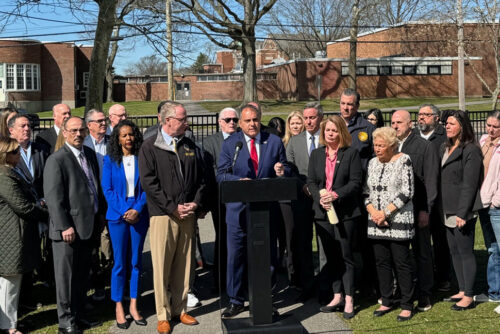
Nassau County Chief Deputy Comptroller Jane Levine, Nassau County Comptroller Howard Weitzman, New York State Senator Michael Balboni, and Nassau County Board of Assessors Chairman Harvey Levinson at the Dec. 19 press conference.

"Nassau County has too many layers of government. In addition to the county, three towns, two cities and 64 villages, there are more than 200 other districts with taxing authority, not including school and library districts. They have wildly varying tax rates, and, unfortunately, many of them have little or no public accountability," said Comptroller Howard Weitzman at a Dec. 19 press conference in Mineola.

In response to his beliefs that many of Nassau County's more than 200 special tax districts may be seriously mismanaged and unaccountable to taxpayers, Weitzman released Nassau County Special Districts: The Case for Reform, a 25-page "white paper" study that calls for a non-partisan Nassau County conference on special tax districts to oversee a comprehensive review of their structure, operations and budgets as well as to recommend whether they should continue to exist, be combined or otherwise be reformed. In addition, the comptroller's office will immediately begin a financial review of nine Nassau County water districts - three in each of Nassau's three towns; the Hicksville Water District is among the initial ones to be audited.

"If we are ever going to contain property taxes in Nassau County, we need to find ways to reduce the number of taxing jurisdictions in this county and make them more accountable to the taxpayer," stated Weitzman. "Our analysis of this issue is contained in a white paper we are releasing today entitled Nassau County Special Districts: The Case for Reform. Based on our experience auditing sanitary districts earlier this year, we are convinced that a lack of oversight and transparency is common in commissioner-run special districts, and may well exist in other types of special districts. The effect is all too clear - waste, inefficiency, and sometimes worse, with Nassau's beleaguered taxpayers footing the bill."

The goals of the comprehensive review will include: examining the structure, operation and budgets of all special districts operating in Nassau County; recommending changes to the structure and governance of special districts, including consideration of whether existing commissioner-run districts should be combined, merged into town-run districts or disbanded and whether existing town-run districts should be combined; reviewing the sufficiency of existing oversight, and the need for additional legislation and controls to increase accountability and transparency; and examining whether there should be legislative reform of the election process.

The white paper finds that many of the 200-plus special taxing districts in Nassau have certain attributes in common, including a lack of budget accountability (i.e., district budgets are often not reviewed by a higher government body, such as a town board, even if statutory authority may exist for such reviews); a lack of transparency (i.e., few or no public meetings and a lack of information about district operations made available to the public); inadequate administrative, personnel and financial controls, resulting in unnecessarily high costs to taxpayers; and elections held at inconvenient times for which little public notice is given, and for which voter turnout is unacceptably low.

"People are beginning to 'connect the dots' between these wasteful practices and high property taxes. Therefore, I believe the public may be more willing than ever before to consider new ideas for streamlining or consolidating this overabundance of local government, and making it more financially responsible. I believe this can be accomplished with no reduction in the quality of local services," stated Weitzman, who was joined at the press conference by representatives from both the Town of Oyster Bay and Town of North Hempstead, Nassau County Board of Assessors Chairman Harvey Levinson and New York State Senator Michael Balboni.

The comptroller's decision to audit nine water districts follows on the heels of his early 2005 reviews of five sanitation districts in the three towns. Through these audits, Weitzman found millions of dollars in waste and extremely lax financial controls in four out of the five districts. As a result, New York State Comptroller Alan Hevesi and the Nassau County District Attorney's Office initiated independent investigations, which are currently ongoing.

As it currently stands, Nassau County water districts selected for review include, in the Town of North Hempstead: Manhasset/Lakeville, Garden City Park and Westbury (which are each water and fire districts); in the Town of Oyster Bay: Jericho, Hicksville and Plainview; and, in the Town of Hempstead: East Meadow, Franklin Square and West Hempstead. The districts, which include both town- and commissioner-run organizations, were selected after an analysis of financial statements and a comparison of the property tax burdens for all water districts. The analysis compared such factors as district revenues, expense levels, tax rates fund balances and year-to-year increases or decreases in expenses. Following the initial review of the nine aforementioned districts, the comptroller will select a smaller group of districts, which will also be selected to undergo full operational and financial audits.

According to Hicksville Water Commissioner Karl Schweitzer, the district looked at everything Weitzman outlines as a discrepancy in his white paper to see if they could make improvements and noted that Hicksville "meets the comptroller's recommendations." He said that the Hicksville Water District's goal is to continue to provide residents and commercial interests with a safe and sufficient supply of drinking water.

"We are striving to meet service quality standards while keeping costs down. We believe that the people we serve benefit from a community based and administrated water supply system," Schweitzer said. "The concept behind permitting local governments to provide essential services is to permit the local community and its voters control over how these services are provided." He added, "In Hicksville, we pride ourselves on our level of responsiveness to our community. We never forget that it is our neighbors who we are serving ... We cannot be compared to a sanitation district and by doing so, [Weitzman] is painting everyone with the same brush."

Schweitzer said that while Weitzman's whole purpose of the audit is to eliminate duplicate services, conducting an audit of Nassau County's water districts is a duplication in and of itself, particularly since the Hicksville Water District was audited by the state three years ago. "We are absolutely on the up and up [and] have always gotten favorable remarks," Schweitzer said. "We look forward to the comptroller's plan to audit and analyze both our water district and local government model for managing the public water supply, and plan to fully cooperate in this endeavor."

"We must formulate a master plan for the 21st-century provision of services currently provided by special districts that were formed in response to the needs of the early 20th century," Weitzman said.

The white paper recommends that the structure and administration of town-run special districts be examined. As a first step, Weitzman recommends that all stakeholders, including local and district officials, state legislators and representatives of community and business groups meet to establish a plan for conducting a comprehensive examination of county special districts and for the development of recommendations for reform.

"It's clear that high taxes are already the number one issue in Nassau County. But taxpayers have become even more concerned this year as reports of waste and abuse surfaced in one local tax district after another. We have seen revelations about the misappropriation of funds by local school district officials; waste and abuse at local sanitary districts; and over-spending by local fire departments, as detailed in Newsday's recent investigative series. These reports demonstrate how easily excessive and wasteful spending and poor personnel, contract and property management practices, can flourish in the absence of rigorous financial controls and oversight," said the comptroller.

In conducting his own analysis of some 400 taxing authorities in Nassau County earlier this year, Levinson said he wasn't surprised to learn that water provider usage charges were as widely varied as the property tax rates imposed by other special taxing districts operating through each town. According to the assessor, the variation of water usage charges based on a typical residential use of 100,000 gallons per year showed that homes in the Town of Hempstead are charged anywhere from $79 to $426 with property taxes ranging from $38 to $205 for a house valued at $450,000. A similar sampling examined in the Towns of North Hempstead and Oyster Bay, however, showed a water usage charge ranging from $84 to $330 and a property tax levy varying from $5 to $300 for a property of equal value.

"When a glass of water costs more than a glass of milk or your neighbor across town is paying a different price for a glass of water, you have to question whether or not your money is being well spent and if there isn't a better way to provide services for these rapidly aging water systems," said Levinson.

The assessor, who in the past has called for a statewide review of Nassau County's school and special districts, suggests placing all Nassau's public water districts under a single water authority, similar to the Suffolk County Water District in which the residential charge is approximately $200 for 100,000 gallons of water used each year.

Creating a possible Nassau County Water District, however, would require statewide reform. "Since public authorities fall under the jurisdiction of the state, regulatory action is needed to create a regionalized approach, single tariff pricing and a uniform tax rate by town," said Levinson. "It is my hope that increased scrutiny aimed at these 'invisible' layers of taxation will result in an exchange of ideas and creation of a water delivery system that will provide substantial tax savings to all homeowners throughout each town."

In response to the comptroller's white paper, New York State Comptroller Alan G. Hevesi said, "Comptroller Weitzman has performed an important public service with his audits of the sanitary districts and now his white paper on the many levels of government in Nassau County. Both his audits and ours have clearly shown that when there is no oversight, some organizations will be well run, some will be poorly run and, in some, there will be corruption." He added, "Clearly, there are too many government bodies with too little oversight. I support his call for a Nassau County conference to bring together all the parties to develop a plan for maintaining services while reducing the cost to taxpayers."

To facilitate planning for the event, the comptroller's office will distribute copies of Nassau County Special Districts: The Case for Reform to district, town, county and state officials. Copies are also available at www.nassaucountyny.gov/comptroller.


LongIsland.com Logo
An Official Newspaper of the
LongIsland.Com Internet Community


| antonnews.com home | Email the Hicksville Illustrated News|
Copyright ©2005 Anton Community Newspapers, Inc.
All Rights Reserved.

LinkExchange
LinkExchange Member

Farmingdale Observer Floral Park Dispatch Garden City Life Glen Cove Record Pilot Great Neck Record Hicksville Illustrated News Levittown Tribune Manhasset Press Massapequan Observer Mineola American New Hyde Park Illustrated News Oyster Bay Enterprise Pilot Plainview Herald Port Washington News Roslyn News Syosset Jericho Tribune Three Village Times Westbury Times Boulevard Magazine Features Calendar Search Add An Event Classified Contacting Anton News