|
|
A map of the former Sylvania Plant on Cantiague Road in Hicksville. Soil remediation has been proposed for certain areas.
|
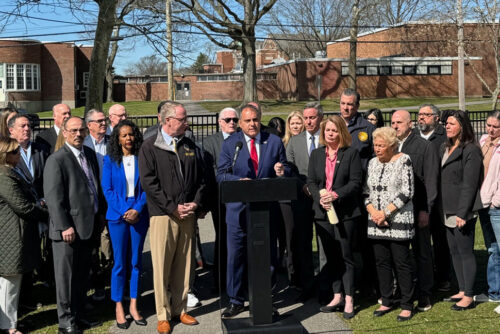
The New York State Department of Environmental Conservation (DEC) will hold a public meeting to present its proposal for soil remediation at the former Sylvania Electric Products Incorporated Facility located on Cantiague Road in Hicksville. The meeting will be held in the Burns Avenue Elementary School on Wednesday, Dec. 11 at 7:30 p.m.
At the meeting, DEC and State Department of Health staff will review the history of the site and describe the results of soil investigations completed to date and the proposed remediation work plan. Meeting participants will be given the opportunity to ask questions and provide comments on the proposed plan. Written comments also may also be submitted to: Robert Stewart, Project Manager, NYSDEC, SUNY Building 40, Stony Brook, NY 11790-2356. The comments must be submitted by Dec. 27. Based upon the public comments received, DEC may modify its proposal or select a different course of action.
The Sylvania facility was primarily used for the manufacture of nuclear fuel elements for reactors between 1952 and 1967. Uranium and thorium were the primary elements used for these fuel elements. Process wastes were reportedly discharged to four on-site recharge basins and to two industrial leaching pools.
The site is bordered on the north by the Nassau County Department of Public Works facility, on the west by Cantiague Rock Road, on the south by the General Instruments Inactive Hazardous Waste Disposal Site, and on the east by Cantiague Park. Groundwater, which occurs at approximately 70 feet below land surface, flows toward the south. The site is currently divided into three parcels.
In December 1986, buried drums were discovered on the southernmost parcel, an area operated by Air Techniques. These drums contained waste solvents which were attributed to former operations involving the manufacture of reactor fuel elements. Approximately 57 drums and 80 to 90 cubic yards of contaminated soils were removed in 1987. Investigation revealed groundwater contamination by tetrachloroethene and trichloroethene, both common industrial solvents used for degreasing of metal parts. This contamination was discovered in both upgradient and downgradient test wells. Radiation contamination was discovered on parts of the site in 1995.
GTE Operations Support Inc., a corporate successor to Sylvania, has agreed to investigate the contamination and remediate the site to allow unrestricted use. The extent of soil contamination was defined during investigations conducted from 1999 through 2001. Results of these investigations were provided during a public meeting in May 2001.
The primary contaminants found in the investigations are uranium, thorium, tetrachloroethene, trichloroethene and nickel. Most of the contamination is located in the eastern portion of the 140 Cantiague Rock Road parcel and in the south-central and eastern portions of the 100 Cantiague Road parcel. There is also limited soil contamination in the northern portion of the 70 Cantiague Road parcel. Two small areas of soil on the adjacent golf driving range, just outside the eastern site border, have minimal amounts of contamination.
All of the soil with contamination that exceeds the proposed cleanup objectives is currently covered by asphalt or concrete. This surface cover prevents direct human contact with the contaminated soils and shields site workers from exposure to radioactive materials in the underlying soils. Under the current site conditions, no health hazards have been identified for site workers or the general public.
The proposed soil remediation consists of excavation of all the affected soil with levels of contamination above the proposed cleanup objectives for the site. These cleanup objectives have been selected to allow unrestricted future use of the site. The planned extent of initial soil excavation is based on numerous soil samples. The excavation will be expanded if sampling from the sides and bottom of the excavated areas show remaining contamination levels above cleanup objectives. A supplemental soil investigation is in progress. The objective of this investigation is to better define the necessary area of excavation and establish appropriate locations for shoring.
Several measures will be used to ensure that workers, the general public and the environment will be adequately protected during the remedial activities. Security personnel will ensure that unauthorized personnel are not allowed on the site. Areas under excavation will be covered with a temporary enclosure to prevent dust and vapor migration while the air inside this enclosure will be treated, as necessary, to remove air contaminants. A community air-monitoring plan will be implemented to monitor air emissions and to prevent exposures to the public and continuous monitoring for both chemical and radiological contaminants will be performed during all excavation activities.
At the completion of the excavation, confirmation and verification sampling will be performed to ensure that cleanup objectives have been met.
Excavated contaminated soils will be placed in large bags designed for this purpose and shipped to an approved off-site treatment, storage and disposal facility in Utah. The bags will be moved by truck to a railroad siding on West John Street, approximately one mile from the site. The bags will be loaded immediately on railroad cars at the siding and there will be no waste storage at the railroad siding. The excavation is tentatively scheduled to begin in May 2003 and is expected to be completed by November 2003.
On-site and off-site groundwater contamination is still under investigation. There are no known users of the contaminated groundwater close to the site. However, there are five active public drinking water supply wells which are located slightly more than one mile from the site that and could be downgradient of the site. Each of these drinking water wells is affected by volatile organic compounds. However, the water from these wells is treated to remove these contaminants prior to distribution to the public. These treated drinking water supplies are routinely sampled to ensure that they meet stringent state and federal drinking water standards.
At this time, it has not been established whether the Sylvania site is contributing to the contamination that which has been detected in any of these public supply wells. There are other potential sources of chlorinated solvents in the surrounding industrial area.
Copies of investigation reports and other site documents are available at the Hicksville Public Library and at the DEC's regional office in Stony Brook. Information is also available at or by calling Mark Lowery at (631) 444-0350.