News

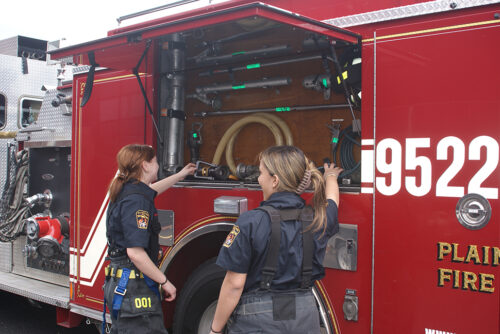
The lead researcher from the consulting firm Center for Governmental Research, Joseph Stefko, Ph.D. faced a roomful of firefighters and EMTs at the first public meeting on studying the prudence of consolidating fire districts and ambulance services and flatly stated, "I know you come here with concerns and may be suspicious, but I represent an independent, objective organization...we have no preconceived notions about this study...no cookie cutter approaches." He went on to add that the first step is to analyze the current service delivery framework and then to identify options for enhancing the quality and cost effectiveness of emergency services in the Town of North Hempstead.

He introduced Hofstra University researchers, among them Richard Guardino, Jr. who was a former supervisor for the Town of Hempstead, is now vice-president for business development at Hofstra and was a member of the Governor's Commission on Local Government Efficiencies and Competitiveness.

The attorney who will "provide analysis of laws regulating consolidation and the legal ramifications of taking on debts and assets" is Michael Sahn.

Town supervisor Jon Kaiman tried to hit a reassuring note by saying that the baseline data gathered through the study could provide a foundation for further grant applications or budget increases if needs are identified. "Could we look for a new way to do this in the future?" he queried.

The first question raised by a fireman was to the point. He said, "There's a rumor going around that this study is the beginning of a take-over by North Shore Hospital for ambulance calls. Is that true?"

Dr. Stefko gave an unequivocal, "No."

Another firefighter from New Hyde Park said, "The cardinal point of utmost importance is public safety. If we could save some dollars, that would be great, but you have to understand that our number one priority is effective service."

Andrew DeMartin, chairman of the board of the Vigilant Fire Company and commissioner for Manhasset Lakeville Fire and Water District, pointed out that if current redundancies were eliminated, first responders might not be able to effectively deal with "large-scale incidents" such as hurricanes, blizzards and blackouts. Mutual aid, the term that describes the assistance frequently given by one fire department to another in working emergencies, takes place smoothly. According to fire fighters, mutual aid provides a seamless continuity of service that supercedes any benefits of consolidation and without the legal and financial headaches.

Mr. De Martin said, "I don't care what any study says, I know you can't beat the cost of free labor and you can't beat the quality of service we provide."

Great Neck Village Officials Association President Leonard Samansky backed up the firefighters responses by saying, "We are very happy with our service in Great Neck and don't want to see it diminished."

After the meeting, one of the firefighters reminded the Record that this past summer, the Nassau County Central Communications Center, that dispatches 911 calls was knocked out by a lightning hit, seriously damaging switching devices that control the radios and also causing the computer system to crash. Local dispatchers in Great Neck, Port Washington, North Bellmore, Locust Valley and Rockville Centre came to the rescue and filled what could have been a disastrous void, one that lasted for two hours.

Firefighters explained that one of the challenges they face in providing ambulance service is a need for public education. Some members of the public have taken advantage of the free service by calling an ambulance for transportation to the hospital. Volunteers spend hours in training to hone their skills and give up hours of personal time with their families to rush to calls; they really want to help people in need. But to drop everything and dash to a non-emergency is not only a waste of a valuable service, but might imperil responding to a true emergency as quickly.

Great Neck households pay, through their village or town taxes, $40 a year for ambulance service and the response time averages 8 minutes. On the peninsula, there are two ambulances located at the Vigilant Fire House and one located on the north end of town at the Alert Fire House on Steamboat Road. The EMTs are based at the Vigilant Fire Company, but the Alerts have trained EMTs who provide emergency services as well.

Manhasset-Lakeville, although covering a large geographical area, responds to 800 calls a year. The reason they have fewer calls than the Vigilants is because they provide supplemental back-up to Nassau County's police ambulance bureau.

The Vigilants respond to 2,000 calls a year. The area north of the Long Island Rail Road is not serviced by the county's ambulance system. According to Andrew De Martin, the Vigilant's ambulance service is robust, fully staffed during day and evening hours.

That is not the case everywhere. The Village of Rockville Centre, due to a shortage of volunteers to respond during the day, recently entered into a 6-month trial contract with North Shore Hospital for ambulance service with an allocation of $200,000 in the village budget to cover costs.

Privately, firefighters tell the Record that there has been a long-standing disagreement between the fire companies and some village officials regarding insurance reimbursement for ambulance calls. Under state law, volunteers are not allowed to take payments and they are not inclined to get involved in the paperwork that insurance collection would require or volunteer their services to create a revenue stream for a municipality.

The Request for Proposals (RFP) document produced by the town and Great Neck Plaza and obtained by the Record spelled out the intentions behind doing a feasibility study, clearly stating: "The primary goal is to determine the optimal organizational structure to create in order to consolidate ambulance and EMS services, in a way that will enhance service delivery, streamline processes, reduce cost per call, reduce EMS response times, increase insurance revenues, reduce geographic service duplication, create transparency in organizational operations and budgets, and increase efficiency."

The RFP focused at great length on the amount of money that could be generated by filing insurance claims, $350 per ambulance call.

So while the lead researcher, Dr. Stefko, stated there is no hidden agenda at play, many of the first responders who spoke to the Record under conditions of anonymity remain skeptical about the Town of North Hempstead and Village of Great Neck Plaza's intentions. In spite of their misgivings, they are cooperating with the researchers, providing information about current conditions.

The timeline for producing a draft report with recommendations for public comment is June 2009. The study is funded by a $180,000 grant from the New York Department of State.


LongIsland.com Logo
An Official Newspaper of the
LongIsland.Com Internet Community


| antonnews.com home | Email the Great Neck Record|
Copyright ©2008 Anton Community Newspapers, Inc.
All Rights Reserved.

LinkExchange
LinkExchange Member

Farmingdale Observer Floral Park Dispatch Garden City Life Glen Cove Record Pilot Great Neck Record Hicksville Illustrated News Levittown Tribune Manhasset Press Massapequan Observer Mineola American New Hyde Park Illustrated News Oyster Bay Enterprise Pilot Plainview Herald Port Washington News Roslyn News Syosset Jericho Tribune Three Village Times Westbury Times Boulevard Magazine Features Calendar Search Add An Event Classified Contacting Anton News