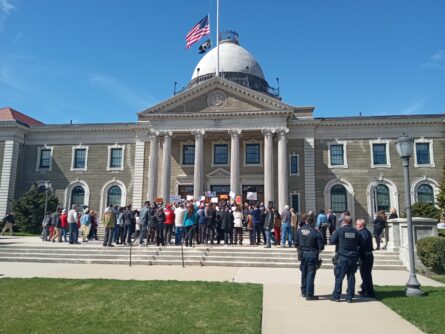
As the Village of Great Neck's zoning board of appeals once again heard the case for variances for a proposed mikveh on Wood Road, the meeting turned nasty. The anger one mikveh attorney complained of coming from the public, at this meeting, actually came from the two attorneys for the mikveh. No real progress was made at this April 3 hearing; instead, the board spent the long hours trying to achieve peace as they sought to work through the variance requests.
|
|
Mikveh attorney Steve Schlesinger threatened to take the Village of Great Neck's zoning board to court if they turn down the mikveh project as is.
|
Bahary Architects P.C. made the application for Ohr Haemeth, The American Society for Torah Education in Latin America, Ltd., asking for three variances for a stand-alone mikveh building at 48, 50 and 52 Wood Road, where a conditional use permit also is being sought for a religious use. The permit is covered under federal legislation, RLUPA (Religious Land Use and Institutionalized Persons Act), which essentially forces the local municipality to accommodate the religious institution.
The variances include: relief for insufficient frontage on Wood Road, since this project provides only 159.1 feet of the required 200 feet; relief from insufficient front yard distance from the street, since this project only provides 20 feet instead of the required 35 feet; and permission for a two-family residence, which is not permitted in this Residence D District.
The proposed mikveh would be a 6,157 square foot building. In addition, they are asking for two residential apartments, for an attendant and a rabbi. To achieve all of this, two houses on the lots would have to be demolished.
The hearing began with architect Robert Bahary presenting the site plan. As he began, BZA Chairman Dennis Grossman noted that the plan showed none of the suggestions they had made at a prior hearing. Mr. Bahary said that it would be too much of a "hardship." Mr. Grossman spoke of his concern regarding the pressure of more traffic in this already high-traffic area.
Mikveh attorney Steven Schlesinger then complained that this project has taken too long to receive approval; he added that his client is unwilling to go through any more revisions. Mr. Grossman replied that the board wants to work with the applicant "in the best interest of the community, the neighbors and the applicant." Mr. Schlesinger said that he wants the board to rule on the project "as is."
At that point Mr. Grossman reminded the applicant that the application was not even completed until this past December, and that there were many questions, and "things evolved for the benefit of the community as a whole."
Zoning board member Nick Nabavian stated that the board just cannot approve the current plans. He emphasized that the board very much wants to work with the applicant, but that approval at this time "is just not feasible."
Ms. Schlesinger then commented that the plans must be as drawn because the applicant might one day want to expand, if the near-by Friendly Taxi property became available.
Village resident Leon Korobow said that he was "shocked" by Mr. Schlesinger's statement and said that the board should not grant a variance based on a possible future sale. Mr. Korobow reminded everyone that it is the residents who will "foot the bill" if the application is granted, since then the property would come off the tax rolls. "I don't think this is a clear benefit to the community," he said.
A discussion of RLUPA followed and Mr. Korobow stated that the applicant appears to have "a feeling of entitlement."
Mikveh co-counsel Murray Honig then complained of the "aggravated atmosphere" surrounding the hearing. Mr. Grossman reiterated that his goal was for "an open playing field," and that he wanted "the best answer that suits everybody." He once again broached the traffic issue and said that studies in the area have shown traffic at 135 percent of capacity on Wood Road. And board member Victor Habib added that it is "not unreasonable to try to adjust to accommodate everyone."
Board member Steven Markowitz stated that "the community is concerned about this project." He emphasized community concern over the impact of another new religious institution. "The community is alarmed, to some degree," he said. Later in the meeting Mr. Markowitz explained that the mikveh is a tax burden on the entire village.
A discussion then followed regarding the funding for the mikveh and Ohr Haemeth. Mr. Schlesinger then told the board that they should "realize" its "limitations." He then broached the subject of a "Supreme Court challenge." Mr. Schlesinger told the zoning board should they challenge the mikveh project, they would lose, forcing the village to pay "my $550 hourly fee."
Mr. Grossman questioned why the applicant would want to take the village to court since the board wants to work with them. Mr. Schlesinger said they would "consider reasonable tweaks."
Then the meeting turned angry once more as Mr. Schlesinger raised the issue of the zoning board quickly approving plans for Temple Beth-El several years ago, because, he said, the village attorney is a member of Beth-El. There were audible gasps from the audience. Mr. Grossman stated that they are there to help "anyone in need." He explained that the aforementioned incident came following a devastating fire at the temple and the zoning board did indeed work long and hard, "into the early morning hours," to try to help the temple and the children involved.
Both publicly, and privately during a break, residents asked for an apology from Mr. Schlesinger, but none was forthcoming. Village resident Fred Knauer called the statement regarding Beth-El "malicious," and "uncalled for" and "unnecessary." He called for an apology, but his call remained unanswered.
Several residents then spoke up against the mikveh, while several young women spoke in support. And while many residents addressed the issue of yet another tax burden, the supporters never mentioned this issue.
At 10 p.m. Mr. Grossman adjourned the hearing. It is anticipated that the applicant will appear again before the zoning board on May 1.