News Sports Opinion Obituaries Contents
News

Often during July or August, I'll be asked a variation of this question: "So what do you do all summer?" The implication is that the school district staff are all "away" for the summer months. Nothing could be further from the truth! In fact, the calendar usually has from 50 to 55 workdays between the last day of school in June and the start of the new year in September, and all are crammed with activity in our schools. In July, we offer a most comprehensive enrichment, recreation and remediation program, some of which extends into August. This summer, more than 600 students took advantage of 59 separate courses, ranging from a whole spectrum of remediation to enrichment offerings in photography, music, art, first aid, advanced mathematics and much more. Our summer recreation program enrolled over 1,500 students in myriad activities.Working around all this school-based bustle and movement, somehow our custodial and maintenance staff manage to accomplish a huge amount of cleaning, repairing, updating and modernizing. Floors are stripped, waxed and sealed, filters and ducts are cleaned, masonry is repaired, lighting is always being upgraded for brightness and efficiency, fields and playgrounds are updated, painting gets done, and the list is virtually endless. It all got done in-this summer-53 workdays. Concurrently, the offices are abuzz with the scheduling of classes for students and teachers, ordering of books and supplies, hiring of new staff, and countless other tasks needed to ensure our schools are clean, safe, and "teaching and learning-ready" for the big day when we reopen in September. By mid-August, teachers come back to their classrooms, rearranging, changing, moving, and readying for the return of students.

Dr. Ronald L. Friedman

And suddenly, it's all over! July and August vanish, as they always seem to do all too quickly, and we're into an exciting, new school year. It's no secret that to school students and staff, Labor Day is really New Year's Day! Jan. 1 is well and good as a calendar artifact, but for most of us, the year begins in September. The millennium change, all the "Y2K" issues we faced, seem so far away and long ago as we move along in the last half of this decade. It's a great time, though, to look ahead. In our schools, what will this new year bring? What are the challenges we face?

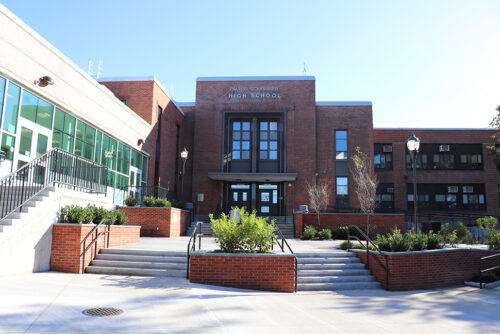
It would truly be easy to fill this space with a listing of what's good about the Great Neck Schools. If you'd like to see a listing, you can go to our website, greatneck.k12.ny.us, click "news" in the left column, and then "district accolades." Yes, North and South High Schools both were listed in Newsweek's "Top 100 High Schools in the Nation." In fact, both were in the top 50. And yes, that listing is based on numbers of students taking Advanced Placement (AP) exams. Newsweek's ranking system has been criticized by some for not taking into account the scores on those exams, only considering total numbers of students enrolled in advanced courses. If the ranking in fact were weighted by scores, Great Neck's schools would likely be even higher than where they are now! Our students' AP scores are well above national norms. And yes, our scores on all other measures that the state uses to "rate" schools and districts range from comfortably above average to "off the charts." Yes, The New York Times ran a feature article this spring showing that families from overseas are actually finding Great Neck, using the Internet, as the place they want to raise their kids, and are moving directly here from across the globe, bypassing traditional intermediary residences in the major U.S. cities prior to becoming suburbanites. Enough. Please go to the "accolades" link for more, if you like. As superintendent, I'm happy about all that. But I'm more proud of other realities.

We're a "diverse" district. "Diversity" is the upscale term du jour for what, when I was a kid, was sometimes referred to a "melting pot." We have a great mix of ethnicities, backgrounds, economic status, abilities and disabilities in our district. I'm proud that we get along and support one another, for diversity builds strength and resilience in a community. I'm proud that we pay attention to all of our students, not just the ones who help make our "accolades" page a long one. We have many "average" students. Are you surprised? Sometimes superintendents and others-parents and staff-in a school district paint a picture that would seemingly place almost everyone over at the extreme right side of the bell curve. Statistically, they're only fooling themselves! Our board of education recognizes that every individual counts, and sets the tone for all of us in the district in that regard. The good statistics will continue to come, as we certainly persist in supporting and adding to the advanced programs and courses we are quite proud of. Our district is nationally recognized for the wealth of programs and courses for our capable students, and we are continually adding to and tweaking what we do for such students. But it's the many "individuals in the middle" who are the majority face of our children. I'm most proud of our goal to ensure that everyone-every child, every family-receives the individual attention they need to succeed, thrive, and feel good about themselves.

Let's look at the matter of "the kids in the middle" a bit more in depth. Consider again the bell curve, which shows how populations of people everywhere are distributed, even in the Great Neck schools. The middle section of any bell curve contains about two-thirds of the people on the entire curve. That's a statistical fact of what are called "normal distributions." Most people are in the middle on most measures one can conduct on humans: intelligence, educational abilities, height and weight, and so on. In our schools, we recognize that fact and ensure that the two-thirds of our youngsters who are in the middle obtain the resources they need to help them to succeed, and most importantly, to feel good about themselves by virtue of real challenges and successes. We start with small class sizes, particularly in the early grades, so that each individual elementary school child can be known as a unique, special person. We recognize that a great deal of growth and learning can happen if you set high expectations, and provide caring, competent support. Encouragement, not belittling, with intelligent mentoring by capable teachers really pays off for our children. Push, but encourage and reward and support at the same time. In the middle and high school years, the same principles are applicable, and the challenge is to ensure that students in such larger settings do not "fall through the cracks." It's a challenge but a critical one and one to which we must and do pay continual attention.

And then we have children with disabilities, or with other significant learning issues that may not technically fall under the very carefully defined and delineated categories called "disability," but nevertheless comprise issues that adversely affect learning. We have made major strides in the past two years to include our youngsters with disabilities in the mainstream with their peers, providing appropriate support. It makes good educational sense for the youngsters with disabilities, their non-disabled peers, and it's the law anyway. The only part of this exciting and educationally prudent process that saddens me are the very few people who complain about this, as though their youngsters were being exposed to something or someone adverse. What a shame for society that such attitudes still exist! Yet the evidence, statistical and anecdotal, is there to support the value of including youngsters with special needs, to the extent it is practicable and educationally sound, in mixed groups, for the good of all involved. Our board of education, staff, and I will continue to look at data and evidence, and not ill-advised emotion, to guide our decision-making.

I'd like to turn to some issues we face, spotlighting two specific tough challenges. The first is one facing all of us in school districts across the country, with particular implications for districts and schools noted for excellence. It is our need to survive and thrive despite the misguided requirements of the notorious federal No Child Left Behind (NCLB) legislation. A posting in U.S. News and World Report on August 23, 2006 reads as follows: "According to a new Gallup Poll, 58 percent of Americans believe the 5-year-old No Child Left Behind law has either harmed or had no effect on schools, compared with just over a quarter who believe it has helped. And while most people approve of NCLB's goal of raising standardized test scores, few seem to support its methods. 'Systematically, the public rejects every strategy in it,' said Lowell Rose, director of the poll . . ." That's a majority of Americans, even those in the so-called "red states."

The NCLB is a piece of federal legislation that is particularly sinister in its details, for it is filled with a web of potential "gotchas" supposedly designed to hold schools accountable, but in reality having the effect of denigrating public education nationwide in favor of vouchers, private/charter schools and elite interest-group-based "academies." The feds and the state require us to "disaggregate" student data into hundreds of groupings, and if any one group of youngsters does not make what is called "Adequate Yearly Progress," we end up on a "gotcha!" list. The requirements for AYP range from reasonable to outrageous. For example, consider the youngsters who come to our country from abroad with no knowledge of English. Up to now, at the end of their first year in the U.S., those youngsters would take a test designed to see how well they are learning English, rather than taking the standard English reading and writing state exams. Next year, that exemption ceases. All children newly arrived will have to pass the regular state English exams a year after they arrive, even those (and there are quite a few) who come with little or no formal education at all, even in their native language. Now, remember the bell curve. Despite their adverse circumstances, many of those students will be able to pass the English state exams in a year, because we will provide them with substantial help and assistance. Yet, there will be enough, naturally, on the lower end of the bell curve; after all, they are human! And - aha! Through the magic of "disaggregation of data," the small group of youngsters who may need another year to read and write sound and excellent English may well become a "subgroup not achieving AYP" (Adequate Yearly Progress), and-you guessed it-Great Neck is on a "gotcha!" list in Newsday! As I mentioned earlier, the number of such disaggregated subgroups is in the hundreds. The law really wants to "get you" if you happen to be a public school district.

The second challenge facing all school districts is dealing with the concerns about funding of public education, nationwide and right here on Long Island. Most proposals "out there" to revise, streamline, or otherwise change school funding formulas do not favor Great Neck, but would likely take dollars from us to distribute to other parts of the Island and state. A formidable ongoing challenge we face is in keeping expenses in check, scrutinizing every dollar we spend, while at the same time retaining the quality services and programs we provide to our students that are the cornerstone of what we are most proud of. Yet fixed costs continue to rise, and we have little or no direct control over much of those costs. Sadly, mandates from the state and federal government abound and are multiplying seemingly without end. Rarely does any funding come along with the imposition of new mandates. And so, we have an ongoing challenge to do more, with less, by increasing efficiencies and by making tough decisions. We have expanded our cooperative purchasing efforts and are using technology to reduce expenses. For example, our energy infrastructure - our boilers, controls, and related systems - are aging and need to be replaced. Most systems are 50 or more years old. For two years, our staff and board of education have worked to develop an energy efficiency project to replace our boilers, heating systems and allied control systems. This project could easily have amounted to a multimillion dollar cost increase in our budget, or a bond issue to fund the project. Instead, we developed a plan to use the substantial energy savings we will realize with new systems in place to fund the costs of the systems themselves. The plan is just about in place, and will allow the upgrades without additional monies allocated in the budget and without the need to fund a bond issue to pay for the necessary energy changes.

Other challenges beyond the two I spotlighted above do, of course, exist. Schools are being asked or required to assume myriad responsibilities that heretofore were in the domain of the home, family, religious institution, or other arms of government. We deal with immunizations, student health, socialization skills and bullying prevention. We help new parents to learn to parent. We deal with drug prevention and intervention, students with very severe and multiple disabilities, dysfunctional families, and more, on a daily basis every day of the school year. In the Great Neck Public Schools we are able to do what we can, and do it well for our children and families, only because we have your support. To our parents, we thank you for all you do to support our efforts on behalf of your children. To those of you without students in the schools, we thank you especially for your support and encouragement. We thank all of the citizens in our school community, with or without school students, for making our community a vibrant, thriving place in which to live, learn, grow and enjoy. And last but assuredly not least, I thank our board of education for their devotion, guidance and unwavering strength to always do what's right and just. As this new year begins, I wish all of the people in our school community a healthy and productive 2006-07 school year!


LongIsland.com Logo
An Official Newspaper of the
LongIsland.Com Internet Community


| antonnews.com home | Email the Great Neck Record|
Copyright ©2006 Anton Community Newspapers, Inc.
All Rights Reserved.

LinkExchange
LinkExchange Member

Farmingdale Observer Floral Park Dispatch Garden City Life Glen Cove Record Pilot Great Neck Record Hicksville Illustrated News Levittown Tribune Manhasset Press Massapequan Observer Mineola American New Hyde Park Illustrated News Oyster Bay Enterprise Pilot Plainview Herald Port Washington News Roslyn News Syosset Jericho Tribune Three Village Times Westbury Times Boulevard Magazine Features Calendar Search Add An Event Classified Contacting Anton News