The Village of Great Neck began a dialogue with local builder Frank Lalezarian to consider the concept of an emergency work force housing project on a piece of undeveloped land behind Old Mill Road, bordering on Great Neck Estates. One large building would be apartments rented by Mr. Lalezarian and the other, smaller building, would be owned by a separate entity that would rent apartments to local first responders (Alerts and Vigilants). Although the mayor and members of the board of trustees appeared receptive, many Old Village and Estates residents questioned the density, the traffic and the prospect of rezoning a single-family district to a multiple-family dwelling zoning district.
Paul Bloom, Mr. Lalezarian's attorney, presented an overview of the "concept" of the project, which, if zoning is changed, should result in 24 work force units. The property is landlocked, and access would have to be either via Old Mill Road or Middle Neck Road (through property owned by Mr. Lalezarian at the corner of Old Mill Road and Middle Neck Road).
Mr. Bloom, stating that he wanted to start a dialogue with the community, said that the project involves 2.6+ acres; he emphasized that he was far from applying for a zoning change at this early point in time. He also noted that the developer would want to develop the property to the maximum, but would not seek any variances.
This preliminary proposal calls for a three-story, 120-unit apartment building and a smaller building, with 24 work force housing units. Mr. Lalezarian would donate the land for the work force housing and pay the cost for design. A separate entity (which could be under control of either the local fire companies or the village) would have to raise the funds to finance the building cost for the work force housing.
Mr. Bloom said that this would be a long process ("a lot of processes"), including SEQRA review (environmental review) and he did not want to even consider the application process until he knew the thoughts of the board and the community. "We're looking for constructive criticism," he said, adding, "We're just showing a concept; we're looking to see if the concept has life."
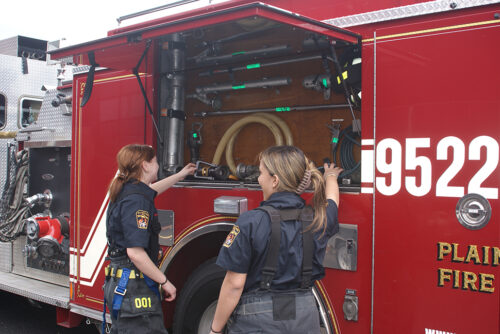
Mr. Bloom did delve into the great need for work force housing for first responders, to keep young firefighters and emergency workers on the peninsula, to avoid having to turn to more costly paid fire companies.
Several Great Neck Estates residents spoke; those who live on Clover Drive border the property that could be turned into a road. All spoke passionately against this upzoning, again, stating the concept of density and traffic, and straining public services such as water and sewers. One such resident, Rachel Applebaum, spoke of the dangers of turning Great Neck into another Queens and she called for a community-wide referendum to see if residents are in favor.
Several Old Village residents also spoke against the project, although the general feeling was in favor of some sort of work force housing, just not in a residential area, and not in an area with so much traffic already. Elizabeth Allen asked why the builder could not consider a "smaller version," more of a townhouse or detached house project. Another questioned why the builder could not include work force housing in his apartment complex already under way at the corner of Arrandale Avenue and Middle Neck Road.
Ken Bleck, chairman of the Vigilant Fire Company, spoke of the real need for such housing. "We need more young people," he said, noting that the high cost of homes in Great Neck is forcing young people, potential first responders, to move. Mr. Bleck also stated that the proposed concept, with 24 work force units, would satisfy a housing need for 20 percent of the current first responder population.
Mitchell Beckerman was the first Old Village trustee to respond, terming the project "a great idea," though he did state that the entire concept "needs to be looked at." Mr. Beckerman then broached the subject of a grant that Mayor Deem had just announced; Mayor Deem reported that he had applied for a $3.5 million grant from the federal government, on behalf of the village, to fund the building costs for the work force project. The mayor had written to Senator Charles Schumer and U.S. Rep. Gary Ackerman, and, as well, had contacted NYS Senator Michael Balboni and Assemblyman Thomas DiNapoli.
Mr. Beckerman explained that the mayor is not permitted, by law, to apply for a grant without the approval of the board of trustees. The trustees had never been informed about the applications. Village attorney Stephen Limmer advised that the mayor may not make such an application without board approval. Mr. Beckerman also added that the trustees had "only heard rumors" about the work force housing, were never informed by the mayor about the project or the grant application, and were never told that News12 would be present at the meeting.
"We're the legislative body and you are the executive," Trustee Mark Birnbaum told the mayor. Mr. Birnbaum assured that the board would certainly be in favor of this action, but the mayor cannot act alone. "We have the legal responsibility," he stated. He also asked if the mayor had read the NYCOM (New York Conference of Mayors and Municipal Officials) manual on the duties and powers of village officials which is given to all village elected officials. Trustee Edna Guilor-Segal noted that the mayor could have "at least asked for our ratification."
Deputy Mayor Ralph Kreitzman also expressed strong support for emergency first responder housing at below-market rental rates and stated that the project added should be seriously considered.
At that point, Mr. Kreitzman also reported that he had recently been told that Mayor Deem had also approached the board of education for permission to use the North Middle School for sheltering village residents during an emergency. A contract had been negotiated and signed, but Mr. Kreitzman said that it is not binding without board of trustees approval. Again, Mr. Limmer agreed. Mr. Kreitzman also noted that, with the input of the board, comprised of two attorneys, an accountant and an architect, with over 40 years of municipal experience, and the public, the agreement might have been better.
When contacted about the contract by the Record, Board of Education President Lawrence Gross stated that "It was our understanding that Mayor Deem represented the village and that the agreement was on behalf of the village." Mr. Gross noted that all school board issues are always discussed before a full board and that he also needs board approval for any authorizations.
The contract, with the Great Neck Public Schools Board of Education, for a sheltering agreement, will officially come before the village board at the next meeting.
As for the grant applications that the mayor signed, there are other problems, in addition to lack of board approval --- the application was made on behalf of the village and Mr. Bloom stressed that Mr. Lalezarian was not giving the property to the village, but to a separate entity that would control the project, possibly an entity comprised of members of the Vigilant and Alert fire companies. Mr. Limmer suggested that the board look into the status of the grant applications and determine what can be done. This, too, will be on the agenda for the March 21 board of trustees meeting.