On the evening of April 2, more than 50 concerned residents attended a meeting in Glen Cove City Hall sponsored by Glen Cove's Substance Abuse Free Environment (SAFE). An organization established in 1981 to combine the strengths of the public and private sectors in the Glen Cove community to provide alcohol and drug prevention services, SAFE held the meeting to report on the Bach-Harrison Prevention Needs Assessment (PNA) recently administered to Glen Cove students, school faculty and parents.
|
|
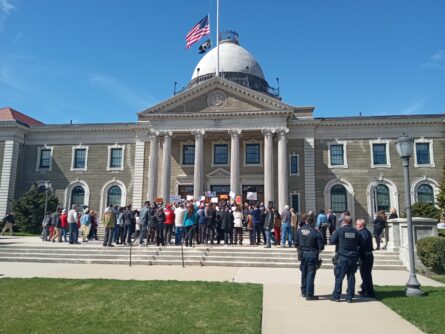
SAFE board, committee and staff members presented the results of the 2008 Bach-Harrison Prevention Needs Assessment relating to drug and alcohol use among the youth of Glen Cove to concerned residents. Pictured are presenters and attendees at the city hall meeting.
|
In 2004, SAFE, Inc. received a Drug-Free Communities Support Program Grant from the Office of National Drug Control Policy, making it one of only 224 agencies nationwide to be so awarded. The object of the grant was to change societal norms about alcohol and substance abuse through a sustainable coalition of city leaders, school district personnel, SAFE board and staff members, parents, youth, and private citizens. The coalition is overseen by SAFE's Board of Directors and co-chaired by Executive Director Dr. Sharon E. Harris and Glen Cove School District Director of Administrative Services Dr. Joseph Hinton. The board is made up of parents, police personnel, educators, and health care, financial and business professionals.
The SAFE coalition is comprised of four committees: youth, community, parents, and school, and representatives of the committees were on hand to hear the findings of the PNA as compared to the PRIDE (Promoting Responsibility in Drug Education) Survey, administered in 2005. Professional facilitator and grant evaluator Dr. Bernard Gorman, who works with the coalition to ensure its effectiveness and sustainability, presented the assessment findings in a report prepared by him and Dr. Harris.
Among those in attendance at the meeting were Mayor Ralph V. Suozzi, who was only able to stay for a short time, as he had another commitment; City Councilman Tony Jimenez, a SAFE board member; Georgie Connett, chairperson and former youth board executive director; Dr. Hinton; Mary Berhang, SAFE board member and retired athletic director of Glen Cove Schools; Dr. Scott Silverman, SAFE board member and current athletic director of Glen Cove Schools; Ramon Gonzales, SAFE board member and assistant professor at Farmingdale State University; Mary Cooper, SAFE board member and recording secretary and treasurer of the Glen Cove Youth Board.
SAFE staff members who attended were Program Coordinator Robin Mead, LMSW; Wendy Sanchez, outreach worker and Lauren Caballero and Liz Bouza, SAFE's Spanish Parenting Program facilitators. Not able to attend, due to the recent birth of her second child, was Deneen Jackson, SAFE project coordinator.
Opening his presentation by comparing today's environment to that in the musical The Music Man, Dr. Gorman declared that "We've got trouble," however today's trouble starts with "D" and that stands for drugs.
He went on to introduce the participants in the Prevention Needs Assessment. The PNA was administered to students in the sixth, eighth, 10th and 12th grades in January 2008. A total of 696 surveys were found to be valid and honest. By gender, the number of respondents was almost equal. Sixth- and eighth-grade students each contributed 28 percent of the surveys utilized, and 10th- and 12th-graders contributed 22 percent each.
The ethnic breakdown was 42 percent white, 32 percent Hispanic, 9 percent African American, 4 percent Asian and 2 percent Native American. The ethnicity of the remaining respondents is unknown.
The study focused primarily on alcohol, tobacco and marijuana and was measured by four core criteria: 30-day use, average age of usage onset, perception of disapproval of use by peers and parents/adults, and perception of risk or harm.
Compared with the 2005 PRIDE survey, it was reported that increases in alcohol consumption has occurred in the sixth, eighth and 12th grades, with a slight decrease reported in the 10th grade. Alcohol consumption in Glen Cove continues to be higher than the national average.
A decrease in reported tobacco use was found in the sixth, 10th and 12th grade, with a slight increase reported in the eighth grade. The report stated that the "notable decrease" in 12th-grade use may be attributed to the new tobacco policy (Tobacco 19) implemented at the high school and a result of a decreased availability initiative implemented by the coalition's community committee in conjunction with the Glen Cove Police Department.
Use of marijuana was found to decrease in the 10th and 12th grades, with no use by sixth-graders reported in either study. In Glen Cove, marijuana use is lower than the national average in eighth and 10th grades; however, use in 12th grade continues to be the most prevalent, as well as being higher than the national average.
In regard to the age of onset for alcohol consumption, 2008 data is virtually the same as that of 2005. Sixth-graders report the age of first use as 10 years old, eighth-graders report 11 years old, 10th-graders say age 13 and 12th-graders report age 14.
For tobacco, the 2008 survey exhibits a delay of first use from age 10 to age 11 at the sixth-grade level as compared to 2005. While a slight increase was reported in eighth-graders, 10th and 12th grade report no change, ages 13 and 14, respectively.
Compared with the 2005 PRIDE survey data, the age of onset of marijuana remains the same for all students - no use in the sixth grade, age 12 for eighth-graders, and age 14 for 12th-graders.
A decrease in perception of disapproval of use of alcohol by peers was reported in the sixth grade in 2008, and disapproval rates remained the same as in 2005 for eighth-graders. Conversely, an increase of perception of disapproval was reported this year for the 10th and 12th grade. The report noted that perceptions of disapproval seem to increase with age, which would correspond with a teenager's level of awareness; however, awareness is not a sufficient deterrent for use.
Compared with the 2005 PRIDE survey, data remains relatively the same in 2008 for all grades in regard to perception of parental/adult disapproval. This would indicate that early prevention efforts and parental dialogue is occurring, especially at the sixth-grade level. The most noticeable increase transpired in the eighth grade.
In regard to tobacco use, older students who smoke report that they see more disapproval from their peers, while the notion of disapproval among non-smokers is reported to have dropped. This would indicate that stronger prevention efforts need to be put in place. Compared to 2005, perception of parental/adult disapproval remains relatively the same in 2008 for all grades.
Perception of peer disapproval of marijuana use has remained relatively the same from study to study for sixth and eighth grades. An increase was found in the 10th and 12th grades, indicating that maturity brings knowledge, but while negative attitudes toward marijuana use is apparent, behavioral changes have yet to take place. As with tobacco, parental/adult data remains relatively the same for all grades.
The perception of personal risk or harm from alcohol use is similar from study to study for the eighth and 10th grade. Data from sixth-graders indicated a decrease in perception of harm, while 12th-graders reported an increase, indicating that the trend toward understanding risks is growing, but still not enough for teens to make behavioral changes.
The perception of risk regarding tobacco decreased this year in sixth-graders, but remained relatively the same in the eighth, 10th and 12th grades.
While no marijuana use was reported in the sixth grade, it was notable that in the 2008 study, those students perceived the drug as less risky than they did in 2005. Numbers remained the same for the eighth grade, while an increase in the perception of risk of marijuana was reported in the 10th and 12th grades.
In summary, the report indicates that alcohol is the most used substance among sixth-graders, however the numbers suggest experimentation as opposed to regular use. Long-term use by eighth-graders has more than doubled, and the pattern continues among 10th- and 12th-graders. According to the report, "Alcohol use is clearly a cause for concern among Glen Cove students, particularly during and after eighth grade. The level of binge drinking by 12th-graders is also fairly high, but below what national studies have found for college freshmen at some of America's best colleges and universities. Perhaps the 12th-graders are being socialized into the world of their older acquaintances."
While tobacco use is not an issue among sixth-graders, by eighth grade, 18 percent of students reported that they had tried tobacco. Cigarette use continues to rise in the 10th and 12th grades. Although Glen Cove's numbers are problematic, they are not unusual compared with state and national norms.
Marijuana use in Glen Cove is less than the regional norm in the lower grades, however, by 12th grade, use is higher, suggesting that Glen Cove students are experimenting with marijuana at an older age and eventually catch up to and surpass the norm in long-term use. While marijuana usage exceeds regional norms for the 12th-grade students, the difference is not considered statistically significant.
Recommendations for improvement were offered by the SAFE committees. Prevention initiatives for younger students are essential, as are programs such as the Life Skills Training programs offered by SAFE and programs that address the depression and alienation so often felt by youth in grade eight.
Good family management, communication and modeling are vital to developing healthy teens with intelligent attitudes toward drugs and alcohol. Parents need to be aware of social host laws and the consequences for their violation.
Police officers need to continue to be trained to engage in dialogue with the city's youth, instilling in them a respect for the law, as well as the belief that the police will do anything to stop illegal behavior.
The youth committee recommends initiatives to engage young people in pro-social activities, such as Prevention Education and Peer Mentoring programs and the timely Pryibil Beach Summer Outreach program.
Throughout the presentation, murmurs could be heard throughout the audience, as bilingual interpreters translated the fact-filled, critical information to Spanish-speaking parents and residents. Following the program, the crowd enjoyed cookies, fruit, juice and soda while discussing issues among themselves. The community members at city hall on April 2 were determined to learn all they could to keep the youth of Glen Cove SAFE.
For further information on SAFE and its programs, as well as more details on the Bach-Harrison Prevention Needs Assessment, contact Dr. Harris at 676-2008.