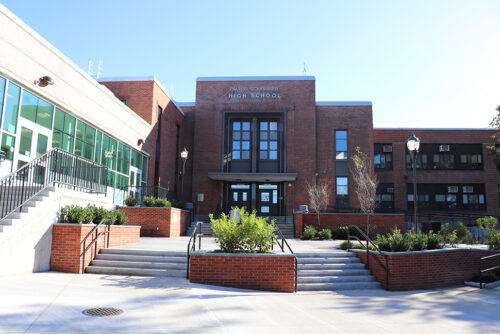
A palpable range of emotions filled the Glen Cove High School cafeteria on Monday, June 5 at a special meeting of the Glen Cove Board of Education. It was standing room only, as a number of presentations were on the agenda. A ceremony marking tenure for a number of faculty members, site committee reports and a presentation of puppetry by the Kids on the Block (KOTB), a theatrical arm of the Glen Cove Youth Bureau, featuring situations that impact on today's youth, were scheduled to be featured. Additionally, parents who had asked to speak at the special meeting (special meetings of the board traditionally do not include comments from the public), were waiting their turn.
The evening began with the recognition of the "Tenure Class of 2006," as the board and administration honored the members of the class. Doing the introductions was Executive Director for Human Resources Deborah Albanese, who took on the job immediately upon receiving tenure herself. Ms. Albanese said the night was significantly poignant to her, as many of the awardees had joined the Glen Cove School District three years ago, as had she.
Following a reception for the honorees, and after those who had come for that ceremony left, board president Richard Tortorici addressed a room which was still crowded, primarily with parents and students. "I know many of you are here tonight to address the physics debacle," he began, "and speaking for the board of education, we are highly embarrassed by the situation. The school district is taking full responsibility." The only people not responsible, he said, were the students.
The physics debacle had been brought to full light within the past couple of weeks, but speaking with this reporter, Dr. Aronstein explained the conditions surrounding the situation, which have their origin much earlier this year.
At the beginning of the school year, the school had two physics teachers and three classes of honors physics, with a total of about 45 students. An AP physics teacher left his position at the end of this year's first semester, and the other physics teacher took on all the classes. About three weeks ago, the superintendent said, he heard from a group of students who were concerned that they had not completed the physics curriculum and felt unprepared to take the upcoming physics Regents exam. High school Principal Dr. Joe Hinton spoke with the teacher, said the superintendent, who assured the principal that the class would, indeed, finish the required work. Worried that it was not going to happen, Dr. Hinton approached Dr. Aronstein and Dr. Shari Camhi, assistant superintendent for curriculum, instruction and technology, both of whom felt the same way, according to Dr. Aronstein. When he was then approached by a group of concerned parents, he said, "I knew I needed to do a more detailed and comprehensive investigation." Administration secured the teacher's grade books and Dr. Hinton surveyed the students to assess how many tests and labs had been completed through the year. "We went through lab reports and lesson plans, we correlated and cross referenced and made the determination that the students would not be able to complete the required 1,200 minutes of lab work, " said Dr. Aronstein. The administrators researched the requirements, and found that some of the labs that were done were not accepted by the Board of Regents, as they were not hands-on.
On Friday, June 2, students were given a letter from Dr. Hinton, and letters were mailed to parents. The letter stated that, in addition to the Regents factor, and based on the teacher's grading criteria, students' "third- and fourth-quarter grades are invalid because students were not given the opportunity to sit for a significant number of tests, were not assigned homework and did not fulfill a critical number of labs."
The letter went on to say that "All students will not be required to sit for the Regents exam. In effect, they are disqualified because the school has not fulfilled the responsibility of providing the required state mandated 1,200 lab minutes." It stated that the students' final grade would be computed by averaging only the first- and second quarter-grades as in the third and fourth quarters, the criteria for grading was not fulfilled.
Dr. Hinton's letter continued, stating that the school would not provide an honors designation for the physics course. "An honors designation can only be applied to fulfilling the Regents requirement," it read. "An asterisk will be placed next to the physics grade with the following notation: 'Due to the school's failure to provide the minimum number of laboratory minutes, this student was disqualified from taking the Regents exam. This should not negatively reflect upon the student.'"
The course would be identified as physics, and not hold the weight of an honors class; however, "if the student [were to fulfill] the 1,200 minutes laboratory requirement, he/she [would] then be qualified to sit for the Regents exam and [would] receive an honors designation, and the course [would] receive the 1.05 honors weight." If a student wished, the letter suggested, he/she could make special arrangements with next year's physics teacher, in order to fulfill the lab requirement, and would be qualified to sit for the January or June Regents exam.
The last paragraph was an apology for the "unacceptable way in which responsibilities have been carried out. We are terribly sorry for the inconvenience and stress this has caused to our students and their parents. I assure you that this kind of situation will never happen again," the letter stated. It was the letter, said many parents, that brought them to the meeting.
At the meeting, Mr. Tortorici said that in their goal planning over the summer, the board and administration would work to get a system in place to assure a situation of this nature would not happen again. For the immediate problem, he said, Dr. Aronstein had been working on alternatives and had come up with what Mr. Tortorici said he believed was a good plan.
Dr. Aronstein began by saying that late Friday afternoon, he had interviewed and hired a physics teacher for next year. The teacher is currently employed part time at the district's Alternative High School. Beginning the day following the meeting, the teacher would come to the high school every day before noon, prepare work, and conduct labs with students for two to three hours after school. Students who wished to avail themselves of these services would get their lab time completed before the Regents, could sit for the exam, and would receive Regents and honors credit.
Another alternative, the superintendent related, would be for students to take the labs after school in the fall (the new physics teacher has agreed to conduct the labs) and take the exam in January, earning Regents and honors credit. After-school tutoring/extra help would also be available for those students who wished to go on to AP physics and needed a stronger foundation.
As the physics Regents is not a requirement for graduation, students who decide not to do the additional lab work would receive a grade based on first- and second-quarter marks and credit for physics, not honors physics. These are the students whose transcripts would carry the asterisk. Dr. Aronstein said he would also write a letter, in addition to the notation, stating that the school was responsible for the physics debacle, so colleges to which the student applies "will know nothing is the student's fault."
At Dr. Aronstein's conclusion, Mr. Tortorici announced that the board would take comments from the audience, but first, the Kids on the Block would perform, so that the student performers, some of whom were elementary age, "would not be kept out too late on a school night."
The interlude of puppetry was enjoyable, enlightening and entertaining. The KOTB is a peer mentoring group, and usually performs for elementary grades, with puppeteers being both high schoolers and elementary students. The troupe performed a skit reminding youngsters that they can always find a friend with whom to talk when there's a problem and another which addressed the peer pressure attached to drugs.
Following a rousing round of applause, the students packed the puppets and the meeting resumed its earlier, sterner tone, with members of the audience, still a large crowd, taking center stage.
Student Karam Basra was bothered by the fact that third- and fourth-quarter grades were not being used to determine students' averages. "Was the work we did in the third and fourth quarters just a waste of time?" he asked. Dr. Aronstein said that that was not the case at all, but that the grades were invalid due to the criteria not having been met, and that he felt using the first two quarter grades was the fairest way to calculate a final mark. Another student said the class had been told by the teacher that they had sufficient work to meet the criteria, to which Dr. Aronstein said, "I disagree, and I have the evidence. People can make claims about anything, but I have the proof [to support my claim]."
Another student rose to ask that, should the administrators examine students' individual notebooks and find they have sufficient completed work, would the grades then count? The superintendent stated that the administration and board would be interested and more than happy to see such information. He suggested that starting the following day, any student who wished should bring his or her notes to Dr. Hinton. "If you can satisfy him and he can validate the grades, I'm open to it. We are more than happy to be fair about all this and that would certainly make all our lives easier," he said.
Student Austin Fender questioned the board as to why this one class was being singled out and having their work scrutinized. Dr. Aronstein responded, "The short answer? Because we became aware of the problem." He said that by looking into the work administration found that labs, homework and exams were not up to standard. Once they came across this evidence, he continued, the administrator and board had to act with consideration to the teacher's criteria.
One parent was concerned because she had spoken with Dr. Aronstein the Friday before the meeting, and he did not tell her he had hired a new teacher. The superintendent explained that he had not seen the applicant until late on Friday, after interviewing two unsatisfactory applicants, and perhaps had spoken with the parent before he saw the third. To the question of "How will these labs prepare the students for the Regents exam?" Dr. Aronstein replied that the teacher would focus on labs to afford the students the requirements needed to sit for the Regents, as well as providing extra instruction, if needed. "These students are very bright," he said, "but they feel they are not prepared and want to do the necessary work" to become prepared.
Much conversation was going on among the audience members, with a number of people calling out questions and comments simultaneously. They ran the gamut from the Regents exam to the midyear teacher replacement, from the letter sent to parents to the grading process.
Much of the discord came from semantics. Parent Nancy Fender questioned how the administration and board could tell students that their work in the second half of the year was invalid. "It's the teacher's accounting that is invalid," she said. "The students are innocent bystanders, doing what was asked of them. There must be some way to count the third and fourth quarters." Dr. Aronstein was quick to reply that he was not saying the students' work was invalid, adding, "Their work is very much appreciated. They put forth their best efforts and no one is taking that away from them" and the only question was that of the grading process. Another parent echoed Karam Basha's earlier statement, that the administration was making the second half of the year's work "a waste of time."
Dr. Aronstein told the crowd about his weeks-ago meeting with a group of parents who, he said, expressed a strong sentiment that the grades in fact could not be justified. However, no satisfied parent took the floor at the meeting. Again, Dr. Aronstein said that he would be happy to revisit the question of justifying the grades if he could be shown that there were more than one or two tests given in the second semester, as well as more labs than noted. He said he and Mr. Hinton were working on "putting together" the information in the teacher's grade books, but did not have the actual labs. "You're supposed to hold onto all the labs until the end of the year. If we can, we will find them and give the students all the credit we can. We are not trying to punish them in any way," he continued. "This is a terribly unfortunate incident and we are trying to make it right for the students." Young Mr. Basra stood to say that he had a folder containing all his labs, and had gotten them from the science coordinator. "Every student should have these labs and they can get them from the science coordinator, he suggested." He then stated he felt the midyear replacement physics teacher should be defended. "My grades did not decrease despite the teacher change," he said. "[The teacher] gave us six tests. We had packets of Regents material for classwork or homework every day. It was less than [the original teacher] gave us, but it was material specific to the Regents. We've done all that work. My contention is that our third- and fourth-quarter grades should be counted and [the teacher] should not be held responsible." He added that he felt the teacher should be commended for taking on all the physics classes midyear.
Voices continued to call out and Karen Ferguson, president of the Glen Cove Teachers Association, was recognized by Mr. Tortorici. The first thing Ms. Ferguson did was to state that she applauded Karam Basra, and the audience took the compliment literally. She then asked the board what had happened to the policy of not discussing items regarding personnel at a public meeting. "This is the wrong forum for this discussion, not the place to tear apart a teacher. If we ask, 'Where is [the original teacher]?' you won't tell us because it is 'personnel,'" she said. "If there is a problem with a teacher, it should be handled privately." Just as every action has an equal but opposite reaction, the questions being called out turned increasingly to questions which referred to the physics teachers. Over the din, Mr. Tortorici explained that the board felt it was necessary to do something "sooner rather than later" which, he said, was the reason students should see Dr. Hinton the next day. The line of called-out questions shifted. "Why is it the student's responsibility to go to Mr. Hinton and prove that they did their work?" voiced a parent. It's the board's obligation ... it was your obligation to be sure [the second teacher] had qualifications. I want to know how we got here." Dr. Aronstein was quick to reply that the parent did not know what had been offered to the teacher.
Once again, Mr. Tortorici was forced to speak over a dissonance of voices. With most of them calling for a continued discussion of teachers, Mr. Tortorici threatened to adjourn the meeting. The dissonance escalated to cacophony. "You have many angry parents here and you are not letting people express how they feel, how angry they are," declared a parent. Mr. Tortorici said, "We are talking about the same things over and over." He then called on a parent who again asked about the original teacher. Mr. Tortorici responded, "The board of education is restricted by laws in the way issues have to be handled. We are advised by counsel before we handle certain sensitive situations. We have no latitude here. On advice of counsel, we have acted appropriately and that's all I will say."
A question was asked as to what kind of system the board was putting in place to avoid a similar situation from occurring again, and Mr. Tortorici reiterated that Dr. Aronstein would work on that over the summer. A student stood to criticize the district for its level of communication. "I spoke with my teacher and he hadn't heard about the letter that went out on Friday until today."
By this time, the room was erupting with voices; accusations, recriminations and cross-conversations threatened to turn the debacle into a brouhaha. President Tortorici stated he was making a motion to go to executive session, asking for a second. Board member Kurt Schmeller seconded the motion. The board was polled and the motion passed. The board and administration left the room to a flood of questions and comments and when asked about the rest of the agenda items, Mr. Tortorici said the meeting would re-convene shortly.
Parents and students continued to debate and discuss all aspects of the physics debacle until the board and administration returned to the meeting.
When they did, Mr. Tortorici announced that Dr. Aronstein would make a summary statement. The superintendent stated that on the issue of third and fourth quarter grades, Dr. Camhi, along with Dr. Hinton and the high school science coordinator, would immediately begin to oversee the job of getting as much of the students' work as possible, and would have the students bring whatever evidence of work, tests and labs they had and the assistant superintendent would scrutinize each student's work on a case-by-case basis to determine the best recommendation for a final grade. "We will take as much time as we need," said Dr. Aronstein, "and be as fair as possible. We do not wish to penalize any student who has done sufficient work; we were merely working with the facts we knew."
In a follow-up interview with this reporter, Dr. Aronstein said that the guarantees made Monday night were, in fact, in the works. "Dr. Camhi has met with a number of students individually, evaluating the status of each one," he said. The new physics teacher has also begun his work at the high school.
At press time, however, the debacle still had life, and it remains to be seen which bodies will remain in motion and on whose head the apple will fall.