By Zefy Christopoulos
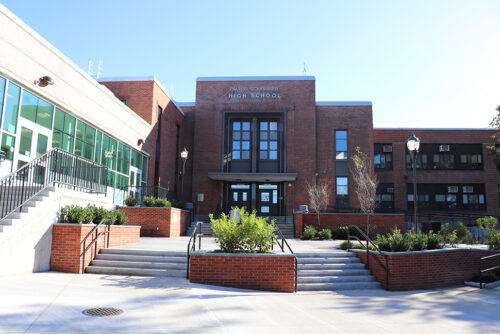
The Glen Cove Board of Education met in special session on Dec. 3 in the high school library. Following a presentation on policy review by a representative of an upstate BOCES, Glen Cove High School principal Joseph Hinton gave a snapshot of high school attendance and offered his thoughts on closed versus open campus at the high school. The closed/open campus debate is a recurrent theme at board meetings mainly because closed campus proponent, school board member Phil Enright, will not accept the consensus of students, parents, teachers and administrative staff-that is, that the current plan is working and doesn't need adjustments. The issue was the subject of a survey taken in each of the school district's buildings during a PTA meeting. Each PTA unit agreed that closing the high school campus to seniors was ill conceived. Another topic of discussion during this special session was the disposition of the Coles School, currently leased to the Solomon Schechter high school. A committee was recently appointed by the board of education to study use of school district facilities including the viability of Coles School. A member of that committee, speaking on his own behalf during the last special session of the school board, concluded that selling the school to Solomon Schechter or taking down the building and selling the land for the construction of 6 to 8 homes would be prudent.
The high school campus is, (as it has been for years), closed for underclassmen and only seniors in good academic standing are allowed to leave the campus during their free periods. Mr. Hinton reported that the high school site-based committee, (whose members include him, students, parents and staff), felt that the present policy is successful and serves as an incentive for seniors to be members in good standing. "It prepares the students with the freedoms and responsibilities of college. It is also a reward," said Mr. Hinton. He added that closing the campus would show the students the administration doesn't trust them and is, in a way, punishing them.
Mr. Hinton reported that the security guards posted at various sites in the high school monitor the comings and goings of students and they are able to determine who among them is an underclassman or is an ineligible senior. (Eligible seniors are issued a card in a different color every quarter). "Based on the security guards' observance, an average of 21 students per period leave in an average of 10 cars. There are 60 cars registered with the high school on campus and if unregistered cars are found along Walnut we ask for help from the police. We check student grades every quarter to monitor failing grades sooner, rather than later," said Mr. Hinton.
As to the issue of cutting at the high school, Mr. Hinton provided a one-day snapshot. His report reads as follows: "On Nov. 15, 110 students appeared on the cut list. It is possible that there were 119 students on the list and nine students cleared up an error since its posting. In addition to the nine cuts cleared, students often have legal absences or an error that is never cleared. Of the 110 students on the cut list, 62 were assigned a cut for a class they have already received "no credit" in. There were 48 students who cut a class for which they had not received a "no credit." The 62 no credit students also account for the majority of individual classes cut. Those 62 students accounted for 170 of the cuts listed. The 48 students who cut classes they were not given a "no credit" grade for, cut a total of 71 classes. Of those 48 students, 12 cut first or second period only, which means they probably, arrived to school late, unexcused. Arriving late is not excusable, however. After second period, 36 students cut a class they did not receive a "no credit" for a total of 55 classes. When you consider the 974 students who attend the high school and subtract the 62 students who received a "no credit" we arrive at 912 students. The 48 students who cut a class that day account for about five percent of the 912. Those 48 students did not cut all of their classes that day, the average is less than two classes missed per students. This means that these students attended most of their classes that day. This also means that out of 20 students in an average class, 19 attended all of their classes that day."
The posting of the cut list in the school's hallway has been determined to "not be maintaining confidentiality" since the cut list includes the student's full name rather than student number and is placed in full view of anyone entering the school. The list will now be posted inside the attendance office and will be given to the student managers. Mr. Hinton said he didn't see a co-relation to having an open campus for seniors since the cutters are predominately underclassmen who are not leaving the building but rather are playing a cat and mouse game with security and staff.
Board member Phil Enright insisted that the campus be closed immediately citing the recent tragic accident in the Herricks School District as he added the notion that a closed campus for all students prevents drug abuse. Superintendent Dr. Mary Ellen Freeley strongly stated that it would be inappropriate and unfair to change the rules for seniors mid-way through the current school year. Mr. Enright received a second from Dr. Rodger Silletti to his proposal to include the closed/open campus on the agenda for the next school board meeting. Meanwhile, the board's attorney will determine if the campus issue is a change in policy that would require two public readings as well as a public hearing.
On the topic of space utilization, school board member Janet Bates-Wilkins said in order for the board to make informed decisions, information from a variety of sources needs to be considered. An architectural analysis of the efficiency of current space usage, potential opportunities in reconfiguration of current space and in the event that further space is required, options that will provide the greatest efficiencies and preserve the vision of quality education of students need to be considered. "Since the potential disposition of Coles School is being considered, the current capacity of the building has to be weighed with the costs associated with restoration and ongoing operation as a school building, with the costs and efficiencies of adding to existing buildings if classroom space is required along with the proceeds available from a sale of the Coles building," said Mrs. Bates-Wilkins. She added that perhaps the board should consider shifting students, (redistricting), in all of its deliberations.
The lease on Coles School has not been extended as yet by the board and expires July 1, 2003. The committee on space utilization will be giving a full report to the board at the Dec. 17 meeting. One member of the committee, Chuck Bondar, speaking solely on his behalf, read a letter to the board during the board's October special meeting. In it he states the cost to refurbish Coles School to public standards will exceed it present value. "It will never operate as a public school in its present condition. Utilizing it as an administration building has been suggested, and after careful consideration, this occupancy will also become cumbersome. Finally, sad as it is, the property without the building is worth more than at its present state. Ideally, the rear of the property can be opened with a cul-de-sac road and between six and eight homes can be built on the property without conflict with the surrounding homeowners while still having room along the Glen Cove road frontage for an office building to be built," states Mr. Bondar in his letter. Mr. Bondar suggested the sale, "as is," to Solomon Schechter or a private sale to a developer which would put the property on the tax rolls.
There are those in the Glen Cove community who would argue that the Coles School should be an educational institution, perhaps the home to an early childhood center for the district's children. Operating as a school during the day, in the afternoon and evening it could be the site of homework help and ESL classes for the children and/or their parents living in the Orchard neighborhood. When the school board declared the building surplus in 1992, a promise was made to the residents of homes around the school's perimeter that the playground would be maintained. The site is the only open space for children in the area to play in a safe environment. The neighborhood is saturated with single and multi-family homes on heavily traveled roads. What happens remains to be seen.