|
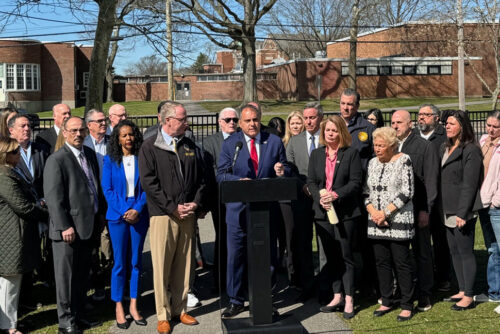
The historic St. Paul's building. Photo by John Ellis Kordes
|
Committee To Save St. Paul's members were pleased to hear trustees voice their support for legislation that could amend the tax law with regard to providing a tax credit for rehabilitating historic properties, such as St. Paul's. The Senate and Assembly are currently reviewing proposed legislation to raise the tax credit rate to 30 percent (from 6 percent) and remove the $100,000 cap.
Committee To Save St. Paul's members have been monitoring recent actions on the federal and state level for the past four months and publicly asked trustees to write a letter of support for the legislation, which initiated in the House of Representatives and already has the support of Congresswoman Carolyn McCarthy.
Because the St. Paul's building is listed on the National and State Register of Historic Places, the Committee to Save St. Paul's/Canus Corporation proposal realizes that this "village asset" makes it possible for a developer to receive federal and state historic preservation tax credits. As a result, CSSP/Canus included tax credits as "equity" in its proposal, which is now being considered, along with several others.
Bills have been introduced in the Senate (S.5425) and Assembly (A.7935) and Committee to Save St. Paul's consultant Murray Gould has been working in Albany for their passage, committee members noted, which could mean a considerable amount of added dollars for the Committee to Save St. Paul's proposal, if trustees select it.
Because the legislature's session will end in approximately two weeks, members have launched an advocacy effort. "With the legislative session scheduled to close later this month, the Committee to Save St. Paul's respectfully requests that the village board of trustees adopt a resolution in support of S.5425 and A.7935 ..." Peter Negri, president of the Committee To Save St. Paul's, wrote in a letter to the board of trustees and reiterated at the June 7 meeting.
The board approved the resolution to support the legislation 7-1 with Trustee Rothschild in disagreement. "I think tax credits are wonderful and I'm sure they are beneficial to the building but I'm concerned we are jumping into this. I don't think we know enough about this and we haven't had the opinion of counsel yet," he said before voting against the resolution to draft the letter.
Trustee Tom Lamberti, and the remaining board members, however, felt otherwise. "I think we should avail ourselves of whatever funds we can get," he said. Trustee Gerard Lundquist added, "Although I do have questions I do support this. The window is open for us."
The letter will be generic, simply stating the village board supports the legislation. The letter will not indicate that one RFP responder is more worthy than another rather it will show support of the legislation so those responders still being considered could take advantage if they wanted to. "It's very generic ... I don't see a downside to this," Trustee John Mauk, chair of the trustees committee on St. Paul's, added before he voted in favor of it.
While the Committee to Save St. Paul's (CSSP) realizes that many Garden City residents are familiar with the mechanism of "tax credits," the committee and its development partner, Canus Corporation, offer to those less familiar some insights into why CSSP/Canus is incorporating tax credits into its proposal, how the incentive program ensures authentic historic preservation and what the revenue means to the project. A link on the "News" page of the CSSP website, www.savestpauls.org, connects you to a "PDF" document created by the US Department of Interior, National Park Service (NPS) and Heritage Preservation Services that describes "The Federal Historic Preservation Tax Incentives Program."
Under the Federal Tax Incentives program, a 20 percent rehabilitation tax credit applies to a restoration project designated by the secretary of the Interior as a "certified rehabilitation of a certified historic structure." The National Register listing qualifies St. Paul's as a "certified structure." The program is available for properties rehabilitated for, among other purposes, residential rental, a component of the CSSP/Canus proposal. That means the dollar amount of tax credits available is 20 percent of the project cost that is within the historic structure. For example, if the Committee to Save St. Paul's/Canus Corporation project for rehabilitation of the Main Building is estimated at $43 million that means that $8.6 million becomes available revenue-an investment from outside sources that unlocks the hidden asset that is the historic character of St. Paul's.
Who purchases "tax credits" and why? Corporations, businesses and individuals purchase these credits for tax purposes. A tax credit differs from an income tax deduction, which lowers the amount of income subject to taxation. A tax credit lowers the amount of tax owed. In general, a dollar of tax credit reduces the amount of income tax owed by one dollar. So, these tax credits are purchased by tax credit investors and later sold or "syndicated."
The CSSP/Canus Corporation has assurances from Morgan Stanley's Consortium Historic Equity Fund and Raymond James & Associates investment firm for the sale of tax credits, allowing CSSP/Canus to produce the project economically while providing ample public space. That means, too, that if CSSP/Canus is awarded the project, it will actually receive more than $8 million in cash to help restore St. Paul's.
CSSP/Canus has developed a project design that is a "certified rehabilitation of a certified structure" consistent with the historic character of the property, and as such, will receive approval by the National Park Service. The NPS assumes that some alteration of the historic building will occur to provide for an efficient use; however, the project must not damage, destroy or cover materials or features, interior or exterior, which define the building's historic character.
The Secretary of the Interior's Standards for Rehabilitation, as interpreted by the NPS, include:
-A new use for the property must require minimal change to the defining characteristics of the building and its site and environment.
-The removal of historic materials or alteration of features and spaces that characterize a property shall be avoided.
-Each property shall be recognized as a physical record of its time, place and use. Changes that create a false sense of historical development shall not be undertaken.
-Distinctive features, finishes, and construction techniques or examples of craftsmanship that characterize a historic property shall be preserved.
-Deteriorated historic features shall be repaired rather than replaced. In cases of severe deterioration, new replacement features shall match the old in design, color, texture and other visual qualities where possible.
-Surface cleaning of structures shall be undertaken using the gentlest means possible.
CSSP/Canus intends to avail itself of the building's potential for state tax credit dollars, and is continuing to monitor the progress of legislation (S.5425) introduced by Senator Frank Padavan (Queens) to enhance the State Tax Incentives program.