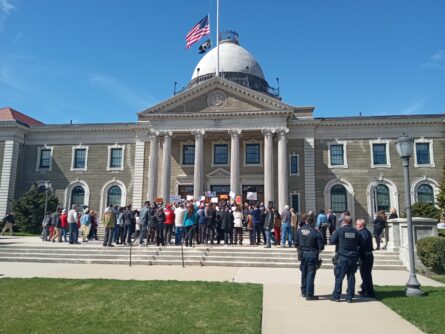
In continuing its "careful" and "systematic" review of the six proposals received last month in response to the St. Paul's RFP (Request For Proposal), members of the Garden City Board of Trustees' St. Paul's Committee completed their initial review and issued letters to some of the respondents asking for additional information and clarification.
Answers to those questions were due back Nov. 3. Interviews could possibly be conducted Wednesday, Nov. 8, although Trustee John Mauk, chair of the committee, did not want to commit to that schedule. Either way, he assured residents that the board would seek public input before it goes "too far in one direction."
Pat DiMattia of Cedar Place, however, wanted a more definitive timeline. Trustee Mauk reiterated that ensuring the process is fair and considerate is key to its success. "Before the end of the year, we'll come back to the board and the public and tell them how the proposals stack up against each other," he said, assuring a committee recommendation is forthcoming although members couldn't provide an exact date. Trustee Mauk also noted that the board must demonstrate to Senator Kemp Hannon that public approval is strong for whichever proposal is eventually chosen.
According to a release sent from the village, committee members believe a comparative review of all proposals is the "best way of identifying the proposal that comes closest to meeting the village's objectives for restoring the historical features of the building with minimal risk to the village, and with little or no additional cost to the taxpayers."
Members are working closely with the village's real estate consultant, K. Backus & Associates, to evaluate and rate each proposal based on the ability of each proposer to meet specific criteria spelled out in some detail in the RFP. Factors being considered include (1) the past experience of the developer and development team in successfully undertaking this kind of historical development project, (2) the developer's ability to finance and fully pay the project cost without taxpayer expense, (3) the potential for the development to be successfully implemented, and (4) its ability to meet overall village objectives for development.
"Some responders were clear enough in presenting their development concepts but were vague about the details of how they would undertake and pay for development without unacceptable financial risk to the taxpayers and residents of the village," Trustee Mauk said in the release, adding that such detail is "essential for the village to determine if the development proposal is financially sound."
Cathy Cavanaugh of Cathedral Avenue questioned the withholding of the six responders' names if the RFPs are not in confidence. Fellow resident Kathy Wood said residents have a right to see the information. "If the RFPs are already written and can't be challenged then why can't we see them?" she asked.
Mayor Gerard Lundquist said it's very common practice. Trustee Mauk added, "We don't want to do this in public because it's a competitive process. Discussing all of it in public gives responders an opportunity to modify their proposal ... The village will lose its leverage." It's important to note that although respondents cannot re-submit their RFP responses they did have an opportunity to modify their idea when answering the committee's questions.
Admitting he's not sure how the board will gauge public opinion on the fate of St. Paul's, Trustee Mauk said committee members will "release as much [information] as we can as soon as we can."
According to Village Administrator Robert Schoelle, the village received a letter, dated Oct. 27, from the Empire State Development Corporation indicating that Garden City did not receive funding in the first round of the $50 million grant program because of "generic weaknesses."
Trustee Tom Lamberti, the single trustee who voted against applying for the grant in the first place because he believed the village did not meet the program's criteria, offered this advice - don't rush to judgment.
This first round gave eight reasons, he said, some of which, in simple terms, were no plan, no project. "We have to have a comprehensive plan and a project. Clearly we're not going to have that for some time until we go through this process ... Don't rush to judgment. I was here that night and people made it sound like this application for the grant was like hanging fruit ... All you have to do is pick it off and money was going to fall. Not true."
Trustee Lamberti continued, adding, "In my stage in life, what I see in this world is a tendency to rush to judgment and develop flawed plans that will not execute the judgment that's made in disaster and I will not allow that to happen at least on my part and in fulfillment of my fiduciary duties to represent the residents of this village. Let's get all the facts."
Back on Sept. 14, trustees voted 7 to 1 in favor of submitting the application to the Empire State Development Corporation, under the Restore New York program.
If the village were successful in obtaining the grant monies, it would have helped offset much-needed maintenance work on the historic Main Building, particularly the replacement of the roof, leaders and gutters, the mechanical electrical and plumbing systems, some trusses damaged by water and rotted joists in the clock tower and repainting and cleaning the masonry.
When trustees voted to move ahead with the application, Mayor Lundquist noted that the grant application's criteria gave priority to projects in economically depressed urban communities, brownfield opportunity areas, Empire Zones, investment zones and federally designated disaster areas recently damaged by the June 2006 floods, etc.